

The Salsa Sound: Exploring The Techniques
Behind Latin Music In The USA From The 1940s-70s
Does anyone not like salsa? It may be one of the most infectious types of music out there and is somehow able to touch so many people regardless of their background. Given the popularity of the music, it makes sense that many arrangers feel the urge to delve into Latin American music and incorporate elements into their own charts or perhaps even write music for the abundant salsa scenes around the world. But if you’re like me and tried to do that with no knowledge of the culture or really any understanding of the musical vocabulary being used, it can feel pretty difficult to try and write anything that sounds authentic.
I’ve always been somewhat obsessed with any music that includes percussion, so it is no surprise that when a friend of mine picked me up one day and was blasting salsa through his car speakers, I was hooked immediately. Unlike many, I had actually never heard salsa prior to my twenties, instead I had only come across snippets of Latin Jazz through YouTube and other means, but really had no idea of the majority of Latin American music thanks to my upbringing as a white middle class Australian. Once I had a taste, I immediately wanted to understand more about the music and how I could incorporate elements into my own writing. Having no idea about anything, I bombarded my friend with questions (he played percussion) with no real strategy. As a result, I came away more confused and what little had been shared made no sense to me at all.
After spending a number of years researching the music and applying those skills to my own arrangements, I started to feel more comfortable with salsa and understood the various components which led into the sound of the genre. Instead of me being the one harassing others with endless questions, I was now the person who was often approached to make sense of the music. By being on the other side, I realized that many people (including my younger self) think of salsa as a unique style that stands alone and thus must have specific rules that have to be adhered to in order for the music to sound correct. While salsa definitely has an established vocabulary, it can’t be compared to other Latin styles such as mambo or son because it is more of an umbrella term which encompasses many different styles rather than a singular sound with set characteristics. With this in mind, salsa is actually quite flexible and can be represented by a broad range of textures, techniques, and rhythms, while still feeling authentic. For those new to this concept, unfortunately it means learning how to replicate salsa through arranging can be a bit more difficult than other types of Latin music. However, as someone that has been through the meat grinder, I know that anyone can acquire the relevant knowledge to write authentic salsa charts. All it takes is a bit of time and persistence.
Don’t worry though, there are plenty of resources out there that break down the sound of salsa and by landing on this particular reading you’ve stumbled upon my take on the topic. Instead of writing out a laundry list of techniques like many other texts do, what I’ve found helpful in my own journey is to understand when certain developments were made and how they were integrated into the music. That way one technique can be introduced at a time and it is easier to know exactly why it was used in the first place. Because let’s be honest, even though it is amazing to be able to replicate the sound of a style, the best part about arranging is taking techniques and applying them through our own creative process. If we know why rhythms, textures, harmony etc. were used in the first place, it can help inform why we may want to use them too, or perhaps give us more of an understanding of the role and importance they may or may not have to the overall sound of the music.
With that in mind, to get to the root of the salsa sound we need to look at quite a lot of other factors, particularly the half a dozen or so styles which led to the development of salsa in the 1960s. To do so in a singular resource would be quite overwhelming, so instead I’ve broken down all of the relevant information into style related articles that can be handled one at a time. Before jumping into this resource, I would highly recommend you feel comfortable with danzón, bolero, conga de comparsa, rumba, son, son montuno, mambo and cha-cha-chá, as each of the styles impacted the sound of salsa to varying levels. You definitely don’t need to be a master of any of them but you should feel somewhat familiar with the terminology and rhythms established by each one. And with that, let’s get started!
Latin Music in the United States
When we think of the word salsa it is easy to think that it must have come from a Latin American country. However, you may be surprised to know that it was actually born in New York City after decades of musical development in the United States. As we’ve explored in a number of different resources, specifically the one on Latin Jazz, for close to two centuries there has been a musical relationship between Cuba and North America. With Havana being the primary port in the Americas throughout the slave trade, it isn’t surprising that aspects of Cuban music were transplanted elsewhere in that part of the world. Thanks to this connection, many of the musical styles out of the United States can be traced back to some level of influence from Cuban music, with perhaps the most significant being the link to ragtime and jazz at the end of the 19th century.
Over the first half of the 20th century the relationship between the two countries grew, consistently influencing one another musically, and with the Jones Act of 1917 which allowed Puerto Ricans to become US citizens, that influence only grew stronger in the major cities of America. It seems that almost every decade of the first half of the 20th century could be defined by some kind of Latin influence. In the 1920s the western world was obsessed with son thanks to the hit El Manisero, then in the 30s it was the rise of Argentinian tango, followed by the creation of the big band Latin sound of the 40s and then the mambo boom of the 50s. Other than tango, all of the crazes were thanks to the integration of Cuban music often played by the growing contingent of Puerto Ricans who lived in the United States. To no surprise, that link kept getting stronger and stronger in the second half of the century too, albeit in varied ways which eventually led to the creation of salsa in the late 60s and 70s.
As salsa was a natural progression of the Latin music played in the United States prior to the 1960s, many of the core principles of the style actually carried over from the styles of the previous decades. What that means for us practically, is that it would be wise to be familiar with the various musical developments that took place beforehand in order to fully understand why salsa sounds the way it does. Instead of starting at the beginning, what makes the most sense for this particular resource is to pick up in the 1940s where many of the core fundamentals of the salsa sound were established, particularly the new innovations that hadn’t been seen in both Cuba or the United States prior. But in case you do want to know more about Latin music in America prior to the 40s, I’ve written on the topic in the Latin Jazz resource.
Picking up at the tail end of that particular article, the 1940s was a time when big bands were all the rage, Latin music was hot, and Cuban musicians were starting to move to New York City. The decade was also home to the first ever Afro-Cuban big band in North America, an ensemble which redefined Latin music and helped add a number of innovations still used today. Under the direction of Mario Bauzá and Frank “Machito” Grillo, the group was formed with the sole purpose of integrating jazz with Afro-Cuban music in an authentic manner that respected both cultures equally. Unlike other bands of the time which either played watered down variations of son or simply appropriated one or two rhythms and added them to the normal music of the day, Machito’s band took the true essence of both worlds and fused them together without compromising the artistic integrity and traditions of either form of music. The band was built on the common Cuban jazzband model of the day, with a number of trumpets and saxophones making up the horn section and a hybrid rhythm section of bass, piano, and percussion underneath. At first, many of the early recordings fell in line with the status quo and stayed within one lane, either being purely Cuban or swing. But after a few years the sound of the band changed and by the second half of the 1940s they had found an approach which placed jazz improvisation, phrasing, articulations, and harmony alongside the polyrhythmic foundation of Cuban music. Personally, this period of the band may be one of my favorites and I am so grateful that there are a handful of recordings that document the time.
When comparing Machito’s recordings with similar ensembles in Cuba during the same period, there are actually some notable differences worthy of investigation. Aside from the variety of horn voicings and lines that come straight out of the big band jazz tradition, the primary place of innovation is in the percussion section. Unlike the Cuban jazzbands which mainly took the established roles from son montuno and danzón-mambo, the musicians in Machito’s band used a wider variety of Afro-Cuban rhythms in their percussion parts. It’s likely that these same creative choices may have taken place in Cuba too, however in the recordings I’ve come across I am yet to find the same level of usage as what took place with Machito and his orchestra. One of the most significant changes was the integration of timbales, bongó, and congas together in the same section. Machito’s band is often credited with being the first instance where this took place but of course that is a claim which is almost impossible to validate. Due to the existence of the Cuban jazzband, it is likely that the mixture of all three was likely being experimented with in a number of different places at the beginning of the 40s, with Machito’s band becoming one of the most well known examples. What we do know though, is that Machito established the model for the mambo big bands which came later.
With all three primary Cuban percussion instruments being placed in the same section, it represented three different parts of Cuban music: the bongó was from son, the timbales from danzón, and the congas from rumba. In the three styles, each instrument had established rhythms and roles built around being a solo instrument, so by joining forces the rules had to be rewritten. To some degree this had already started to happen prior to Machito forming his band, but it was with Machito that the foundations for the salsa percussion section were cemented.
Building off of the rhythms and variations discussed in the mambo resource, one of the biggest shifts took place in the role of the timbales. In the earlier Cuban styles, the kettle drums were mainly relegated to a singular rhythm that would be played throughout a piece. With the creation of danzón-mambo, the role expanded slightly to add a few bell variations, but for the most part the instrument had less flexibility than the congas and bongó which were built from the highly improvisatory vocabulary of rumba. Unlike their Cuban counterparts, the timbaleros of Machito’s band started to borrow rhythms from the bell patterns of other Afro-Cuban styles. Based on the recordings available, it seems that one of the first options to be adapted was the sartenes part from conga habanera. From there, it wasn’t long before bell patterns from rumba were integrated, with the cascara rhythm becoming one of the most popular by the end of the 1940s.
Similarly to the other Latin percussion instruments, timbales have a number of tones available to the player. By the 1940s, the two most prominent were the shells of the drums and a small cowbell fixed to a stand (now called a cha-cha bell), with the actual skins of the drums being used primarily for fills. While Machito’s various timbaleros didn’t necessarily innovate in this area, although sometimes a cymbal was used from time to time too, they did assign the various bell patterns to the shells and cha-cha bell which changed the overall feeling of the music. After listening to as many examples of the band from the 40s as I could find, there were at least ten or so common options utilized which then could be varied in a number of ways when paired with either the bell or shell texture. For the most part, all of these rhythms came from a wide variety of Cuban styles, but interestingly, never really innovated all that much from the core rhythm being used.
Tabú (Afro Rhythm)
Machito

Botellero (Consistent 8ths)
Machito

Guadalajara (Clave)
Machito

Bim Bam Bum (Conga Bell 2-3)
Machito

Sensemayá (Yambú Clave 2-3)
Machito

Tra La La (Campana 2-3)
Machito

Almendra (Bolero)
Machito

Llora Timbero (Cascara 3-2)
Machito

El Jamaiquino (Double Bolero)
Machito

Before moving on, it should also be noted that as timbales are played by two hands, both the bell and shell texture can be used at the same time, or in the case of the shells, two rhythms can be played alongside one another. This results in many different combinations as well as the development of counter rhythms. As the core of Afro-Cuban music is built around a consistent eighth note/quaver pulse, one of the most common options was to have a set rhythm in one hand while the other fills in all of the rests with eighth notes/quavers. By doing so, the overall sound is of consistent eighth notes/quavers. This idea also came through on the bell parts too, however it was only played by one hand. Instead of playing a certain rhythm exactly, it was common to add eighth notes/quavers as a way of creating variation. As a result, a number of altered patterns started to be used more commonly and were added to the wide range of options already being used.
Afro-Cuban Jazz Suite
Chico O’Farrill

Moving over to the congas, not much changed from the Cuban jazzbands to Machito’s band. For the most part, the drum primarily played the standard tumbao rhythm or used patterns derived from rumba, often more so as a device for improvisation rather than a fixed groove. However, there was some level of innovation that did take place that’s worth mentioning. When comparing Machito’s recordings with various Cuban examples of the same time, it is clear that the conguero is using two drums whereas all of the other examples primarily use one (if they are audible at all). It isn’t clear exactly when it became common for a single person to play two drums, however Cándido Camero is credited with starting the movement when he successfully played rumba on two congas by himself at the Plymouth Theater in New York in 1946. Likely inspired by the performance, the local congueros of New York City started to capture the same sound in their own playing, resulting in a second conga being added to the Machito sound. With two drums, the common conga patterns began to evolve into more variations with the most common being the two conga tumbao and guaguancó. Of course there were even more options available for the congueros who often drew heavily from the rumba tradition, but these were the two patterns that became the backbone of Latin music in the United States in later years.
Mamboscope (2 Conga Tumbao 2-3)
Machito

Tanga (2 Conga Guaguancó)
Machito

Afro-Cuban Jazz Suite (2 Conga Bolero)
Chico O’Farrill

Completing the trifecta, there is not too much to discuss when looking at the bongó. Of course there was fantastic playing, but from a point of innovation, the bongóseros mainly followed in line with the approach established by son montuno. Due to the instrument primarily being an improviser, most of the bongó parts in the recordings by Machito in the 1940s were highly soloistic. In the occasion that they weren’t, the instrument generally reverted to the martillo pattern. Interestingly, in son montuno one of the big points of innovation was for the bongósero to put down the instrument and pick up a campana in the montuno section. While this does happen on occasion with Machito, it is far more common for the bongós to keep playing throughout with the timbales covering any bell parts.
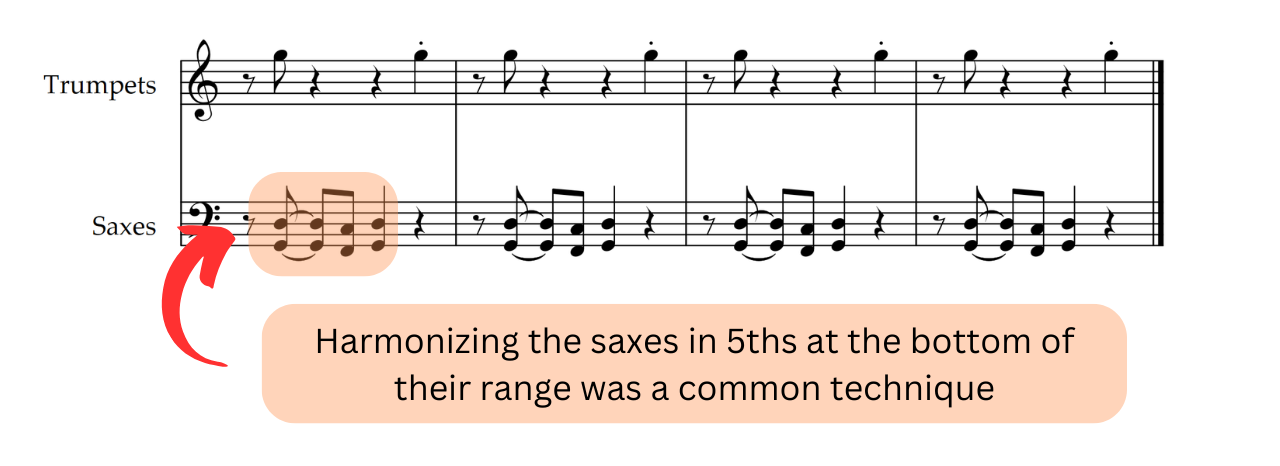
Outside of the percussion section, much of the rest of the music played by Machito and his band can be seen as a mixture of the characteristic sounds of that era. Some charts leant more heavily on the swing sound of the 1940s, with big horn section moments and background figures, while others fell more in line with traditional Cuban styles and approaches. It was a diverse band with flexibility at every level, and it really is amazing to see just how creative they were. As I’ve explored the techniques used to create the Swing Era sound as well as the sound of the Cuban jazzbands in other resources, there is only one additional element that Machito’s band brought that is worth mentioning. Somewhere along the line, the arrangers associated with the band started to use low sax voicings. As the texture can be heard as early as 1942/43 with Machito, it predates Pérez Prado’s similar approach later in the decade and most likely came from the influence of big band writers in the United States. This can be backed up slightly by the fact that the early recordings of Machito were arranged by John Bartee who had written for Cab Calloway and Artie Shaw’s band prior to helping Machito. The technique itself is quite simple and focuses on using the bari sax and tenor in an open 4th or 5th in the bass register. By placing the open interval at the bottom of both instruments' range, it creates a thick and boomy sound which was often used to create more impact from the sax section.
Enlloró
Machito
By the end of the 1940s even more Cuban styles had started to be integrated into Machito’s repertoire, the most notable being mambo. However, it was actually one of Machito’s previous timbaleros who took the sound further, building off of the components he had learned with Machito and combining them with his own composition skills. Today, many still know his name due to how significant his contributions were to Latin American music, and in terms of the development of the salsa sound, if it wasn’t for his prolific output, potentially the Latin music scene of New York City may have gone in a different direction entirely. The man I’m talking about is Tito Puente.
The 1950s
The 1950s were a significant period for Latin music in New York City. Thanks to the road paved by Machito and the integration of mambo and cha-cha-chá, the scene was dominated by Cuban big band music. Known as the “Three Kings of Mambo,” Machito, Tito Puente, and Tito Rodríguez were the three bandleaders which reigned supreme. Between them, they ironed out the innovations made in the 1940s and established a streamlined sound that became a major commercial success in the Western world. Unlike the Cuban bands which had started the mambo trend, the sound of mambo and cha-cha-chá in the United States was somewhat more versatile. What I mean by this is that the percussion parts were more flexible between the styles, with really the only defining difference between the two being the tempo. Whether it be the guiro from cha-cha-chá, the driving eighth note/quaver bell from mambo, or any other texture established in Cuban music prior to the 1950s, all were up for grabs and formed what we now think of as the mambo era sound.
Notably, one particular rhythm, which was likely some kind of hybrid between the conga bell pattern, cascara, and consistent eighth notes/quavers, became quite common among the three bands, so much so that we now refer to this as the mambo bell pattern. When listening to the recordings from this era, any time the timbalero would go to the cha-cha bell, there was a high likelihood that the mambo bell pattern would be used.
Cuando Te Vea
Arr. Tito Puente

Perhaps one of the most striking changes between the decades was the role the timbales played in the percussion section. Coming from danzón, the instrument typically played a support role to the rest of the band, however thanks to a suggestion by Mario Bauzá, Tito Puente took the timbales in a new direction after being inspired by the playing style of big band drummer Chick Webb. Now the instrument was at the front and center and emulated more of the traditional drum set role in a swing ensemble by setting up band figures and driving the groove. While Puente didn’t set up band figures to the same extent as big band drummers of the time, he did create a new sense of momentum in the music and the bell patterns he played, whether they be on the shells, cowbells, or cymbal, all pushed the feeling of the music further. When he did fill into a horn part or new section, he mainly used the established techniques of earlier timbaleros in his recordings from the 50s.
While the mambo bands pushed on, their music started to have a lasting impact on other areas of American music. Without detouring too far away from the core point of this resource, almost all facets of popular music at the time integrated elements from Latin American culture. From rhythm ‘n’ blues to rock and roll, to broadway shows or the silver screen, the rhythms of mambo seeped into everything. It also helped that the Brill building, where many of the pop music writers of the day worked, was a few blocks away from the main venue that the kings of mambo played on a daily basis.
As a result, many of the key rhythms started to be interpreted in different ways, namely by taking percussion parts and adapting them to other rhythm section instruments. The most common was to take the tresillo or habanera/tango/congo rhythm and apply it to the bass parts, however in the world of hardbop and rhythm ‘n’ blues, musicians were experimenting with adapting percussion parts to the drum set. Perhaps one of the most iconic to do so was Art Blakey in collaboration with Horace Silver. Due to the connection between bebop and Cuban music in the 1940s, it was somewhat inevitable that the Latin percussion vocabulary would be translated to the drum set given just how much interchange was taking place. Although it is hard to know exactly when this started to take place, by the mid 1950s an established sound had been created in jazz small groups.
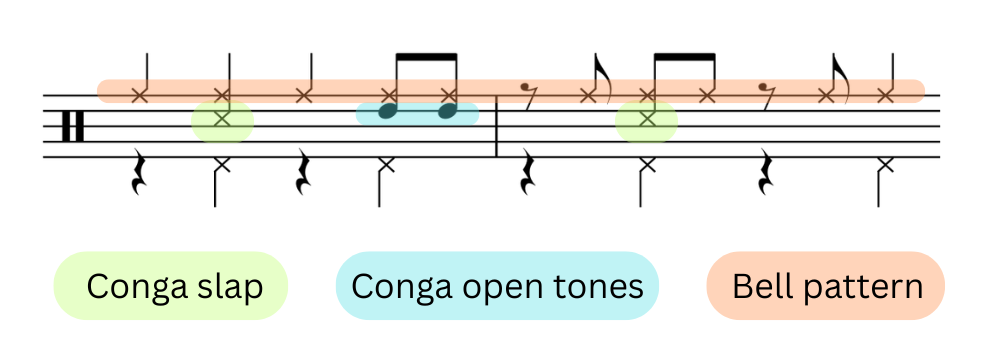
Looking more closely at Blakey’s approach, he orchestrated the various percussion instruments onto similar sounding parts of the drum set. For example, bell patterns would be covered by the cymbals, the toms would emulate the congas, and any sort of slap sounds would be played on the snare. By taking the primary parts of the conga tumbao, specifically the slap and open tones, and various bell patterns, he was able to capture the sound of the percussion section on a single instrument. Now Blakey may not have been the first person to come up with this approach, but he was one of the main pioneers in jazz circles to champion the rhythms and helped influence others to do the same. These days, the approach to Latin drum set playing has continued to evolve, but the same principles established in the 1950s of metallic parts being played on cymbals and conga parts being played on the drums is still the main approach for most styles.
Nica’s Dream
Horace Silver
Getting back to the trajectory of Latin music in the United States, by the end of the 1950s the reign of the mambo bands received a devastating blow due to the political relationships between America and the new dictator of Cuba, Fidel Castro. With an embargo placed on Cuba and a halt on all immigration between the two countries, almost overnight the public image of Latin music changed. Knowing that there was a large market for similar sounding music in the United States, radio stations looked to the music of other countries to fill the void, resulting in Brazilian bossa nova becoming popular and mambo fading out of sight. But a new generation was coming up in New York City and with them came a fresh approach which pushed Caribbean based music in the United States in a new direction.
The 1960s
Like what happened with the Swing Era, coming out of the 1950s the large ensemble format of the mambo big band became unsustainable and lost popularity. As a result, the musicians looked back to smaller options such as the Cuban charanga and conjunto from the 1940s. The music was still heavily mambo and cha-cha-chá driven, but new dances emerged such as pachanga. Originating in Cuba in the prior years, for a time it became the prominent Latin dance style of the early 1960s. Musically, the accompaniment to the dance was a faster cha-cha-chá with heavy emphasis on the downbeats, and due to the charanga instrumentation, the dance was often associated with flutes and strings. Most importantly, the new style started a shift in the Latin scene in New York City which would go on to impact the coming decades.
By the 1960s, a new generation of teenagers with Puerto Rican parents was present in East Harlem and called themselves Nuyoricans. Unlike the previous generation, these teenagers hadn’t grown up with purely Latin American music, and were also influenced by American rock, rhythm ‘n’ blues and soul. As a result, in 1966 a new style called boogaloo was created that was more relatable to the younger generation compared to what had come before. In the same year, the prestigious Palladium ballroom closed its doors for good, and with its departure came the end of the Mambo era in New York City. For the following years boogaloo was all the craze in the United States, to the point where older musicians such as Tito Puente and Eddie Palmieri had to adapt to the new style in order to maintain record sales. Although the style was accompanied by just another one of the dozen popular dances of the decade, it marked the first authentic fusion of Latin and American popular music, being created by Nuyoricans that related equally to both the African American experience and the Latin American experience in the United States.
Boogaloo likely took its name from the Boo-Ga-Loo track by Tom and Jerrio in 1965, with the style fusing the dance steps of the twist with other Latin dances present in New York City in the 60s. Within a matter of months boogaloo had climbed the ladder and become the most popular Latin style in the city, with recordings such as Mongo Santamaría’s version of Watermelon Man providing early templates for artists such as Joe Cuba and Pete Rodriguez. Arguably, the first official boogaloo record was from Richie Ray with his two albums “Se Solto” and “Jala Jala y Boogaloo” in 1966 and 67 respectively.
Only a few years later boogaloo was on the decline primarily due to older bandleaders restricting the younger generation. The seasoned mambo veterans viewed the new music as childish due to the lack of professionalism, with the vocals often being less tight and the music not necessarily following common clave conventions. Most of the older established bands still received headline shows in the 1960s and would be supported by the new boogaloo bands, but even though the younger bands had the top hits of the day, they received limited compensation for these live performances. In opposition to the unfair treatment, the boogaloo musicians rallied together to try and change the conditions, but due to their retaliation, promoters and disc jockeys stopped playing boogaloo music altogether, which eventually caused the style to die. At the same time, the older musicians worked together to bring back an emphasis on traditional Latin styles such as son, culminating in the Fania All-Stars and the rise of Salsa. This was the final blow for boogaloo, and it left New York as quickly as it had arrived.
Due to boogaloo being created out of the fusion of American and Latin music, there were many different variants present in the style. Simply, boogaloo picked up the backbeat from the United States and merged it with the mambo tradition. The lyrics were often mixed between Spanish and English, and handclaps were commonly used alongside overdubbed voices and effects. Depending on which artist you listen to, some used an American Pop foundation with added Afro-Cuban elements such as Mongo Santamaría’s Watermelon Man, or used a son foundation with pop elements such as Ray Barreto’s El Watusi. Both of these examples were released prior to the official creation of boogaloo, but clearly outline the different approaches that created the foundation that the style was built on. Additionally, many Nuyoricans were interested in the doowop style of singing, so boogaloo vocals were phrased more closely to doowop and were sung in similar registers. The result of this synthesis was a funkier, bluesier, style of Latin American music that merged the best elements of the musical styles present in the 1960s. Perhaps the best example of this sound is Bang! Bang! by The Joe Cuba Sextet.
With the many variations of boogaloo repertoire, came an equally varied number of ensembles that played them. The more authentic Nuyoricans used traditional small group formats such as the charanga and conjunto and adapted them to their liking. Others used typical rock’n’roll instruments such as keyboards and other amplified instruments. The consistent factor between all ensembles was the use of percussion instruments and syncopated tumbaos from the mambo tradition.
Unfortunately, boogaloo disappeared quite rapidly and with it came an end to the fusion of American popular music with Latin popular music. Who knows what would have happened next if the older musicians hadn’t stopped the creativity that was taking place with the Nuyoricans, perhaps something similar to what happened in Cuba at the time? As boogaloo began to decline at the end of the 1960s, a new emphasis on more traditional styles of Cuban music emerged. It didn’t take long for the new trend to become a national sensation in the United States, with it eventually picking up the name salsa. Unlike other Latin styles, salsa was a name which encompassed multiple styles such as how the word rhumba had done so from the 1920s. Today it is still used in a similar capacity, so any time salsa is mentioned remember that it really stands for a mix of son, mambo, cha-cha-chá, bolero, and many other popular Cuban styles.
Salsa
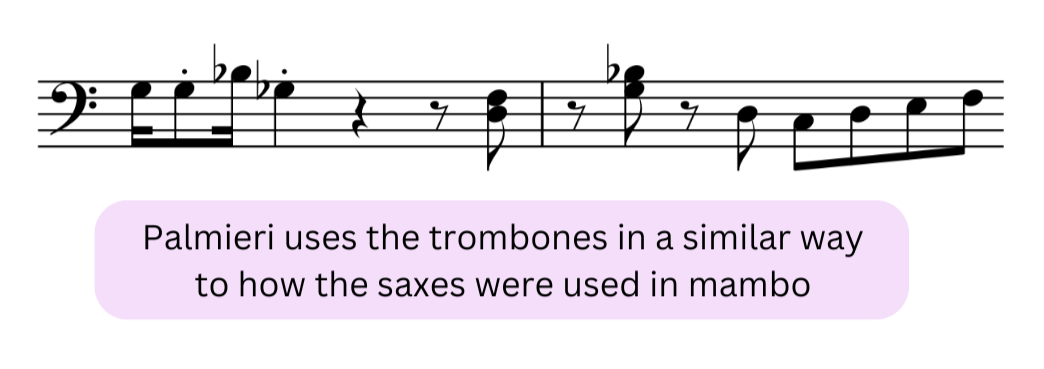
The story of salsa began in the mid 1960s when Johnny Pacheco and Jerry Masucci founded the Fania record label. Pacheco was already well established as a musician and had received some recognition with the pachanga craze earlier in the decade. With the label's first record, they moved away from the popular charanga format and embraced the smaller conjunto ensemble, a move that would later come to define the sound of salsa. At the same time, the Alegre record label released Tema La Perfecta by Eddie Palmieri, which was the first-time trombones were used as a self-contained section in Latin music in the United States, although the instrument had been used earlier in Puerto Rican bomba. The new ensemble format allowed for a more fierce and aggressive style compared to the typical conjunto and charanga formats of the 1940s and led Fania to sign a young trombonist named Willie Colon in 1967, who was only 15 years old at the time, that also used this new trombone centric sound. Colon’s first album “El Malo” helped establish a new format for Latin music and gave Fania momentum to sign other local artists, including both unknown and veteran musicians in the New York scene. One of the main reasons Colon’s album was so successful to begin with, is because it embraced the true essence of Nuyorican life, representing the harsh conditions of the barrio which was highly relatable for Latin Americans living within the United States. The music was embraced immediately and defined the beginning of salsa.
By listening to Colon as well as the albums of Palmieri in the 60s, we can get a good idea of how the new trombone orientation impacted the music. Unlike earlier recordings which leant more heavily on trumpets and saxophones, both Colon and Palmieri used similar vocabulary but with the trombone section. Looking closer at the lines they played, often the trombones would be given similar vocabulary to what the trumpets and saxes had been playing years earlier. At times they would play a montuno inspired line or break off into hits alongside other horns. While this was a subtle change, over the years the trombone has become a significant part of the salsa sound.
Tema La Perfecta
Eddie Palmieri
At the end of the 1960s, other labels such as Alegre embraced the descarga tradition (jazz inspired jam sessions that had been growing in Cuba from the 1950s) and created All-Star ensembles made up of the various musicians on contract within their organizations. Fania mimicked the idea, and in response created their own All-Star ensemble made up of the best Latin musicians they could get their hands on. The result was a group that would go on to change the sound of Latin music globally, and one that quickly made Fania known as the only label for authentic salsa music. With the creation of the Fania All-Stars, the label decided to go back to the sound of traditional son and its related styles (mambo, son montuno, guaracha) as the musical foundation of the ensemble, allowing for more emphasis on the skill of each musician in the jam session format.
To not take away from the purity of son, arrangements were modest in terms of harmonies and innovations, and used a form similar to son montuno, however, with a slightly revised set of names for the sections. Alongside the typical intro-verse-montuno structure was an added mambo section where there would be layered horns over a montuno. This was a moment for the horn section to be featured as well as a way to add contrast to an arrangement. Salsa arrangements also made use of son montuno’s diablo section which focused on high intensity call and response motifs across the horns and vocals at the end of a piece. However, instead of being called the diablo section, now it was referred to as a moña. When comparing a mambo and moña section, both look quite similar but the main difference is that a moña features improvisation alternating with some form of response from the horns and/or vocals.
In 1971, the Fania All-Stars performed at a new venue called the Cheetah Club (previously known as the Palladium ballroom) with the whole evening being filmed and recorded. The result was a movie called Nuestra Cosa Latina or Our Latin Thing, which was the first authentic depiction of the barrio life in New York on film. Alongside the movie, Fania released multiple live albums from the concert, which capitalized on the success of the movie and resulted in the new genre of music expanding outside of New York City. The All-Stars had performed once prior to the Cheetah Club engagement, but it had been primarily based around being a jazz jam session and hadn’t resulted in anything major. This second performance however, built on the success of the individuals within the ensemble, was specifically designed as dance music, and unified a broad range of listeners that related to the image of barrio life. The end result was the inauguration of a new movement that would last for the entirety of the 1970s.
Still unnamed at this point, salsa was an immediate success and launched the Fania empire. As the genre became more popular, two versions emerged: one that embraced this image authentically and that was a natural transition from the 1950s mambo era, and another that reused older songs with a far more generalized approach. Musicians such as Eddie Palmieri and Willie Colon represented the authentic earlier style, which had more grit and a sense of the danger felt in the barrio as well the incorporation of jazz elements, while Pacheco and many of the All-Stars played a version based off of the Cuban band La Sonora Matancera. Notably, it was with artists such as Colon that elements of Puerto Rican music started to be incorporated into salsa, paving the way for the coming decades. Of course this is a generalized view of the entire sound of salsa, with many artists taking elements from both ends of the spectrum and the reality being slightly more complicated than a single paragraph can unpack.
In 1971, the Fania All-Stars performed at a new venue called the Cheetah Club (previously known as the Palladium ballroom) with the whole evening being filmed and recorded. The result was a movie called Nuestra Cosa Latina or Our Latin Thing, which was the first authentic depiction of the barrio life in New York on film. Alongside the movie, Fania released multiple live albums from the concert, which capitalized on the success of the movie and resulted in the new genre of music expanding outside of New York City. The All-Stars had performed once prior to the Cheetah Club engagement, but it had been primarily based around being a jazz jam session and hadn’t resulted in anything major. This second performance however, built on the success of the individuals within the ensemble, was specifically designed as dance music, and unified a broad range of listeners that related to the image of barrio life. The end result was the inauguration of a new movement that would last for the entirety of the 1970s.
Still unnamed at this point, salsa was an immediate success and launched the Fania empire. As the genre became more popular, two versions emerged: one that embraced this image authentically and that was a natural transition from the 1950s mambo era, and another that reused older songs with a far more generalized approach. Musicians such as Eddie Palmieri and Willie Colon represented the authentic earlier style, which had more grit and a sense of the danger felt in the barrio as well the incorporation of jazz elements, while Pacheco and many of the All-Stars played a version based off of the Cuban band La Sonora Matancera. Notably, it was with artists such as Colon that elements of Puerto Rican music started to be incorporated into salsa, paving the way for the coming decades. Of course this is a generalized view of the entire sound of salsa, with many artists taking elements from both ends of the spectrum and the reality being slightly more complicated than a single paragraph can unpack.
In 1971, the Fania All-Stars performed at a new venue called the Cheetah Club (previously known as the Palladium ballroom) with the whole evening being filmed and recorded. The result was a movie called Nuestra Cosa Latina or Our Latin Thing, which was the first authentic depiction of the barrio life in New York on film. Alongside the movie, Fania released multiple live albums from the concert, which capitalized on the success of the movie and resulted in the new genre of music expanding outside of New York City. The All-Stars had performed once prior to the Cheetah Club engagement, but it had been primarily based around being a jazz jam session and hadn’t resulted in anything major. This second performance however, built on the success of the individuals within the ensemble, was specifically designed as dance music, and unified a broad range of listeners that related to the image of barrio life. The end result was the inauguration of a new movement that would last for the entirety of the 1970s.
Still unnamed at this point, salsa was an immediate success and launched the Fania empire. As the genre became more popular, two versions emerged: one that embraced this image authentically and that was a natural transition from the 1950s mambo era, and another that reused older songs with a far more generalized approach. Musicians such as Eddie Palmieri and Willie Colon represented the authentic earlier style, which had more grit and a sense of the danger felt in the barrio as well the incorporation of jazz elements, while Pacheco and many of the All-Stars played a version based off of the Cuban band La Sonora Matancera. Notably, it was with artists such as Colon that elements of Puerto Rican music started to be incorporated into salsa, paving the way for the coming decades. Of course this is a generalized view of the entire sound of salsa, with many artists taking elements from both ends of the spectrum and the reality being slightly more complicated than a single paragraph can unpack.
With the performance of the Fania All-Stars at the Cheetah Club, the start of the salsa boom was ushered in. As the genre became more popular, certain standards were assigned to the music which limited its scope and maximized its commercial potential. Off the back of the success of the All-Stars, Fania changed its promotion and management tactics by allowing the individual vocalists in the ensemble the freedom to make new orchestras, ultimately attracting new musicians to the label and growing Fania’s reach. Over time these decisions led to salsa putting more importance on the lead singer instead of the ensemble as a whole, as well as a shift to try and capture a larger audience outside of the Latin community. As a result, eventually the records put out by Fania started to alienate both their original fanbase and broader audiences, and by 1979 the salsa boom had come to an end. Ultimately, the final nail in the coffin was when the Dominican population overtook Puerto Ricans to become the most prominent Latin American culture in New York City, leading to the rise in popularity of merengue over salsa.
Looking at the specific sound of salsa, other than the inclusion of the trombone section and the focus on smaller ensemble formats, there was not much new that was added during the decade that we haven’t already discussed elsewhere. The base of the genre were the Cuban styles created from 1910-1950, and the vocabulary used was mainly a combination of all of the techniques found in those styles. While it could be argued that there were some innovations in the form of combining jazz harmony of the 1960s with the genre, much of the mainstream sound of salsa stuck to only a handful of typical chord progressions that had been established for decades at that point. Fortunately, what that means for us as arrangers is that the key to being able to replicate the salsa sound is to understand the core components which led into the creation of the genre. By being familiar with son, son montuno, bolero, mambo, and any of the other popular Cuban styles of the first half of the 20th century, you will be able to recreate the salsa sound of the 1970s without too much trouble. Of course, salsa didn’t necessarily stop at the end of the 70s and still exists today, often integrating many elements from other Latin American cultures. So to fully replicate the salsa sound of the 21st century, a full study of the most popular influences would be necessary, such as those from Cuba, Puerto Rico, Dominican Republic and so on. However, that falls outside of the scope of this resource for now, with my main preference being to explore the start of the genre and how it expanded the Cuban sound in the United States.
Salsa revolutionized the global view of Latin American music. It rekindled excitement for the music, and brought together multiple styles under a common name, making Latin American music more approachable for outside listeners. Not only did it revitalize the Latin community in New York City, it brought more emphasis on music being produced in Caribbean countries, allowing countries like Venezuela, Puerto Rico and others to tap into the American market.
The Takeaway
Understanding salsa music can be quite the challenge if you don’t know where to start. However, by tracing back the origins of the genre it can help demystify why certain techniques were used. For the most part, the more innovative period of Latin music in the United States came in the 1940s and 50s, and if you understand all of the components that made up that music you’ll have a pretty good idea of how to create the sound of salsa in the 60s and 70s. However, while salsa was being created in the United States, music in Cuba took another direction which led to the creation of even more amazing styles. But I’ll save that discussion for the next resource!