

The Many Sides of Cuban Lyrics:
From 11th Century Rhyme Schemes to Black-Face Theatre
When I was starting my deep dive into Cuban music back in 2020, one of my core goals was to understand what each major Cuban style sounded like. What I quickly discovered was that’s far easier said than done. Not only did I find it hard to locate resources which gave me a well rounded picture of Cuban music, but almost all of the books didn’t go into the level of detail I was after and left me with more questions. I would often stare at my evergrowing word document filled with notes trying to make sense of it all, trying to have some sort of breakthrough. One of the issues I kept coming across was that there were many different styles which all seemed to sound identical even though they had different names. This was further complicated by the fact that there were many areas of Cuban music where different authors use different names when describing the same style. At times it felt impossible but fortunately I’m blessed (or cursed depending on how you look at it) with being extremely stubborn, often believing that sheer brute force will yield answers. And in this case it worked.
Having spent the better part of my life as a jazz bassist, I had come across a few names of Cuban style over the years. One of which was guaracha, a style that I had no clue what it sounded like let alone how to pronounce. But having come across the name, I made a note of it as a possible area to look into, not realizing how much frustration it would later cause. My main process for trying to understand Cuban music was to read as much as possible, take copious notes, and then try to organize said notes into different style categories. Over time many of the more common styles filled out but the one that never seemed to get bigger was guaracha. What made it extra annoying was that whenever I would listen to examples of the style, they all sounded the same as son with no differentiating factors presenting themselves. I even reached out to a few professionals hoping for clarification, but unfortunately never found the answers I was looking for.
Then one day I came across a particular article which changed my entire perspective of Cuban music and revealed why I kept hitting a wall. As I was mainly approaching my research through the lens of an instrumental musician and arranger, I was only focusing on the instrumental parts. Something which can be quite helpful and get you most of the way with understanding Cuban music, but also a direction which leaves out two critical factors which impact the naming conventions of certain styles. After reading through the article, what I realized was that the lyrics could also define a style's name (the other factor was the accompanying dance but that isn’t as relevant to this particular resource). Specifically, the topic one thing or another. Not being a native Spanish speaker, I had completely overlooked the lyrics and had never tried to understand what the vocalists were singing about. With this revelation in mind, I went back and almost immediately discovered that one of the key characteristics of guaracha was the comedic topics used in the lyrics.
From that point on, lyrics became top priority and unlocked an area of Cuban music I had yet to discover. Initially it was understanding guaracha, but soon after came other vocal styles such as punto guajiro, guajira, and bolero. Each of which came with various waves of characteristics, with punto guajiro plunging me deep into a world of rhyme schemes that originally were created in the Middle Ages. Not to mention that Cuban cowboys and farmers improvised lyrics over these incredibly complex forms. Eventually I realized that all of these vocal styles were part of the same complex, often being referred to as the trova tradition. Thanks to just one word, guaracha, I had stumbled upon a whole world I would have likely missed, a world which was (and still is) incredibly important to Cuban music and one which has so many diverse styles within it.
After spending a bit of time with the various vocal styles of Cuba, I decided it would be best to compile everything into a singular resource to hopefully help anyone that found themselves in the same position I once was. While some of the styles are related to one another, the key factor that binds them together is that they all use lyrics in a different way and at one point were played by a single person accompanying themself on the guitar. Specifically, this resource explores the early, pre-son versions of each style, so the examples may sound a little different to anything you may have come across from the 1920s onward. However, in another resource where I cover son and son montuno in more detail, we touch back on these particular vocal styles and see how son transformed them into their current versions.
Battle Rapping Cowboys & The Decima System
One of the most underrated and often lesser known Cuban styles comes from the rural farmland of the country, a location which allowed for quite a unique type of music to develop and also limited its reach to the outside world. It was created by the roaming cattle herders and farmers, known as guajiros, who occupied the land, a group of people who had once worked closer to the cities but were pushed out thanks to the boom in sugar plantations at the start of the 19th century. These people lived by humble means and would often accompany themselves with Cuban guitars, using a pick to play the instrument. Over time, their occupation and chosen playing techniques came together to create the name we use to describe the music they played: punto guajiro (also sometimes called punto cubano). The style itself is one of the oldest documented forms of Cuban music and can be dated back to the 1600s. However, the form we know today was established in the early 18th century and comes from a mixture of traditions, the most prominent being the decima system. What is fascinating about this particular style is that the guajiros use the decima system as a basis for improvisation, creating phrases on the spot to comment on a given topic as well as trade jokes aimed at one another. While many of the musical qualities of punto guajiro haven’t travelled further than Cuba, it may just be one of the most fascinating forms of music I have ever come across. The style is also a fantastic vehicle to unpack the decima system, a vocal rhyme scheme that can be found across Cuba such as in styles like rumba.
Arriving in the Iberian Peninsula from the French troubadours well before Spain was established as a country, the decima system was a form of poetry based on a ten-line structure. In 1591 a Spanish poet named Vincent Espinel created his own take on the system, naming it decima espinela, which became a mainstay in 17th century Spanish Theatre and like most popular aspects of Spanish culture, was eventually transferred to Cuba. Over time, this particular variation made its way into the hands of the guajiros, where it has since become the established vocal form for punto guajiro.
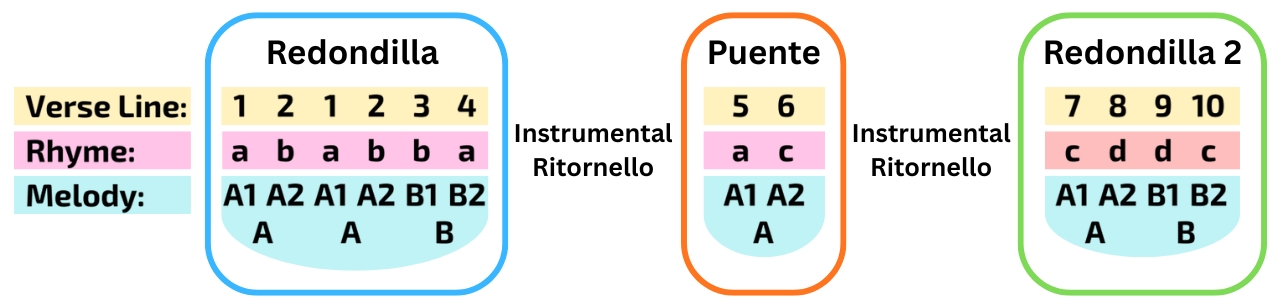
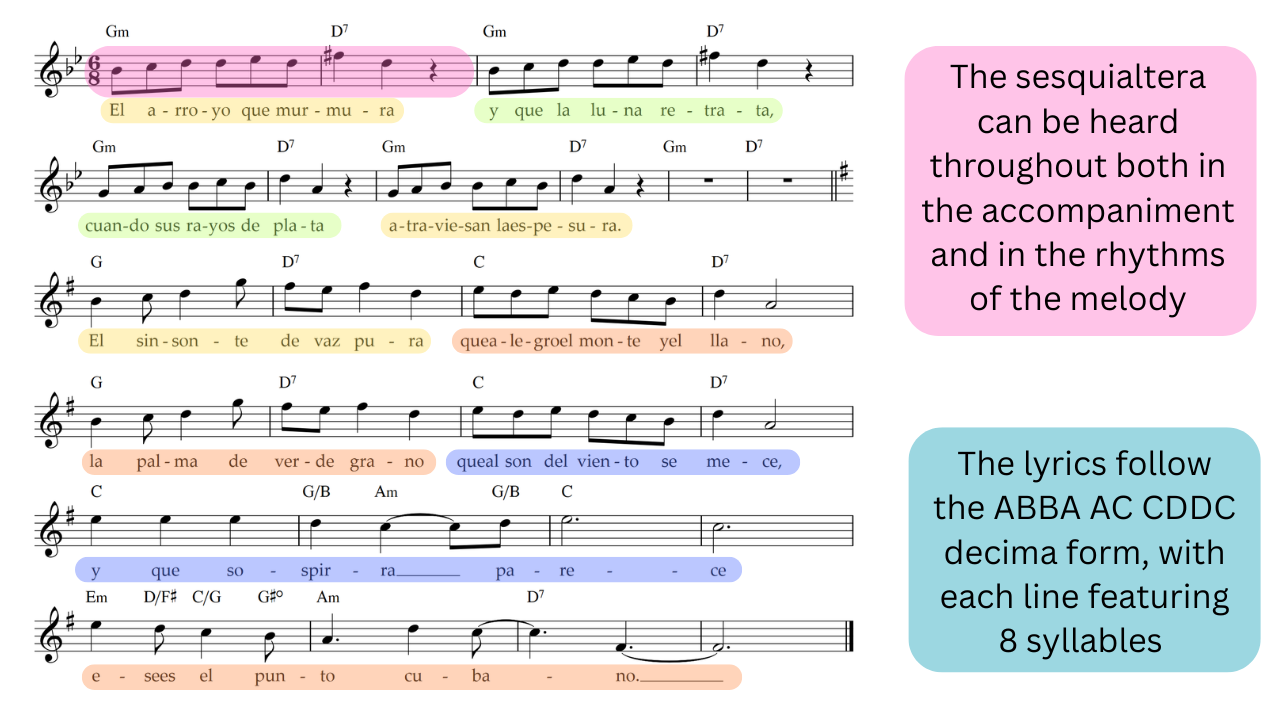
Decima espinela uses a rather interesting system comprised of ten-lines which follow an ABBA AC CDDC form, where each line is made up of eight syllables and lines with the same letter allocation must rhyme. While the system can be explained in a single sentence, it might be best if we unpack it a bit further because there is a level of complexity to decima espinela that is worth exploring. The first aspect is that a single decima includes ten lines, creating a unique form that contrasts heavily to the common rhyme schemes found in Western vocal music today (such as AABB or ABAB etc). Within those ten-lines, the vocalists must adhere to a strict eight syllable phrase per line, no more, no less. This approach is more comparable to poetry as it is rare for Western songs to have syllabic restrictions today, however my knowledge on historic European rhyme schemes is almost non-existent so I am unsure exactly how this would have compared to the common music of the 18th century. Finally, within the ten lines, there must be four different rhyming words used in a certain structure, best depicted by assigning letters to each line. For example, each A line must rhyme with each other, each B line must rhyme with each other, and so on. The first four lines, the ABBA section, is called the redondilla and constitutes a complete statement which is elaborated on in the following six lines. It is followed by an instrumental interlude called the ritornello which is then proceeded by lines 5 and 6, the AC section, which is called the puente as it is transitional in nature. Finally, the last four lines, the CDDC section, make up a secondary redondilla which concludes the decima and is followed by another ritornello.
If you didn’t think that was complicated already, there is another level of sophistication to punto guajiro when it comes to how each line is allocated to a melody. Typically, the melody follows an AAB form and is repeated twice under the decima. To achieve this, the first two lines of the vocal are often repeated, creating an ABABBA AC CDDC form which extends the decima to twelve lines in total. The melodic form is also split with the A actually being made up of an A1 and A2 melody, and the B being divided into a B1 and B2 melody, ultimately allowing for a melody portion to be assigned to each of the twelve vocal lines. To add a final degree of difficulty, the vocalist must improvise their lines, often creating an on-going dialogue between two or more singers. This poetic argument is called a controversia, and each new singer must start their decima with the last line of the opponents decima. Due to the complexity many vocalists today opt to improvise over a quatrain of ABBA.
As you can see, decima espinala is an elaborate system which is further complicated by how it is applied in punto guajiro. I know it took me a while not to feel overwhelmed and it really speaks to the amazing abilities of the guajiros. However, the vocal structure is not the only unique factor of the style and there are many other characteristics to be mindful of. For instance, instead of having a unique melody for each piece, it is more common to draw from a set of existing melodies that are common in the region the music is being performed in. Different towns have different associated melodies and vocalists will use the same melody consistently as the foundation for their improvisation. As a result, there are only a few melodies in punto guajiro, with a majority of them having a maximum range of an octave, being based around the mixolydian mode, and featuring a descending melodic contour.
Not only are the melodies regional, but depending on which area of Cuba you look at, multiple variations of punto guajiro exist. Generally speaking, these variations fall under one of two categories, punto libre being from the west and punto fijo from the East. The main difference between the two comes down to how the decimas are sung. Punto libre is in free time with the ritornellos being played in tempo, whereas punto fijo is in a fixed meter throughout. Of course, there are some variations which exist outside of these two classifications, but over time they have either died out or are now practiced in a limited capacity.
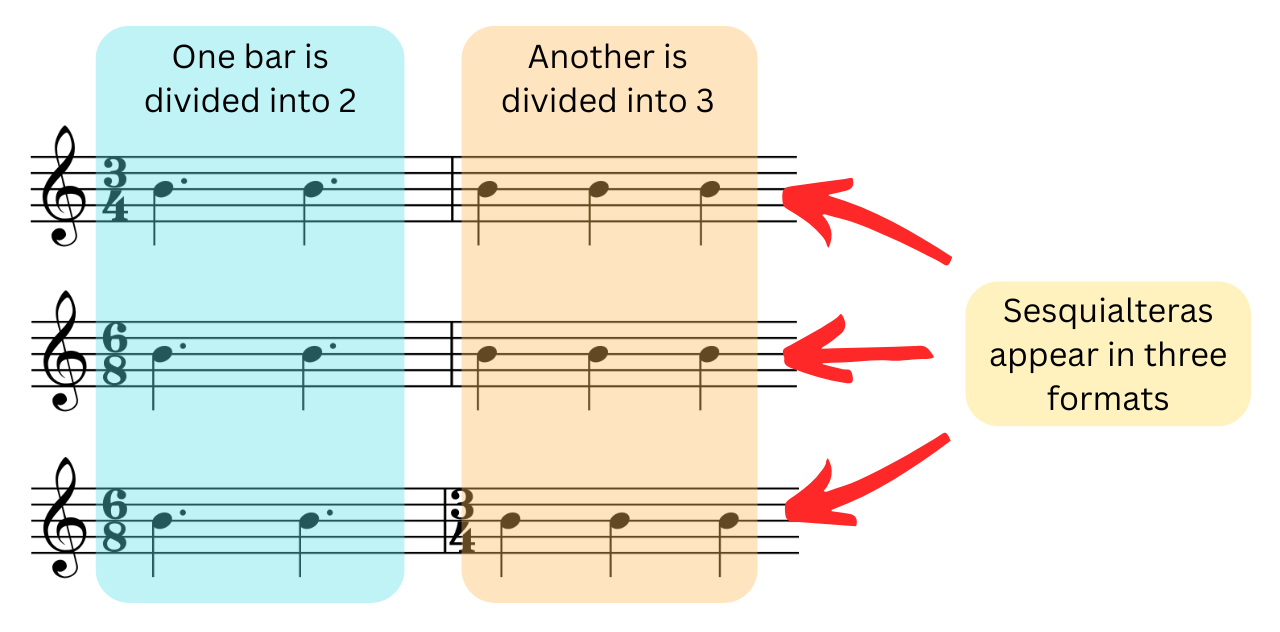
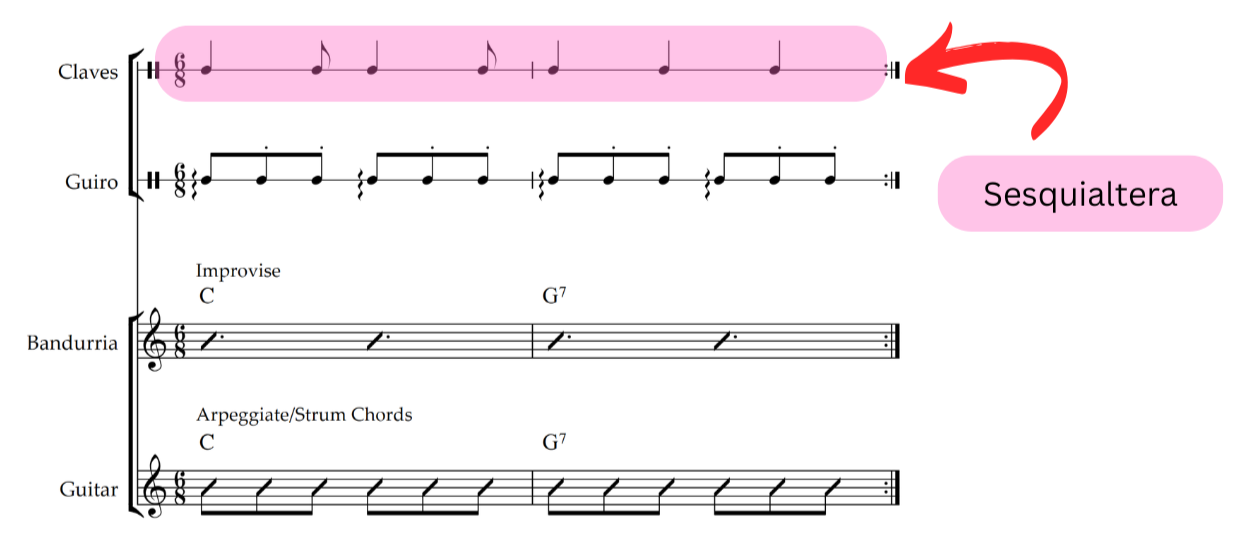
In punto guajiro we also find a unique rhythm, not exclusive to the style as we will see later, but prominent nonetheless. Often referred to as a sesquialtera, an older term that was used to describe a specific form of hemiola, the rhythm emerged in European music somewhere in the 15th or 16th centuries. Whether it was a result of the transatlantic slave trade and the influences of African culture on European society or was purely a European idea, we may never know, however it did become a staple part of early Cuban music. In order to understand the basic concept of a sesquialtera we need to remember that most of the Western music being played in the early centuries of Cuba’s history was in a triple meter (either thought of as 6/8 or 3/4). With this in mind, a sesquialtera is just a fun way of saying a 2-3 ratio over two bars, where the first measure implies a two feel while the second implies three beats. What this looks like in reality is a measure of 6/8 followed by a measure of 3/4, where the emphasis is on beats 1 and 4 in the first bar, and on beats 1, 2, and 3 in the second. Although it sounds somewhat complex when explained via text, when you see the rhythm written with sheet music or when heard, it is far easier to understand. For example, Leonard Bernstein makes use of a sesquialtera throughout the melody of America from West Side Story.
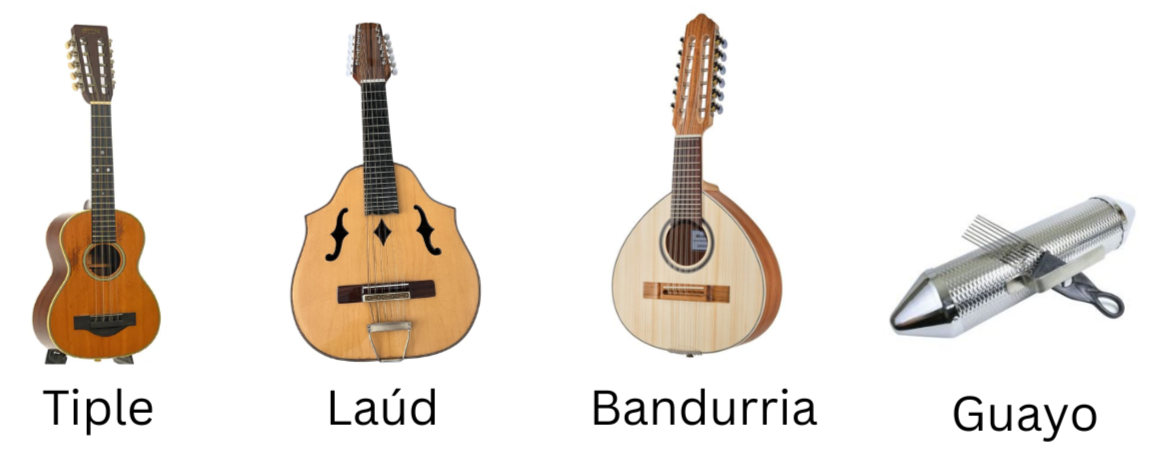
Switching gears to the ensemble, punto guajiro bands often feature a small number of instruments which call back to the earlier styles of music found on the island. Within the ensemble there are usually a variety of Cuban guitars used, including the Spanish guitar alongside either a laúd, tiple, or bandurria. The guitar often provides the harmonic framework for a piece through strumming progressions built around the I, IV, and V chords, while the bandurria (or one of the other Cuban guitars) is free to play more melodically. This is especially the case in the instrumental ritornellos where the bandurria plays single note improvisations and is the main focus of the music while the vocalists rest. There are also percussion instruments such as the claves, guiro, and guayo (a metal scraper), which support the whole ensemble and emphasize the dual sense of 6/8 and 3/4 by playing a sesquialtera throughout.
Punto Libre
Conjunto Los Pinares
Alongside the music, punto guajiro is commonly accompanied by the zapateo dance. The name is derived from the Spanish word zapato which means shoe, with partners dancing separately while constantly tapping with their heels to the music. Unfortunately, even though the dance was popular in the 19th century, it has almost entirely faded away today and is mainly preserved by various dance companies who focus on historic dance forms.
Whether it be the highly complicated decima form, the mixture of Cuban guitars, or a unique type of hemiola, punto guajiro really has a bit of everything. It is a style which doesn’t receive the same amount of attention as other Cuban music, but still has all of the charm and complexity of styles like son. Personally, I was shocked to come across it in the first place, however I am so glad I did because there are so many aspects to the style which resonate with me. But punto guajiro is not the end of our journey, and we now shift to a different area of Cuban vocal music, the theatre, where more styles await us.
Cuban Theatre
Like many places in the Western world, the theatre played a large role in defining the vocal music of Cuba, with three different formats of the artform being popular throughout the 19th and 20th centuries. Although many historians argue when theatre shows started on the island, they most likely occurred in Havana during the 1700s with private house shows called casa de comedias. By 1776, the first major theatre called the Coliseo opened, inspiring the construction of many others around the country and helping introduce a genre of Spanish theatre called zarzuela, which was likely the first major genre of Cuban theatre to exist on the island. However, we will leave zarzuela for later because even though it may have arrived in Cuba first, it did not reach its peak in popularity until the 20th century. Opera on the other hand, emerged in Cuba at the beginning of the 19th century and went hand-in-hand with the development of Havana.
The genre officially arrived in the city from 1801, but it wasn’t until Captain General Miguel Tacón governed Cuba in 1834 that a large-scale opera company was fully funded on the island. Tacón restructured Havana, cleaning up the streets and putting his name on as many building projects as possible. Part of this effort was commissioning a major urbanization program for the city, one which saw the construction of the largest theatre in the Americas at the time, aptly named Teatro Tacón. It should be noted that this specific urbanization program was funded off the back of the slave trade, with Tacón finding ways to increase slavery in Cuba and taxing the transactions of the new arrivals. The entire construction effort was run through a man named Pancho Martí, who was somewhat of an accessory for Tacón and became extremely wealthy through the various ventures. While it may seem odd to mention Martí, he is relevant to Cuban theatre because he chose to spend some of his newly found money to create the first major Opera company on the island. During this period there were only three major companies in North America, with the Havana orchestra being considered the best by far. They travelled to the United States multiple times in the 1830s and 40s, touring for months at a time and performing across dozens of states. The company was even able to draw many of the top European musicians of the time, including virtuosos such as the bassist Giovanni Bottesini and violinist Luigi Arditi.
As with most European artforms which entered Cuba, in the beginning, Cuban opera relied heavily on the original characters and compositions from Europe. However, quite quickly, local composers began writing operas and before long, many aspects of Cuban culture were integrated into the genre. Although the first opera was performed in Havana in 1801, it only took 6 years before the first Cuban composed opera was performed. To further demonstrate how popular the genre was, some 30 years after Teatro Tacón opened, over 400 theatrical works composed by Cubans had been performed in the theatre. Alongside the evolution in the music came the incorporation of Cuban characters and stories, which ultimately created a new branch of comic theatre called Bufo. However, bufo also looked outside of Cuba for influences, drawing from a completely different form of entertainment that was growing in popularity in the United States.
Throughout the 1860s, multiple minstrel shows from North America visited Cuba, receiving mixed reactions from the locals. Although today we consider these black-faced shows extremely racist, this wasn’t the reason they weren’t as popular on arrival to Cuba. Locals preferred entertainment in their own language using their own characters, and the minstrel shows were primarily in English with characters that didn’t resonate with the Cuban audiences. In reaction to this, the Cubans developed their own black-faced comedy show, taking aspects from the minstrel works and combining them with a style of in-your-face comedy that mocked everything, all while being accompanied by music. The Bufos Habaneros, the first bufo theatre group in Cuba, debuted in 1868 to great success, ushering in a new genre of theatre on the island. Important to our exploration of Cuban vocal styles, it is with bufo that we start to see widespread popularity of guaracha.
Prior to bufo, guaracha was likely already present in Cuban culture, with some historians believing the style originated in Mexico and came across to Cuba as early as the 1600s. Not much is known about this early variation of the style, but a newspaper article from 1801 provides some insight, suggesting that it was performed by black and mulatto families who accompanied the songs with guitars, tiples, and guiros. As Cuban opera began drawing from many different avenues of Cuban culture, guaracha was inevitably swept into the theater, where it became known as somewhat of a standard musical format in bufo. The style itself had a quick tempo and was built on a two-part form, where a four-line verse alternated with a repeating four-line chorus. Like many of the popular Cuban styles of the 19th century, guaracha heavily featured the habanera/tango/congo rhythm (see this resource for a deeper unpacking of the rhythm) as well as emphasized the quasi-hemiola/sesquialtera rhythm we explored earlier with punto guajiro. However, one of the defining characteristics of the style was the topic of the lyrics, which focused on the comic nature of bufo and were meant to be quite humorous and depict relevant political or social events in a picaresque way using caricatures.
Aguanta Hasta Que Te Mueras
José Tamayo
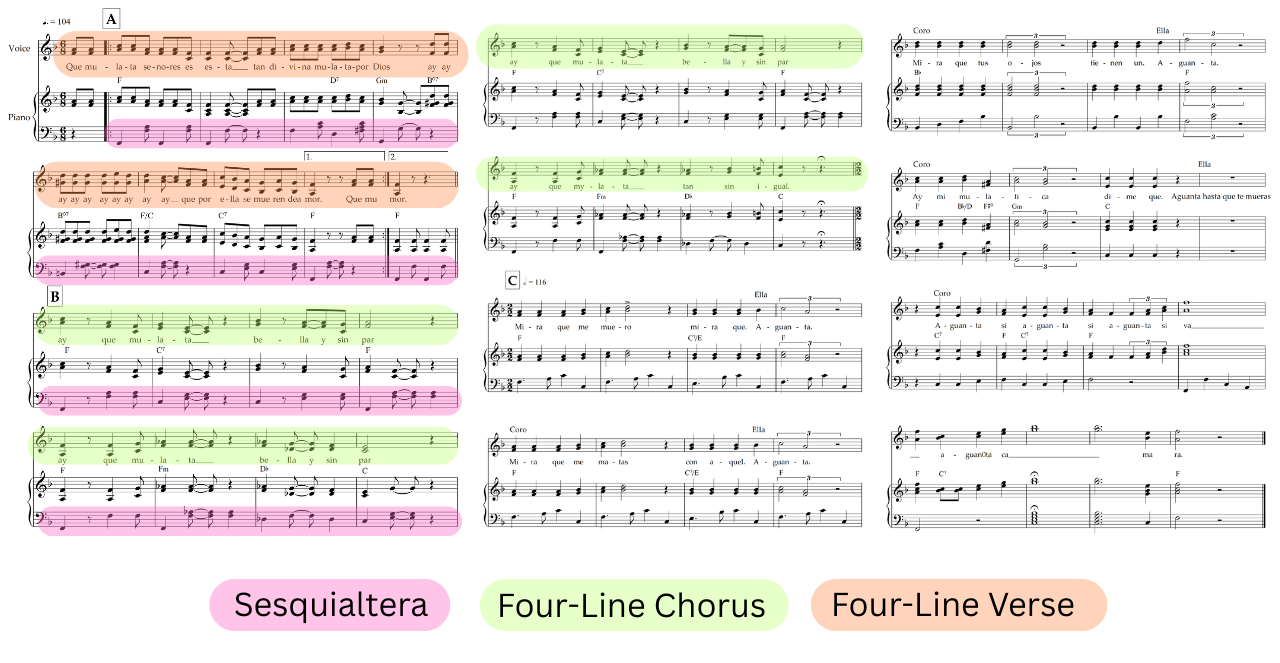
What we see in this example are all of the common tropes of early theatrical guaracha, with the lyrics discussing one of the main caricatures of bufo, la mulata. While I am unsure exactly what sort of acting may have accompanied the music, it most certainly would have tried to make fun of either the mulata character or whichever character was singing at the time. Unfortunately, I am yet to find a recording of the piece and it is quite likely that no such authentic recreation exists, however the sheet music does give us somewhat of a look into the style itself, albeit without any hints to the orchestration used or vocal intent behind the lyrics. Interestingly, this particular example has an added C section, a characteristic that was most likely thanks to the influence of contradanza at the time, a style which featured a B section with the habanera/tango/congo rhythm in the bass line.
Over time, popular Cuban music styles underwent a transition from being primarily in a triple ternary form to a duple binary form. The process has since been named binarization and encapsulates both guaracha and contradanza, as well as affecting other styles such as guajira and rumba. With the transition between the two-time signatures came the erasure of the sesquialtera, but also the emergence of the four main creolized rhythms found in Cuban music as we explored in the resource about danzón.
While we refer to this style as guaracha, it was also commonly called rumba by locals in the 1800s (not to be confused with the Afro-Cuban folklore style by the same name). This may have been due to bufo using Cuban figures such as the guarachera and the rumbera interchangeably, and thus their accompanying music was known by the associated character name. Others have argued that theatrical rumba is actually different to guaracha and is a larger style altogether which guaracha is a part of. However, at this point in time very little is known about theatrical rumba and almost all references to it don’t mention any musical differences to guaracha. The main reason I mention this is because out of guaracha came a style called rumbita which takes its name from theatrical rumba and not Afro-Cuban rumba. Rumbita had a major impact on Cuban music, taking the urban guaracha and transplanting it into rural towns where it began to be incorporated with other musical styles, the result of which helped create one the most influential of all Cuban styles: son. But before we get to that part of Cuban music there is more to be said about Cuban theatre, specifically looking at how punto guajiro was integrated into the artform to help create a new style by the name of guajira.
In 1899, a Cuban theatre composer by the name of Jorge Anckermann composed an iconic song titled El Arroyo Que Murmura, drawing from various influences to create a unique new sound. Anckermann combined characteristics of punto guajiro with an unrelated style that emerged in Spain in the mid 19th century called guajira. What resulted was the creation of a new Cuban style by the same name, once again adding to the inconsistent world of Latin American style names. From punto guajiro came the decima form, the syllabic vocal style, and likely the sesquialtera hemiola. Over time, some composers chose to depart from the decima form altogether, preferring to use a simpler rhyme scheme such as the cuarteta which was based on an ABAB structure. Other characteristics such as the emphasis on the mixolydian mode and the descending contour of melodic lines were used more freely and eventually were abandoned in place of more popular melodic devices. However, one element which was maintained was the imagery depicted in the lyrics of an idealized view of the Cuban countryside.
Thanks to Anckermann’s strong association with Cuban theatre, guajira also drew heavily from that side of the Cuban musical sphere. The harmony followed the common trends of Western music, starting by primarily using I and V chords in major or minor keys and then getting progressively more complicated as classical music evolved. There was also a preference for familiar forms such as the binary AABB structure found in contradanza. However, some composers did add an extra C section in a similar style to the Spanish zapateo, suggesting that the dance which accompanied punto guajiro was also incorporated to some extent in guajira. Finally, Anckermann introduced another element where the A sections were in a minor key while the B sections were in major, a characteristic which was copied in other theatrical guajiras.
El Arroyo Que Murmura
Jorge Anckermann
As we saw with guaracha, often Cuban vocal styles could be aligned with certain types of theatre with guajira being no different. Although bufo may have been one of the more popular theatrical outlets of the 19th century, it eventually faded with time, allowing another format to become the dominant theatrical genre of the 20th century. Originally landing in Cuba sometime in the mid 1600s, zarzuela was a type of Spanish theatre which incorporated both spoken word and sung dialogue. However, it wasn’t until the decline in bufo centuries later where it started to take the spotlight in Cuba, albeit after many musical transformations over the years. The genre travelled throughout Spain and incorporated local elements into performances, such as integrating dance styles, musical genres, dialects, and folklore. As a result, zarzuela became quite popular, reaching its peak in the second half of the 19th century in Spain, with Cuba experiencing their golden age in the 1920s and 30s. Due to its ability to absorb local culture, the Cuban variation was a blend of many popular styles, fusing different elements of contradanza, Italian opera, and minstrel show together. Some have compared the musical accompaniment to Tin Pan Alley but with a Caribbean twist, thanks to the incorporation of creolized Afro-Carribean rhythms. Many of the composers behind the popular danzas and danzónes at the time wrote for the format, with Ernesto Lacuona and Eliseo Grenet being a perfect example with their zarzuela Niña Rita. Similar to how guarachas were used in bufo, guajiras were used in zarzuelas, being one style among many in an overall performance.
As you can see, musical theatre has been a major component of Cuban music for the last 200 years. It created a performance environment which fostered the creolization between European and Afro-Cuban cultures as well as provided a medium for Cuban composers to write for. Specific to this resource, it was the home to two prominent styles that have since gone on to become mainstays in the Cuban music scene, however with a few changes that we will get to in a later article. For now though, there is one area of Cuban vocal music that needs to be addressed, specifically the luscious love songs of the east.
The Cuban Love Song
Back at university, once I had fully entrenched myself in learning about big band arranging and had taken a class on Afro-Cuban music, I was offered the opportunity to write for the Latin Jazz lab band. Part of that conversation was also the chance to rework some small group charts they had in the library for the larger band instrumentation. One such composition was a tune named Eva by Kenny Goldberg, which had the word “Bolero” marked in the top left hand corner. At the time I had absolutely no idea what that meant but went off the accompanying tempo marking to write the arrangement, knowing that the director José Aponte would take care of the specific rhythm section grooves. I finished the arrangement and dropped it off to José, excitedly anticipating the band performing the chart in a few days time. When the concert came, I remember hearing the title being announced and then being mesmerized by the sound of a style I had never heard before. What immediately hit me was the percussion which so eloquently supported the ballad style and set up an irresistible mood. It really was one of those moments I’ll never forget and from then on bolero had a permanent place in my arranging vocabulary. As a result, when it came to looking at Cuban styles in more detail years later, bolero was firmly on the list from the start. Even though I had engaged with the style to some extent, I knew almost nothing about it, let alone the distinct techniques which defined the overall sound. What I found was a delightful history that helped explain how the music not only came about but how it developed into what we know today. One which I think may help others understand the style in greater detail and a fantastic starting point for our look into the final Cuban vocal style for the resource.
In the mid 19th century, there were many influences on Cuban vocal music with some of the most popular lyrical styles being the Spanish canción, Neapolitan song, and the Italian operatic aria. On the eastern side of the country, these styles blended with politics, specifically with the emerging independence movement of the mid 19th century who would write political and patriotic lyrics. The result was the creation of a new style, or more accurately, a new complex called the Cuban canción. A fantastic representation of this movement is a song written in 1851 by Francisco Castillo Moreno and Carlos Manuel de Céspedes, with lyrics by José Fornaris, titled La Bayamesa, which has since gone on to become the Cuban national anthem.
Sometime in the second half of the 20th century, the political messages were replaced by romantic lyrics that shifted the overall tone of the canción. Specifically in the eastern city of Santiago de Cuba, there was a growing tradition of manual labourers who would sing songs and accompany themselves on guitar after a hard day’s work. Many of them were illiterate men who worked in the tobacco industry as cigar rollers. The job was quite mundane and often employers would hire assistants to read to the workers during the day while they completed repetitive tasks. Aside from listening to the readers, the workers would often sing and rehearse a cappella in preparation for the evening when they would go out with their guitars and serenade others at parties. The first figure associated with this new romanticized style of canción was José “Pepe” Sánchez who was a mulato self-taught guitarist that liked to host house parties that welcomed people of all walks of life. Over time he merged the romantic canción with the cinquillo cell, a common rhythm found in east Cuba, to create a new style called bolero. For reference, this was quite different to the Spanish style that shared the same name and was established with Sánchez’s composition Tristezas written in 1885.
With the new style came the implementation of a new guitar technique imported from Mexico known as raking. Instead of strumming a whole chord, musicians would displace each note slightly, creating a rhythmic pyramid that eased into the sound of the full chord. The overall effect gave bolero a lusher accompaniment that flowed seamlessly with the romantic lyrics. Originally, the style was performed with just two musicians, both singing in harmony and accompanying themselves on guitar. The vocal lines were typically harmonized in 3rds and 6ths while the guitars played a mixture of arpeggios and strummed chords, with the new raking technique sprinkled throughout. Unfortunately due to the early bolero musicians not being recorded and the fact that the style underwent significant changes in the early part of the 20th century, we can only make educated guesses as to exactly how the first examples would have sounded.
Tristezas
José “Pepe” Sánchez
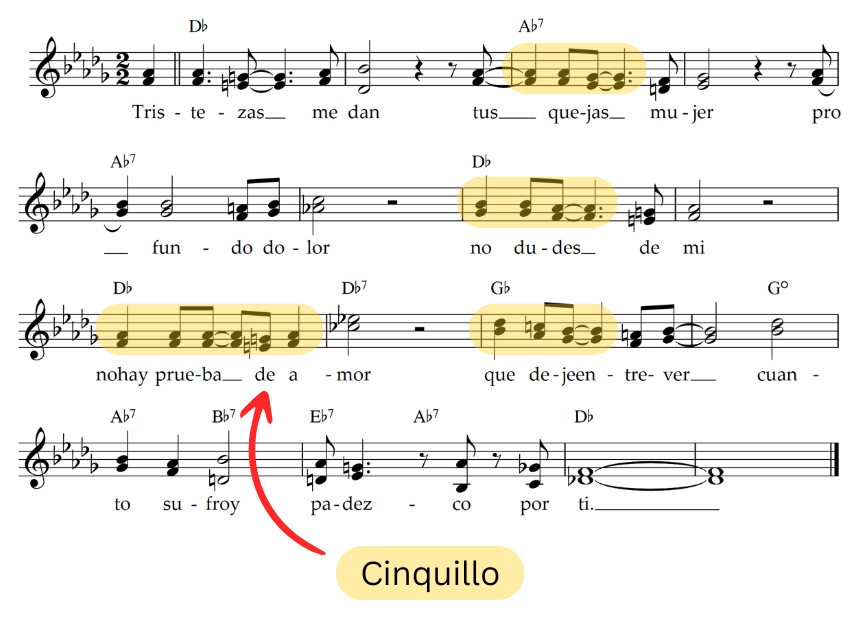
Coming from the canción tradition, lyrics played a major role in bolero. As we have seen, the primary themes that bolero discussed were love and romance, with composers often leaning on clichés that expressed feelings directly. The poetry was filled with descriptive adjectives and simple metaphors, which succeeded due to the sincere execution of the vocalist. Thanks to Sánchez, a new vocal tradition had firmly landed in Cuba, one which rode on the back of his many students from east to west and to other countries in Latin America. One such student was Sindo Garay, who led an extraordinary life between 1867 and 1968. Garay’s parents would often invite Sánchez to their house and at a young age he began receiving guitar lessons from the seasoned musician. With the War of Independence in full swing, Garay quickly became associated with the revolutionary movement and ran messages between towns, notably swimming across the shark infested Bay of Santiago on multiple occasions. To avoid being targeted by Spanish forces, he took a job with a touring circus and went from Haiti to the Dominican Republic, staying there until 1900. Notably, Garay is credited with introducing bolero to the Dominican Republic where it developed into a new style called bachata. When he returned to Cuba he was introduced to the music of Wagner, a significant moment which informed Garay’s vocal harmonisations for the rest of his life. Those who knew him have said the influence of the German composer helped Garay experiment with minor tonalities, specifically the b6 degree of the scale which Garay used frequently over dominant V chords to add more colour. Only a few years later, in 1903, Garay travelled to Havana by accident, falling asleep in a boat which ended up sailing to the other side of Cuba. He quickly returned to Santiago de Cuba, but in 1906 revisited Havana, this time bringing the bolero with him and possibly becoming one of the first people to introduce the style to the western cities of Cuba.
La Tarde
Sindo Garay
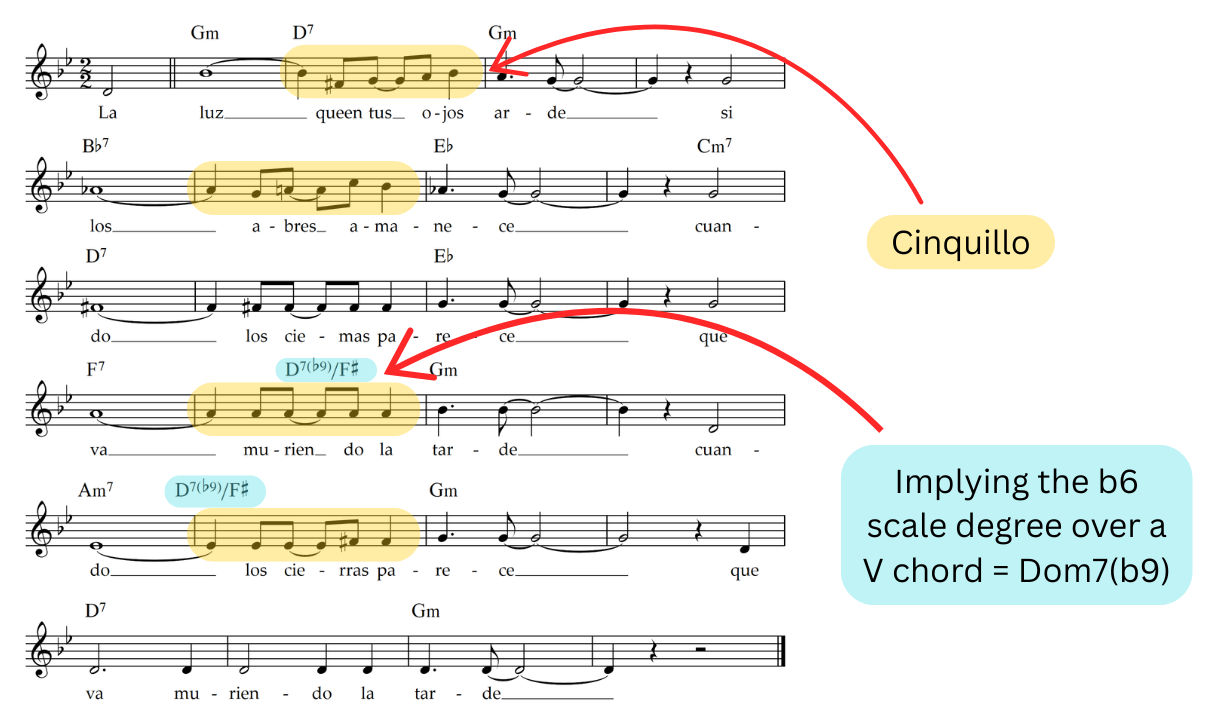
Aside from Garay and Sánchez, many others put their mark on bolero. Another student of Sánchez, Albert Villalón used a picking technique instead of strumming the guitar, adding a new level of sophistication to the guitar accompaniment. He also travelled to Havana at a similar time to Garay and helped spread the new style around the island. Outside of Santiago de Cuba, Patricio Ballagas added various flavors in Camaguey by splitting the two vocal parts into independent voices, allowing them to converse with each other both melodically and lyrically. Once bolero had arrived in Havana the style began being performed in all walks of life except for the upper class which associated the guitar as a peasant’s instrument. In the 1920s, Eusebio Delfín helped change that stigma through his marriage with one of the daughters of Cuban rum tycoon Emilio Bacardi. This allowed him into certain places other boleristas could not, where he helped make the guitar a favorable instrument to the white upper class over time.
By the 1930s, these wandering singer songwriters started to be called a new name: either trovadores or cantadores. Today, any Cuban music which features one or two vocalists being accompanied by a guitar is called trova with styles such as bolero, guaracha, punto guajiro, and others falling into this category. Because of this, vocalists can be trovadores while playing a variety of styles with the name trova purely being associated with the format that the style is being performed in. While it can be quite confusing, what helped me was identifying the various umbrella terms that styles could fall under, almost like creating a Venn diagram to see how they all relate to one another. Using bolero as an example, it is a style which belongs to the trova tradition when it is performed purely by vocals and guitar accompaniment, and both the trova tradition and bolero belong to the much larger canción complex which covers any vocal style created in Cuba.
And with that, we have now covered four different Cuban vocal styles. However, the story for many of them doesn’t stop there and if you came into this resource being familiar with any of the styles we’ve explored, you’ll know that they all sound a little different today than the examples we looked at from a century ago. That’s because a significant shift took place in Cuba in the early 20th century, when one style single-handedly redefined Cuban music and put a mark on every major style present in the country. You may not know much about son, but if you’ve found your way to this resource it’s highly likely you’ve been exposed to a montuno or two in the past. Due to the popularity of the new sound, every other Cuban style began to change and take elements such as the percussion accompaniment, form, and piano montunos from son. When this transition took place, many of the prominent characteristics of guaracha, guajira, and bolero started to be shed with only one or two elements remaining. As you may have guessed thanks to the introduction to this resource, these days the only differentiating factor of many of these styles are the topics spoken about in the lyrics and sometimes the tempo. Guaracha kept its comical lyrics, while guajira talked about the idealized tropical Cuban landscape and bolero serenaded audiences in love themes. But before we look at that transition in more detail, there are more Cuban styles to explore, such as a serious investigation into son and how it developed into such an influential style.
The Takeaway
Cuba’s many vocal styles represent an amazing part of the musical culture of the island. It’s hard to find one area of Cuban music that doesn’t incorporate vocals and I think it is pretty safe to say that lyrics and singing have been quite significant to the overall development of Cuban music throughout the history of the country. There is tremendous depth in the various traditions that exist, whether that be the complexity of the decima system, or the topics discussed in the lyrics. Unfortunately, by coming to Cuban music as an instrumental musician I didn’t think that exploring the Cuban vocal culture was a worthy venture, but thanks to hitting a few walls, such as trying to better understand the difference between guaracha and son, I am so glad that I was introduced to the many wonderful vocal traditions the country has created. No matter which way you look, Cuban music always has wonderful twists and turns that consistently reiterate the beauty of humanity regardless of the conditions that led to its creation. Up next is a style that is no exception and is associated with the annual street parades of the island called conga de comparsa. A wonderful style that may just be one of my favorite types of music to come out of Cuba.