

Mambo Mania
The Arranging Techniques Behind The Iconic Style
Mambo may just be one of my favorite styles of music ever created. It merges everything I love about big band with everything I love about Cuban music. It’s big, it’s brassy, it’s got a great feel, and I don’t think I’ve ever heard a mambo I haven’t liked. Outside of my personal bias, the style was significant to the trajectory of Latin American music and created the blueprint for later movements like salsa and timba. Not to mention helped integrate many of the iconic Latin American rhythms into popular Western music in the 20th century. Similar to the jazz styles associated with big band arranging, mambo and cha-cha-chá have an established set of techniques which help create their iconic sound. However, unlike learning how to write a shout section or sax soli, there are considerably less resources on writing an authentic mambo chart, and if you’re like me, knowing where to start can be difficult. Especially if you don’t know what the music sounds like.
Mambo was always a word I had heard about growing up, perhaps because in grade 3 or 4 I played an arrangement of Mambo No.5 in a beginner concert band, but that didn’t mean I knew anything about the style. The word came up every now and then through my early years as a musician, sometimes being thrown out by a director in a big band rehearsal, or referenced to as a certain type of bass line, yet I never seemed to build any sort of musical association other than it having something to do with a big band. By the time I was in university, nothing much had changed but now I was surrounded by a few more people that used the term. Sheepishly trying to fit in, I just nodded along and acted as if I knew what they were talking about (to my detriment) and of course, never really understood a word. Eventually, I decided to learn more and realized quite quickly that a lot of the music I had been exposed to over the years actually fell under the mambo category. To my excitement, not only did I have some sort of musical association with the style, but of the few Latin recordings I had come across, all of my favorites were mambos.
Now I was faced with a new problem, I knew what the style sounded like but had no clue how to capture that sound in my own writing. My solution was to try and look at the bigger picture of Cuban music (the place where mambo originated), specifically by creating a timeline and looking at the styles which led into the creation of mambo and cha-cha-chá. Going off a stray comment a university colleague had made years prior (that miraculously I had somehow remembered), I knew there was some relation with danzón, so that’s where I started. Before long, a world of amazing Cuban arrangers and musicians unfurled before my eyes and I started to connect the dots. Mambo didn’t just come out of thin air and was part of a lineage of many styles bombarding with one another, taking the best of it all and eventually creating a unique sound. After seeing how the music naturally progressed from one style to another, I started to see all of the various techniques which made up the sound of mambo and felt a bit more comfortable trying to replicate them in my own arrangements.
And that takes us to this resource. While I would always encourage others to go on the multi-year journey I went through, if I had come across some sort of article or book discussing mambo and cha-cha-chá through the lens of jazz arranging, it would probably have saved me a lot of time. That’s why I have put together this particular resource on the topic. Better yet, there are actually numerous articles I’ve written which trace all of the relevant styles up until the creation of mambo and cha-cha-chá, and this particular resource is built off many of the techniques discussed in them. They cover topics such as how to understand clave, the core rhythms used in the styles prior to mambo and cha-cha-chá, as well as a deep dive into the rhythm section parts used in early 20th century Cuban music (e.g. piano montunos, bass lines, conga parts, bongó parts etc.). With all of that said, this particular resource not only looks at mambo and cha-cha-chá in detail, it also looks at how many of the key elements came to be. What I’ve found the most helpful is asking why certain techniques are used and then trying to find the answer. So instead of writing a quick list of sounds to try and copy, we’ll explore how each element developed, providing context on why they may have been used in the first place and hopefully leaving you with a bit more information to help you choose what techniques you want to use or omit in your own writing. And with that, let’s jump in!
Danzón-Mambo
Like most styles of music, mambo didn’t simply come together out of thin air. Instead, it progressed from a lineage of styles that go all the way back to 16th century England which took on influences to create the style we know today. By the latter half of the 1800s, that specific branch of music had led to the development of danzón, Cuba’s most popular style at the time. But as with anything that is popular, danzón had to eventually yield its spotlight for another type of music a few decades later. Thanks to the emergence of son, almost all styles of music in Cuba changed overnight. Montuno sections started appearing everywhere and the beginning of the 20th century helped many Cuban styles come together into a unified national sound. Danzón was no different, and thanks to the developments of a few key people, the style evolved yet again into a new variation called danzón-mambo. If the name didn’t give it away, this was the style that filled the gap between danzón and mambo, where a few new techniques were established and the foundation was set for the creation of a musical explosion in the late 1940s.
Picking up where we left off in the danzón resource, in 1910, composer José Urfé incorporated an additional section at the end of his piece El Bombin de Barreto. Now there are many theories as to what led to the extra section being added, with some saying it was a natural development isolated to danzón and others pointing to the influence of son’s montuno section, either way, Urfé’s decision to add the final section was critical for the development of the style. Unlike the previous A, B, and C sections, Urfé broke from the strict 8 bar division and used a repetitive progression of the I and V chords. By doing so, it mimicked the same feeling of the montuno section of son and helped danzón cling on to some level of relevance amidst the rise of a new popular style.
El Bombin de Barreto
José Urfé
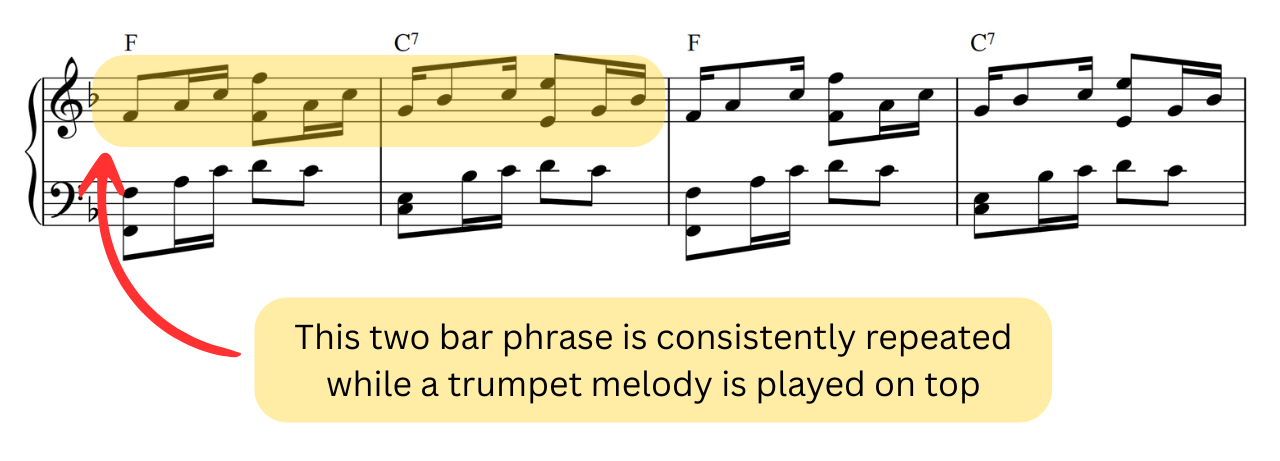
Alongside the added D section to the rondo form of danzón, the instrumentation of the ensembles which played the style was also changing. Sometime in the early 20th century, the outdated orquesta típica format was slowly being replaced by a new lineup called the bunga, which featured a piano, violin, flute, and bass. However, that instrumentation was adapted further by Antonio María Romeu, who added a second violin and percussion, calling it the charanga. The combination of this new lineup of instruments and the added vamp section became the foundation for a new wave of musicians to redefine danzón in a similar way to how Arsenio Rodríguez had impacted son. While there were likely others who helped contribute to the evolution of danzón, four members of one particular charanga stand out. Leading the group was flautist Antonio Arcaño who formed La Maravilla de Arcaño in 1937, alongside Israel “Cachao” López on bass, Orestes “Macho” López on cello, and eventually Enrique Jorrín on violin.
Building off of Urfé’s added D section, Macho wrote a composition titled Mambo which reorientated danzón into something a little different. Although the tune was composed in 1938, the recording came years later, which means that it likely isn’t a perfect representation of the initial concept of the piece and may feature certain developments which came in the 40s. With that in mind, the recording begins with one short 4 bar statement, likely referencing the theme that would have been stated in the original ABACA form, however instead of committing any more time to the original danzón structure, the majority of the recording is of the open D section. Fortunately for us, the main area we are interested in is the D section, and it is unlikely that the unrecorded A, B, and C sections featured anything different than what we have seen before with other danzónes.
Mambo
Orestes “Macho” López
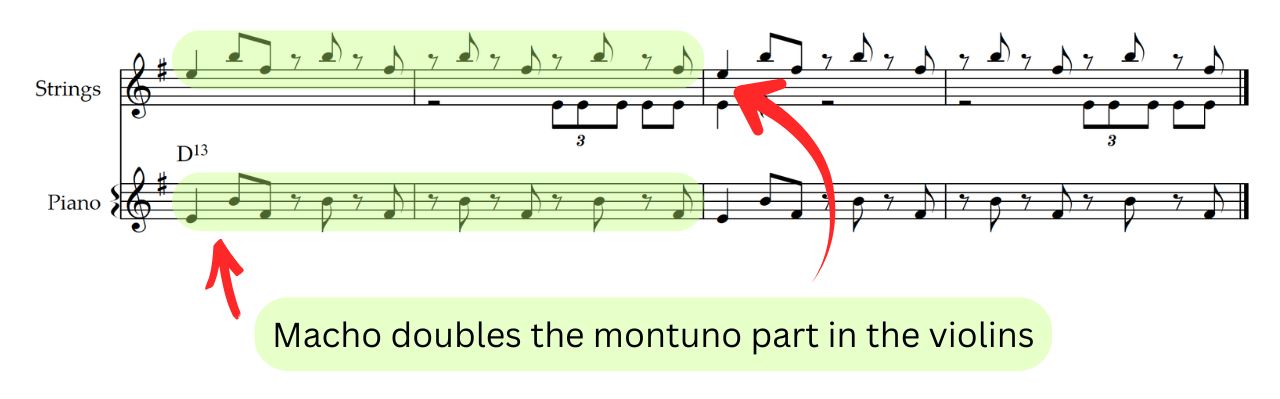
Similar to how son most likely influenced the added D section of Mambo, the other changes can be linked directly to Arsenio Rodríguez. During the 1940s, Arcaño’s charanga was one of the busiest bands in Cuba, often sharing the stage with Rodríguez’s conjunto. By this time, Rodríguez had started developing son into son montuno and had added the conga to his ensemble. Through exposure, and most likely many conversations at gigs, various characteristics of Rodríguez’s music started to be used by Arcaño’s charanga, and by 1943, Arcaño had even hired Rodríguez’s brother Kiki to teach someone to play conga in his own group. With the extra instrument came a few changes to the ensemble, most notably the addition of a cowbell used by the timbalero in the D section. Unlike the campana used in son montuno, this bell was smaller which fitted the lighter orchestration of the charanga. It also was more common for the bell to play consistent downbeats instead of the rhythm used in son montuno. Additionally, the beat 4 push found in Rodríguez’s bass lines started to be repurposed by Cachao, who favored the habanera/congo/tango rhythm most likely due to the strong connection between the rhythm and danzón. By the time Arcaño’s charanga was able to record Mambo, all three of these elements (the conga, bell, and beat 4 push) had become established components of the composition.
Mambo
Orestes “Macho” López
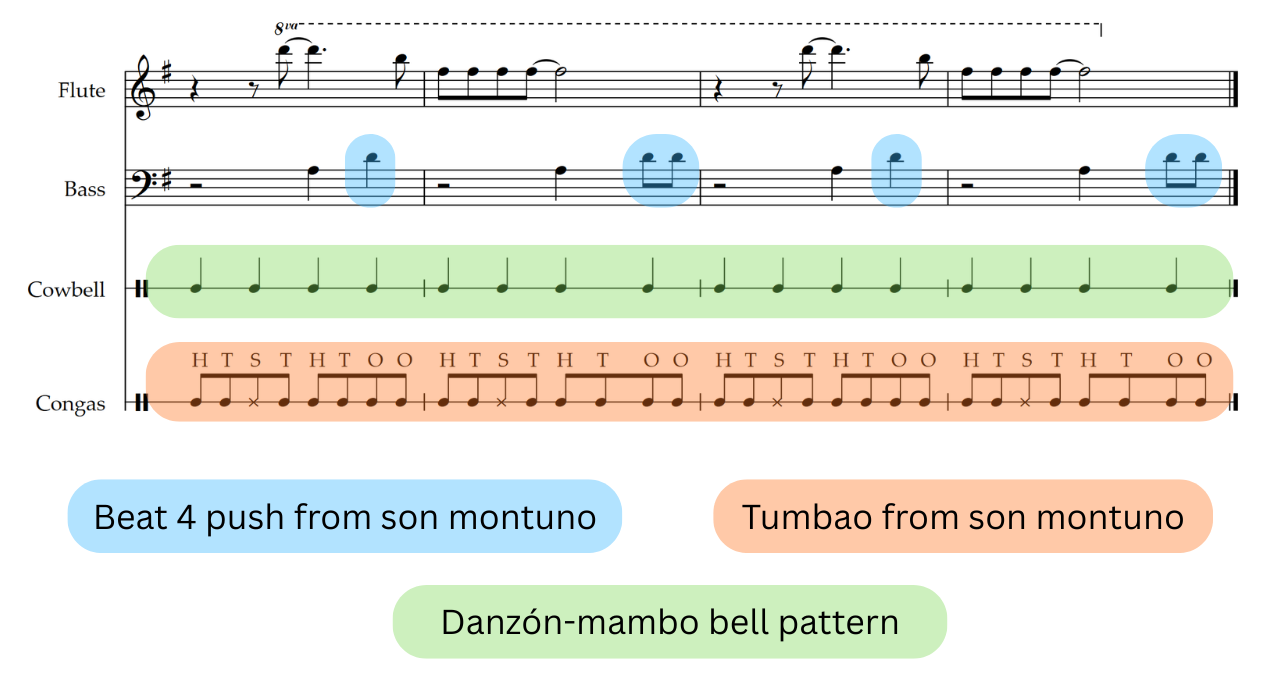
Collectively, all of these developments came together to create a new variation of danzón which Arcaño’s charanga titled danzón-mambo, named after the piece written by Macho. Although Mambo may not be the best recorded example to represent the style, due to it being recorded years after the initial composition was written, it does feature all of the core components which differentiate danzón from danzón-mambo. However, Arcaño and his charanga did record a number of danzón-mambo’s between 1944-51 which feature the full ABACAD form, with many being found on the compilation album “Danzón Mambo” by Arcaño y sus Maravillas. Thanks to the creativity of Arcaño and his colleagues, the stage was set for the style to shift even further away from danzón.
A New Sound
Coming out of many years of military conflict and political intervention by the United States, in the 1940s Cuba was finally able to rule on its own which resulted in over a decade of fantastic artistic contributions. The music scene was primed with new innovations such as danzón-mambo and son montuno, two styles which introduced the conjunto and charanga formats to the world and perhaps more importantly, helped push Cuban music back towards its syncopated roots. Although Arcaño and Rodríguez established both styles at the start of the decade, it was actually the influence they had on the next generation of arrangers and composers which led to the creation of mambo. Not to mention the overwhelming presence of big band swing music from the United States, both in the form of recordings played over the radio and the firmly established Cuban jazzbands that had been a staple in the western cities of Cuba since the rise of American run casinos in the 20s. With these three elements present, the country was primed for yet another musical expansion.
As Cuban jazzbands were primarily created to cater to American audiences evading prohibition, they generally played popular music from the United States. At first that looked like emulating the famous white bandleaders at the time such as Paul Whiteman, but as the decades moved on, the ensembles changed to reflect the current trends. By the 1940s, the Cuban jazzband had evolved to replicate the common big band lineup and as such, introduced many of the characteristics of the swing era to the country. What that looked like musically was the incorporation of jazz harmony, such as the addition of extensions and alterations in line with American bands led by Stan Kenton and Benny Goodman. It also meant that the standard ways of orchestrating the band were copied too, such as splitting the horns into two defined sections: the saxes and the brass. Unlike the charanga and conjunto which featured only a small handful of horns, whether that be the flute or two to three trumpets, the Cuban jazzbands now bolstered three or four trumpets, four saxes (usually two altos and two tenors, with some ability to double on clarinet), and at least one trombone alongside a full rhythm section with some form of percussion.
While I have not come across any recordings of these bands trying to play jazz (my guess is that most American record labels were more interested in capturing music that was uniquely Cuban rather than any sort of replication of what already existed in the United States), there are a number of tracks that do demonstrate how they played son montunos and guarachas. What we can hear in these examples is the emulation of many of the classic approaches found in the swing era such as the use of falls and shakes. Perhaps more interesting though, is that the articulations used by these bands is more in line with the older sweet jazz approach, where phrases would be either all staccato or all legato with no mixing. Thanks to the influence of Louis Armstrong, American jazz had moved on from this approach in the 1920s, but it seems that the Cuban jazzbands embraced the older approach throughout the 40s.
Zapatero Remendon
Julio Cueva’s Jazzband
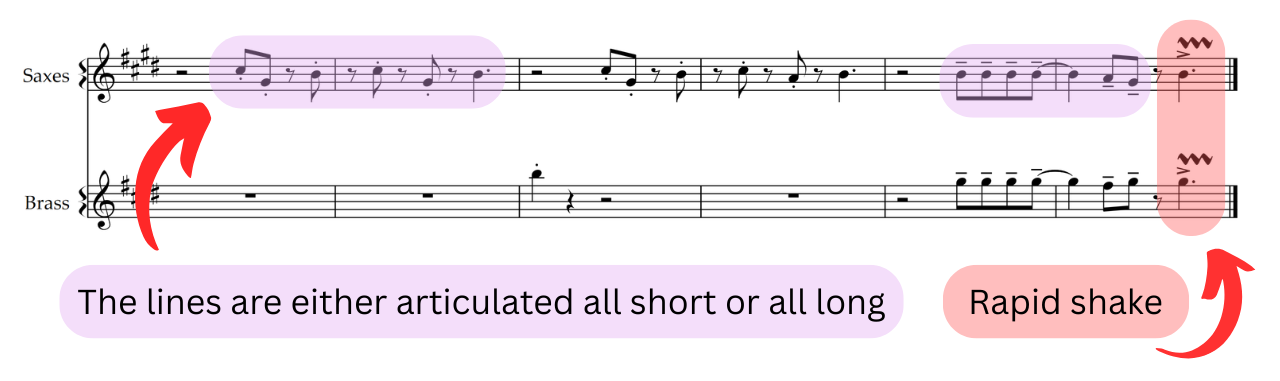
Other elements also seeped in, such as the incorporation of background figures, pads in the horns, and even the occasional sax soli. Although these were used in various capacities, one characteristic was perhaps more prevalent: the fast and wide vibrato. Whether you like it or not, the signature vibrato sound of jazz in the 1930s and 40s was also present in Cuba too, and can be found especially in slower tempo arrangements of the time.
But why is any of this relevant to mambo? Well it was in these bands that the new generation of Cuban arrangers were making their mark. By writing for the jazzbands, they were expected to replicate the techniques being used by the big band writers in the United States. However, they were also being influenced by the developments taking place in the Cuban music scene and were blending everything together into a new sound. It was common for most pieces to build on top of the characteristics found in Rodríguez’s son montuno, specifically the rhythm section parts which could all be linked directly to his innovations in the late 1930s and early 40s. With that base, they then experimented with everything else and took ideas somewhat equally from son montuno, danzón-mambo, and the American big band tradition. It’s hard to say exactly who started this new approach, however there are a few names that we can link to certain contributions which inevitably came together to create mambo.
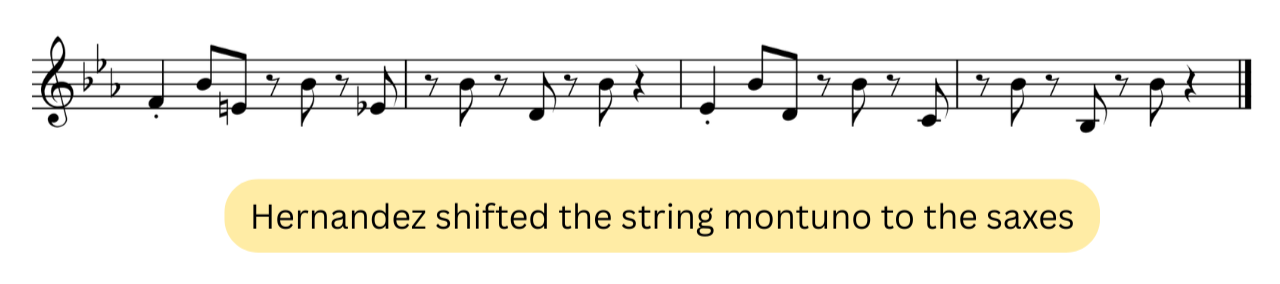
Up first is René Hernandez, a pianist who worked in Julio Cueva’s jazzband sometime in the early 1940s. Due to Cueva’s interest in guarachas, Hernandez used the up-tempo style as the foundation for his arrangements and added layers of son montuno and danzón-mambo on top. More specifically, it is clear that Arcaño’s charanga played a pivotal role in his arranging approach as one of the most significant contributions Hernandez made was to reallocate the montuno part from the string section to the saxes, most likely due to the absence of the strings in the jazzband format. Moreover, the montuno part in the saxes didn’t just double the piano part but often operated as its own unique line while the piano was free to either improvise, comp, or play another montuno entirely. When operating in this manner, the sax part is often called a sobremontuno with the piano part being associated with the word montuno. By orchestrating the original concept created by Orestes “Macho” López, Hernandez established one of the signature sounds of the emerging mambo sound.
Figurina del Solar
Julio Cueva’s Jazzband
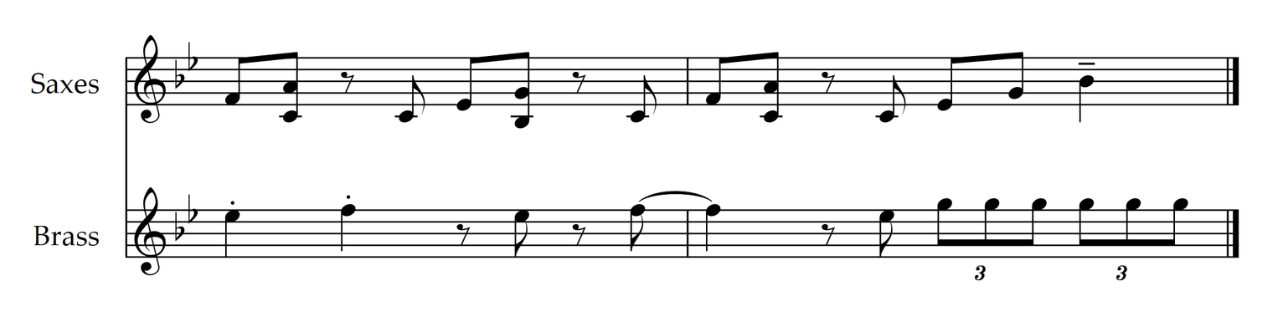
But the saxes were only one part of the equation, and often on top of the sobremontuno were highly rhythmic brass parts which added to the excitement. In a similar manner to how Hernandez was influenced by Arcaño, it is likely that the inspiration behind the brass parts came from Rodríguez’s conjunto. However, instead of a high degree of interweaving, the brass parts were simplified into a singular line that was either in unison/octaves or harmonized. As highly rhythmic brass parts were also present in swing era big band writing, it is likely that Hernandez was also inspired by more than one source when writing his brass lines.
El Arpa y la Orpa
Julio Cueva’s Jazzband
Aside from being credited with creating the sound of the sax sobremontuno, in this period of Hernandez’s career it is hard to tell exactly which arrangements he contributed to Cueva’s band. Unfortunately, what that means is that we don’t know if he was behind any of the other impactful techniques which shaped the development of mambo. Additionally, Hernandez left the band in 1945 when he decided to move to New York City and was replaced by Bebo Valdés who took on the role of pianist and arranger. Due to many of the recordings of Cueva from this era only existing in the form of rereleased compilation albums with little information on personnel and arranging credits, it’s hard to know exactly when certain recordings were made and whether a given arrangement was penned by Hernandez, Valdés, or potentially others whose names have been lost to time. What we do know though, is that Valdés continued on writing in the same manner as what Hernandez had established with the band, so it is likely that many of the tracks from these albums can be linked to either of them. As such, other than the one defining technique that can be linked to Hernandez, for the rest of this brief investigation into Cueva and his band during the 1940s, all of the techniques can be thought of as broadly associated with both Hernandez and Valdés, and most likely represent common musical trends in Cuba at the time.
Moving away from the horns, there were some further developments made in the rhythm section too. Being a direct copy of the American big band, the Cuban jazzbands naturally included the drum set. Interestingly, in the recordings that do exist, the presence of such an instrument is often barely felt if not omitted entirely leaving us to question how much it actually impacted the music of the 1940s. After looking at a few of the surviving photographs from the period, it seems that often a hybrid drum set was used and my guess is that the components associated with swing music were most likely only used for playing that type of music. As a result, the Cuban styles that the bands played fell more in line with the musical trends of the time and focused predominantly on Latin percussion to provide the rhythmic foundation for the ensemble.
Most commonly the section included an upright bass, piano, bongó, conga, and some sort of hybrid position which could cover a bell part, claves, or maracas. Following in the footsteps of Rodríguez, all of the instruments followed the conventional roles established by son montuno, with there being some level of variation with the percussion instruments. By having two hand drums and two instruments that were able to play a bell, either the campana or the smaller bell associated with danzón-mambo, each player could be somewhat flexible which resulted in multiple variations available to arrangers. The most common was to have the conga play a consistent tumbao throughout while the bongósero would either play a martillo or transition to the campana. If the campana was being used, then the third percussionist would stick to a non-bell texture such as the maracas, whereas if a martillo was being played then they were free to play the smaller cowbell. It is even possible that this third player had the option to play a campana too, however we may never know exactly what the hybrid drum set/percussion part normally had access to or was responsible for.
Unfortunately, even though the audio quality of the 1940s was significantly better than earlier decades, the recordings which exist of Cuban music from this period make it hard to hear if timbales were present in the jazzbands. Based on the incorporation of the bongó and congas, as well as the influence of danzón-mambo and the charanga format, there is every reason that they may have been used as part of the hybrid drum set. We do know that by the 1950s they were present in the average mambo ensemble, however that may have been due to the influence of Machito’s band in New York which many say was the first band to bring the three instruments together. From the tracks I’ve heard, my thought is that the timbales most likely weren’t a part of the Cuban jazzbands for the majority of the 40s, but the role of the instrument was being covered by the hybrid drum set/percussion chair of the ensemble, which helped develop the basis of the vocabulary used once the timbales did eventually join.
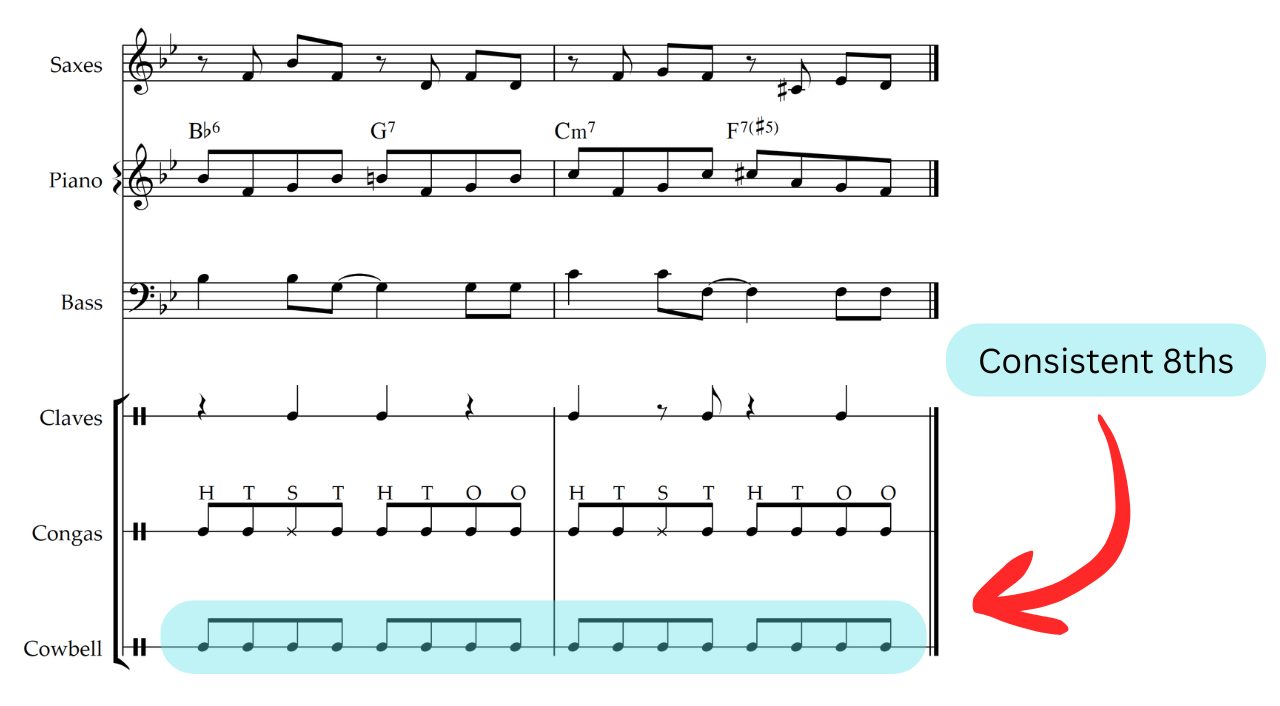
Looking a little closer at the bell patterns played in the Cueva band, there is a slight diversion to the two common options established by son montuno and danzón-mambo. Instead of choosing to play the campana rhythm or consistent downbeats, sometimes the small bell would play consistent eighth notes/quavers. By doing so, three bell options were now available for the arrangers, each of which provided subtle differences and could elevate the energy accordingly.
En Tiempo de Magos
Julio Cueva’s Jazzband
These instrumental characteristics were almost universally applied across every piece written for Cueva’s jazzband in the 1940s. However, that didn’t mean that every piece sounded the same. In actuality, most of the pieces contrasted with one another due to the differences in form and melody, not to mention the topics the lyrics spoke of. Some arrangements were built more heavily from the form of son montuno, whereas others broke from the common Cuban options entirely and mimicked the structure of American popular songs. This was a stark difference from the music of Rodríguez and Arcaño who predominantly composed using the same form, either son montuno or danzón-mambo respectively. Interestingly, the rhythm section parts can help point to what a given arranger was being influenced by, with those drawing from son montuno featuring the campana and a bass part derived from the tresillo rhythm, whereas those channelling danzón-mambo used the smaller cowbell and often had a bass part derived from the habanera/congo/tango rhythm. There were also many cases of cross pollination where one bell part was used over another bass line.
Por Poquito Me Tumba
Julio Cueva’s Jazzband
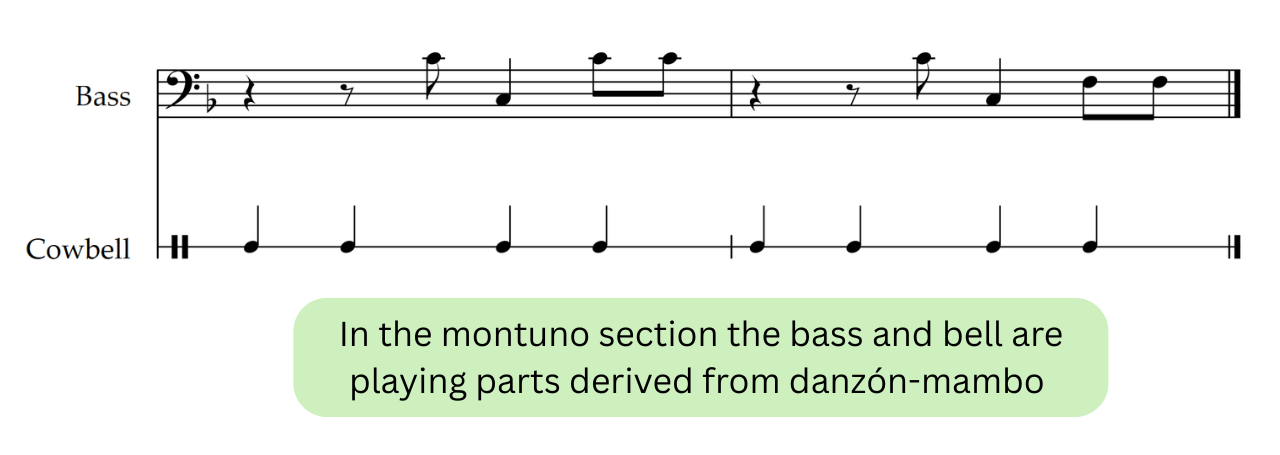
Regardless of which source they got their influence from, both Hernandez and Valdés drew from one particular element of son montuno and applied it to many of their arrangements. Originally added by Rodríguez as a way to increase the energy and build into the final montuno section of a given piece, the bloque/cierre was a new addition to son montuno which generally featured a short set of collective hits played by the entire ensemble. Instead of copying this model completely, in Cueva’s band the common practice was to shorten the concept further and place it at the end of certain sections to help mark some kind of transition. Sometimes that meant going from the verse to the montuno, to signify a shift from vocal to instrumental, or a shift up or down in dynamics which corresponded to a change in rhythm section parts and/or textures. Like many aspects of this period of time, perhaps Hernandez and Valdés were also drawing on influences from the swing era where hits often closed off sections, so it is hard to say exactly what led to this use of bloque/cierres.
Within the span of less than a decade, Cuban music had moved once again into a new territory. Starting with Rodríguez and Arcaño, the foundation was set, with Hernandez and Valdés developing the music further. However, there is one more character we need to discuss who took everything established in the 1940s and put it together to create mambo as we know it today. If you’ve heard anything about mambo before, you’ve likely heard of him, his name was Pérez Prado.
The Mambo Boom
If there is one thing we know about local music scenes today, it is that many people often have played with each other or at the least have met a large contingent of the people that play the same type of music that they do. The 1940s Havana scene was no different, and the more I read about the bands, whether it be Rodríguez’s conjunto, Arcaño’s charanga, Cueva’s jazzband, or any number of other notable ensembles of that decade, there always seems to be some sort of crossover in personnel. With this in mind, it is easy to imagine how elements of one band could be transplanted into another quite quickly, without even factoring that these musicians most likely heard the performances of their peers too. This was exactly the case with Pérez Prado who was brought into Orquesta Casino de la Playa as a pianist and arranger thanks to the request of Cascarita, a vocalist who had recently moved to the ensemble from Cueva’s band.
With a background singing in front of arrangements by Hernandez and Valdés, Cascarita had likely become accustomed to Hernandez's new sound and requested that Prado follow in their footsteps. In a similar manner to how Hernandez and Valdés developed the music of their predecessors, Prado tried to innovate further with his music. Inspired by Stan Kenton’s approach to arranging, he experimented with an added level of dissonance and aggression not found in Cuban music up until that point. Unfortunately, like most artistic pursuits, Cascarita and the band preferred the more commercially viable approach established by Cueva’s band, leaving Prado in a position where his arrangements were no longer being recorded. Unfortunately for Prado, around the same time one of the main sheet music publishers in Cuba also blacklisted him from selling arrangements. Forced into a corner, he looked outside of Cuba for his work to be recognized and ended up in Mexico City where he began running his own band in 1948. Fortunately for us he did, because what came next redefined Latin music forever.
Upon arrival, Prado established his own band with five trumpets, a single trombone, four saxes, and a rhythm section where he pushed the limit of Cuban music even further. Likely inspired by Kenton’s sound, he stretched the range of the horn section by placing the trumpets in their upper register and the saxes down low, voicing the horns with a higher level of dissonance than any other Cuban writer at the time. It was also clear that he was happy to experiment with other grooves outside of the typical son montuno and danzón-mambo choices, and wrote many arrangements where the percussion used rhythms from the rumba tradition. It is very possible that Cueva’s band and Orquesta Casino de la Playa used similar textures in their live arrangements, however if they did, the available recordings primarily follow the established sounds we have explored so far.
Through his experimentations Prado came across a particular format which combined all of the elements from the previous arrangers into a singular package with his composition Mambo No.5. Now all of these elements may have come together earlier in his arrangements, but it was with this particular composition that the world took notice. Thanks to his recording released in either 1949 or 1950, Prado ushered in a new era of music that blew up across the United States in particular. Even though the word mambo had been used by some Cubans, it was this one track which engrained the name of the new style and led to the mambo boom across the world.
By listening to Mambo No.5, we can see how all of the earlier components came together. There are the sax sobremontunos, the high articulate brass, the cierres/bloques at the end of each section, and the common rhythm section roles from both son montuno and danzón-mambo. Perhaps the most unique aspect to the composition is the form. Instead of being built on an established Cuban form or even something from American popular music, Prado takes a different approach and isolates the D section from danzón-mambo. As a result, every section of the music is built around a different vamp which we now think of as a mambo section. While this sounds very similar to having multiple montuno sections next to each other, the differentiating element is what goes on top of the rhythm section. In a typical montuno, there is an alternating call and response which takes place between the horns, lead vocals, improviser, or choir, usually in 2 or 4 bar cycles. Whereas in a mambo section there is usually a sobremontuno in the saxes and there is the flexibility to put any sort of melody line above. In more traditional forms of the style, the accompanying rhythm section will also play parts associated with the relevant style, for example montuno = son montuno and mambo = danzón-mambo. From the surface, these are subtle differences but they do result in slightly different flavors of music. Within the mambo style, composers are free to create their own form, often combining any number of montuno and mambo sections together.
Outside of what can be seen in Mambo No.5, Prado made some minor developments with the percussion parts, specifically the bell patterns and textures used. In a number of the recordings from 1948 and 1949, there is an added cymbal to the percussion section. Up until now, there has been almost no evidence of the influence of the drum set, but in at least four recordings from this period a ride/crash cymbal is used to either accent the horn parts or as a replacement for the maracas. It’s hard to say where the inspiration for this decision came from, but if I were to take an educated guess I would say it probably came from an emerging timbalero named Tito Puente out of New York City who also incorporated a cymbal into his playing and was likely inspired by the American drummer Chick Webb. Regardless of how it got there, I am yet to find a similar texture in the recordings of Cueva’s jazzband or Orquesta Casino de la playa. By the 1950s, the cymbal was an established texture in the mambo sound and was plastered all over Prado’s later recordings.
And just like that, mambo was born out of a multi-year process which started with José Urfé in 1910 and finished with Pérez Prado in 1950. Hopefully you can see that mambo itself is quite a flexible style, one that can have many different flavors due to how it draws from both son montuno and danzón-mambo. It can be a little overwhelming to begin with due to there being so many layers of influences, however once the pieces start falling into place it can be one of the most fun styles to use in your own writing. But this resource isn’t quite finished yet and we still have one more style to cover which is closely related to the music we’ve unpacked so far.
Cha-Cha-Chá
After the success of mambo, one musician sought to change the direction of Cuban popular music once again. Revisiting Arcaño’s ensemble in the 1940s, there’s one member that was mentioned earlier that we haven’t discussed yet. Alongside the López brothers was a violinist who joined the band in 1948 named Enrique Jorrín. He too composed for the charanga and kept playing danzón-mambos well into the 50s while mambo reigned supreme. However, his approach to the style was different than his fellow composers as he used less syncopation, in a somewhat similar way to how La Sonora Matancera interpreted Rodríguez’s son montuno in the 40s. After spending a short period of time with Arcaño he moved to Orquesta América where he released La Engañadora and Silver Star in 1953, both of which made use of his new take on danzón-mambo. After receiving some level of popularity, Jorrín’s new style was given the name cha-cha-chá, thanks to the sound of the accompanying dance. Not much was new with Jorrín’s early cha-cha-chá and many of the features were present in the danzón-mambos of the 40s. However, it did offer an alternative style to mambo, one which was truer to danzón-mambo and continued the danzón branch of Cuban music in an alternative direction.
Looking more closely at the two compositions, we can start to pick out some of the core differences between cha-cha-chá and mambo. The most obvious is the instrumentation which still makes use of the charanga format and heavily leans on three main instruments that weren’t a part of the Cuban jazzbands: violin, flute, and guiro. While the style would be exported to other instrumentations later, the association with flute and particularly guiro seemed to stick with cha-cha-chá and become part of the core sound. As a result, maracas were more likely to be used in son montunos and mambos, and would often be replaced by the guiro in cha-cha-chás. Coming from danzón-mambo, the timbales also played a much larger role compared to the early mambo sound and used the same rhythms as what was established with danzón, however by the time Jorrín had recorded these two tracks, timbales had become integrated into the mambo ensembles and weren’t necessarily limited to charangas. While the timbales were utilized, it was far more common for the timbalero to play the small bell associated with danzón-mambo. Due to the abundance of the downbeat bell pattern being used, over time, the associated cowbell became known as the cha-cha bell, becoming one of the staple components of the style.
Silver Star
Enrique Jorrín
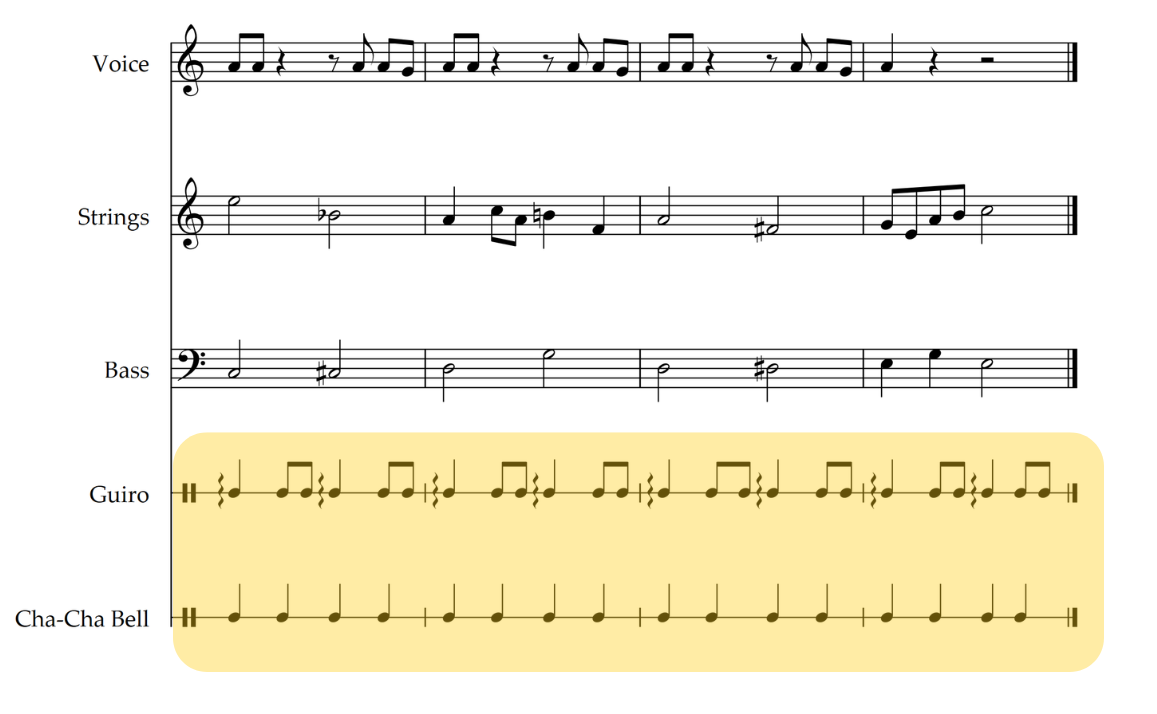
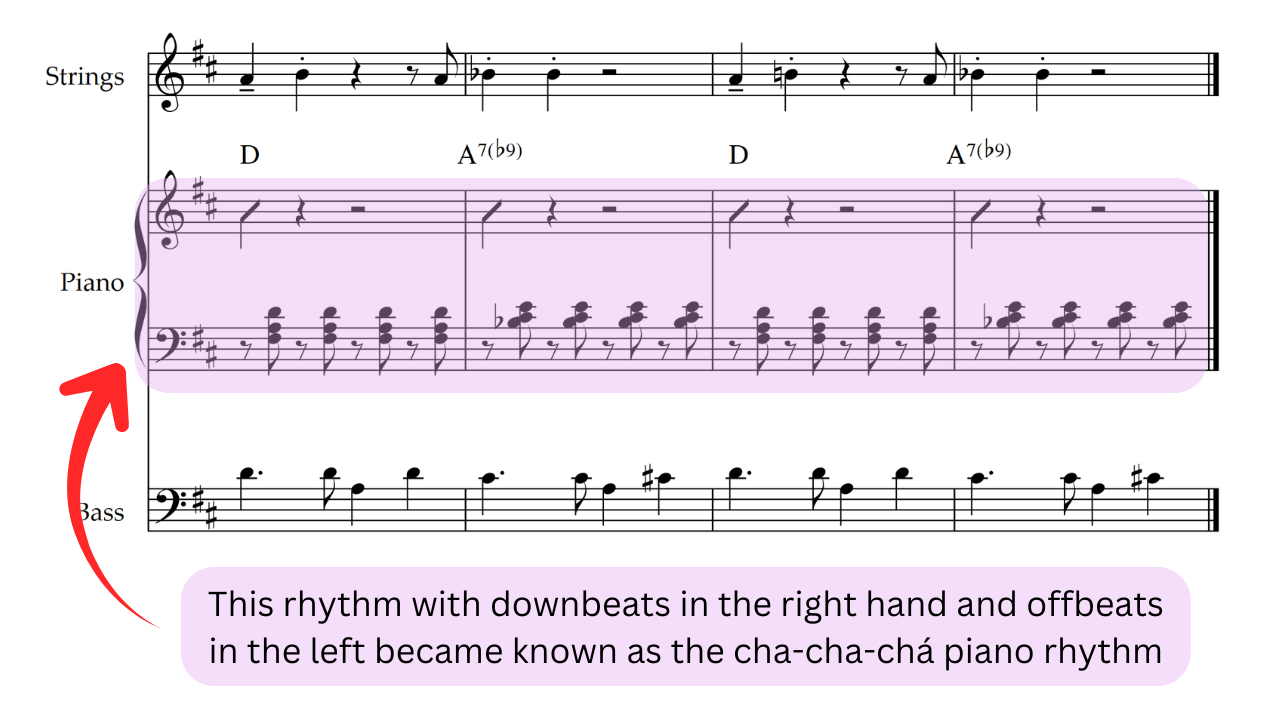
The other rhythm parts were also slightly different to mambo and danzón-mambo, with the piano favoring downbeat patterns over the use of a montuno in almost all sections. By doing so, the style contrasted drastically to the syncopated sound of mambo and allowed for more contrast between the string parts and the piano. This type of piano playing wasn’t necessarily unique to Jorrín’s recordings though, and had come from a lineage of bands like La Sonora Matancera who had used a similar approach for multiple decades at this point. However, for one reason or another, this particular type of playing became firmly associated with cha-cha-chá and is now considered one of the defining elements of the style.
La Engañadora
Enrique Jorrín
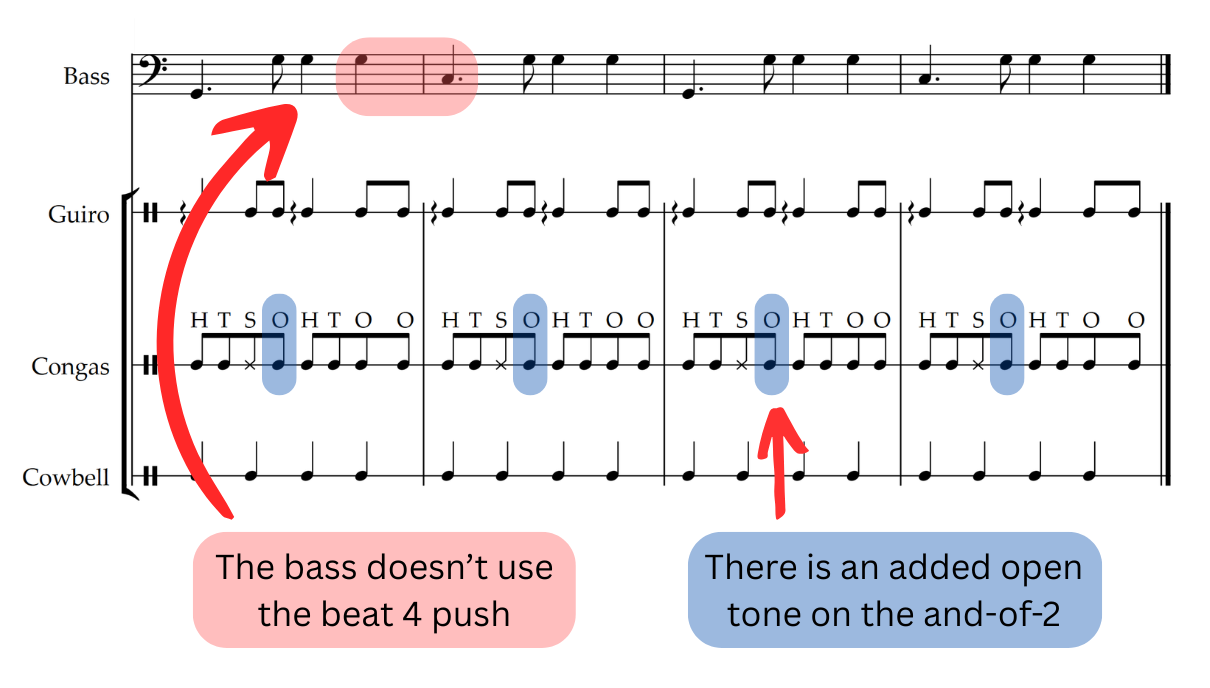
As Jorrín’s new style had come directly from danzón-mambo, the bass lines and conga parts fell in line with the established conventions of the earlier sound (that being a predominance of the habanera/congo/tango rhythm on the bass and a tumbao on the conga). In La Engañadora and Silver Star we see both conventions honored, as well as a simplified bass approach which favors downbeats over any sort of beat 4 push. Additionally, in the conga there is one subtle variation to the common tumbao with an added and-of-2 open tone.
Silver Star
Enrique Jorrín
The last texture worth discussing are the vocals. Instead of relying on a lead singer, Jorrín chose to have the ensemble sing. Due to the lack of formal vocal training, the vocal parts were quite simple, catchy, and sung with a light vocal timbre. They featured short motivic phrases that used small intervals and could easily be picked up by listeners, often paired with lyrics which told comical stories. Now not all cha-cha-chás featured vocals, but the simplicity of the vocal lines originally written for the style branded a certain melodic character to the music which continued on in any instrumental variations. Looking at the vocals of Silver Star, we can also see another key component of the style. In the chorus Jorrín used the words “cha-cha-chá” alongside a particular rhythm, potentially being the first to establish the stereotypical association with the style. Regardless of its high use, this particular rhythm has become an integral part of the cha-cha-chá sound, so much so that many people today who are completely unaware of the style would sing the words to it, my teenage self included.
Silver Star
Enrique Jorrín
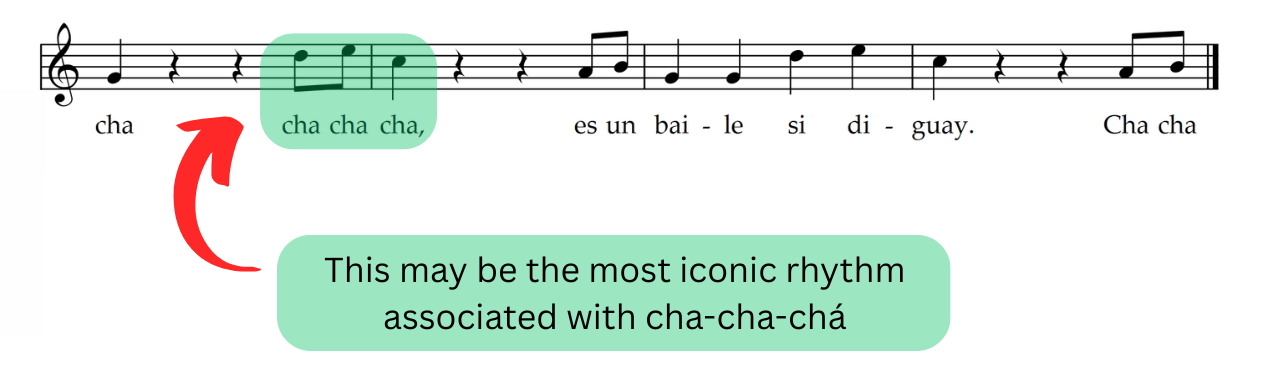
Outside of the specific instrumentation and parts they played, Jorrín introduced an interesting component to cha-cha-chá at the end of La Engañadora. Due to the style being considerably slower than mambo and more in line with danzón-mambo, in the final section of the piece he shifted to double time and picked up much more syncopation in the string and piano parts. It is hard to say where this idea came from, but it became a common characteristic of the style which was emulated by other composers such as Tito Puente.
Collectively, all of these elements came together to create the cha-cha-chá sound. Looking at the style alongside danzón-mambo, many of the core characteristics had already been established by Arcaño and his charanga prior to Jorrín joining the ensemble. However, once Jorrín released the two recordings with Orquesta América in 1953, many of the unique aspects he brought to the table became the staple components of cha-cha-chá while a number of those more strongly associated with danzón-mambo faded with time. Quite quickly the mambo bands jumped on Jorrín’s new style, and within less than a year many other arrangers were writing their own cha-cha-chás. Interestingly, once the style entered the big band format, it mixed with the many characteristics of mambo to create a sort of amalgamation that drew on both styles equally. As a result, in many arrangements from the 1950s you can hear a base of cha-cha-chá but with added elements of mambo and vice versa, further confusing what components actually define both styles. In such cases, often the tempo would be the primary differentiating factor between whether a tune was classified as a cha-cha-chá or mambo, with the former being slower and the latter faster.
When looking at the two styles in detail, this resource only scratches the surface and primarily focuses on the core components established at the start of both mambo and cha-cha-chá. After the release of Mambo No.5 and La Engañadora, countless other bands began writing their own material and for the entirety of the 1950s the world was saturated with the two styles. As you can imagine, this led to many variations which used combinations of everything we have unpacked here plus added influences from elsewhere. For the most part, the best examples of this period actually come out of New York City, where the mambo bands dominated the local music scene and musicians like Tito Puente became household names across the world. Instead of drawing out this resource any longer and cross pollinating Cuban music developments with those made by Latin Americans in the United States, in the next resource we will continue the journey with these two styles in North America and how they eventually turned into salsa. Focusing on developments like the integration of the timbales, drum set, and the myriad of variations found in the rhythm section parts of bands led by Puente and Machito.
The Takeaway
Looking at mambo and cha-cha-chá from the outside can be confusing at the best of times. They mark the first major styles to come out of Cuba that heavily integrate many elements of the music that came before them. As such, in order to fully understand both, you need to be well versed in son montuno and danzón-mambo. But trying to comprehend everything all at once can be quite overwhelming, I know it was for me. My suggestion is to follow the development of the music and try to comprehend each subtle change one at a time. Eventually, it will all come together and you’ll be able to listen to a mambo or cha-cha-chá and know where each part is drawn from. Interestingly, the two styles mark a crossroads for Cuban music thanks to the rise of Fidel Castro in the late 1950s. Instead of following a singular thread, the music diverges into two different sounds, one strongly associated with Latin Americans in the United States, and the other with the Cuban music scene. Up next we will continue the journey of the two styles by looking at how they developed further in New York City and eventually established the salsa craze of the 1960s and 70s.