

Demystifying Clave
& Its Afro-Cuban Origins
If you’ve heard anything about Cuban music or other Latin American cultures, you’ve likely come across the term clave before. It can feel like somewhat of a magical word, something that we know is important but at the same time is so hard to define. And if you get it wrong, you’ll likely hear about it. Yet why is clave so difficult to discuss when it is an essential part of almost all Afro-Caribbean music?
Growing up in a predominantly white Australian community, clave wasn’t on my radar for most of my early life. In fact, I came across Latin Jazz recordings many years before I had even heard of the term. It wasn’t until I got to university that I was introduced to the concept, which seemed like an essential part of the music I was listening to, yet no one was able to put a consistent definition to what it was and how it operated. Terms like 2-3, son, and rumba, were all thrown around and all I knew was that it was important that I must adhere to this mystical guideline whenever I interacted with Latin music. But that is far easier said than done, and for many of my first Latin charts I would simply slap a clave direction on the page and hope for the best. As you can imagine, the results varied drastically which didn’t help my confidence. To make matters worse, it became apparent that some of the rhythms I used didn’t align with the clave direction of a piece, often causing critique from those that knew better.
This pattern continued for years, even after I had taken classes on Latin music and started understanding some of the basic percussion parts. Whenever I felt like I was making progress, inevitably something would come up which would remind me just how little I knew and take me right back to step one. Unfortunately, even though I was slowly accruing various information over time, no solid method had come my way to explain clave direction. Everyone I asked was able to convey the basic function of the pattern but crucially couldn’t articulate why a rhythm felt correct or incorrect alongside clave.
What eventually got me over the barrier was looking into rumba, one of the traditional Afro-Cuban styles which was actually where many of the main clave rhythms in modern Latin music originated. By understanding this branch of Cuban styles, I started to see how bell patterns orientated the music as well as how certain rhythms had a set direction. What became clear to me was that the direction of these rhythms had been established over centuries, so much so that in today’s Cuban music to play the rhythm in the wrong orientation would feel incorrect. Having grown up outside of this culture, the rhythms didn’t have the same significance to me but the more I listened and studied rumba, the more I started to become familiar with the vocabulary being used.
Over time I began to amass a small list of rhythms and orientations, allowing me to start integrating them into my own writing with the confidence that I wasn’t crossing clave. Not only that, but I also started to see which rhythms were used with certain instruments and realized that rumba played an even more significant role in Cuban music. You see, rumba not only provided a framework for clave in Latin music over the last 150 years, it also established many of the core percussion rhythms played across many different Afro-Caribbean styles, as well as was the first major style to use the conga drum. By understanding rumba, it allowed me to make sense of so many other styles of music, and as I explored the development of Cuban music through the 20th century, I realized that it was one of the critical pieces needed to understand the complex puzzle that is Latin American music.
However, learning about rumba when you’re unfamiliar with the style isn’t that straightforward even if you know it will help you better understand clave and Latin percussion. Which is why I decided to put together this particular resource. Over the coming paragraphs we’ll look through rumba in more depth, helping to familiarize many of the core components of the style while also focusing on key characteristics such as clave and common percussion parts. But just a quick warning, I am by no means a master Cuban percussionist, nor have I spent a lifetime playing rumba, so the information here should be seen as a work in progress. While I have often questioned myself whether I should write about this topic given my background, I know that if I had come across a resource like this on my journey to understand more about clave and Latin percussion, specifically from a composition and arranging perspective, it would have saved me many months and many awkward moments. There’s a lot to cover, from multi-layered percussion parts to interesting polyrhythms, and even a bit of choral harmony too, and hopefully by the end of it all you’ll not only understand clave but have a deeper appreciation for one of the most amazing Cuban styles to be created.
The Formation of Rumba
Like most Cuban styles, rumba didn’t just appear out of thin air and can be linked to a long lineage of musical traditions. If you’ve looked through my other resource on the influences behind Latin music, you’ll be familiar with the fact that most of Cuban music was a result of the creolization which took place between the African nations brought through slavery and the Spanish colonizers. While other Cuban styles such as danzón can be thought of as starting with a primarily European musical base with added Afro-Cuban elements, rumba is the complete opposite. There are definitely some European elements that can be observed, but many of the core characteristics are distinctly African, making rumba a fantastic example of how Afro-Cuban culture was formed. However, this is somewhat of an oversimplification of the situation because rumba not only represents a fusion of African styles but also the conditions in which they came together. Rumba didn’t exist in Africa, even though all of the pre-requisite rhythms and cultures were there, and instead was the result of those nations existing in a distant country ruled by the Spanish. A great example of how we must always be mindful of the Spanish influence in Afro-Cuban music, even if it may not be directly seen in the music itself.
When the African nations were brought to Cuba, the first major wave of enslaved people came from the Kingdom of Kongo. As a result, the primary foundation for Afro-Cuban culture was built from their traditions, with rumba being no different. The early form of the style is thought to have resembled a specific Congolese ceremony called yuka, a secular ritual which combined singing, dancing, and percussion. More specifically, rumba was likely built on the accompanying dance, where onlookers would create a ring around a given couple. Due to the secular nature of yuka, the ceremony may have been more accessible to those from other African nations, and could have helped creolization initially take place between the many different enslaved groups present in Cuba. On top of the initial Congolese layer came the imagery of Yoruban Santeria found in the vocal lines, as well as many different instruments such as the bells of the Abakuá and the catá of the Dahomey. What helped bind them together was a shared rhythmic vocabulary played with a common instrumentation of three drums and a bell pattern. Over the span of nearly four centuries, elements of each African nation began integrating with one another and eventually culminated in the creation of a singular Afro-Cuban style that they could all relate to.
Alongside the various layers of Afro-Cuban culture, rumba also took influence from other places too. The structure of the vocal part incorporated the decima form from the Spanish, while the nasal timbre drew inspiration from the previous inhabitants of the Iberian Peninsula, the Moors. There were even influences from unlikely cultures such as those from the Canary Islands, which led to the main vocal structure of the first section in rumba. Additionally, in styles such as rumba columbia, dancers were known to incorporate elements from flamenco which likely came from the interactions between Spanish peasants and Afro-Cubans in the shipyards. Even how the early rumberos acted and dressed was influenced by the black curros, a group of free people of color who had travelled from Spain and had a defined image prior to the formation of the Abakuá.
As you can see, there were quite a few influences under the surface which led to the creation of rumba but it is also important to understand how they actually came together. Something that is better said than done as much of Afro-Cuban history was not seen as significant in the eyes of the Cuban enslavers, leaving us with very few records from the time. Fortunately for us, historians have identified four key areas in western Cuba where the formation of rumba took place: solares, barracoons, cabildos, and the docks.
Up first are the barracoons, a common building found on plantations that were often used to house slaves. Thanks to Spanish slavery permitting a day of rest each Sunday, these buildings became a primary location for Afro-Cubans to come together and play music. For close to 300 years, plantation owners allowed these gatherings to take place, but after the Haitian Revolution they were forbidden with the hopes that it would stop potential slave uprisings. Of course, the gatherings still existed but were quite secretive until the end of slavery eighty years later. Regardless of the new rules, the musical groundwork had already been done, paving the way for the creation of rumba. While we may not know what sort of music was being played in the barracoons it is likely that an early version of rumba would have been present in the 1800s.
Next were cabildos, society houses which helped preserve the cultures of the various enslaved African nations in Cuba. As I mentioned in another resource, cabildos were initially set up by the Spanish to help convert slaves to Catholicism but backfired spectacularly, instead operating as a place for Afro-Cubans to actively partake in their various African cultures. Hidden from the Spanish guards, the houses were perfect for gatherings, constructing contraband drums, and playing music. Similar to barracoons, it is hard to say exactly what sort of music was being played in cabildos all those years ago, but we do know that the buildings themselves enabled the continuation of African traditions for centuries which was vital in the formation of rumba. With that said, there was one specific Spanish influence that did creep into the Cuban cabildos.
In 1845, a popular poet and musician named José Anselmo Clavé founded a French style choir made up of working-class people in Barcelona, Spain. Over the following decade, the group became quite popular and established a new tradition of choral singing in Spain, eventually taking the name of the founder and being known as coros de clavé. As with many aspects of Spanish culture, the coros de clavé tradition made its way to Cuba where it became popular within the Afro-Cuban communities of Havana, specifically finding its way into the cabildos of the city. Originally these groups were for women only with some being as large as 150 members, all dressed in luxurious clothing and singing while they walked the streets. Grammar and diction were important to the ensembles, to the point that a specific member of each choir would be assigned as a censor whose role was to maintain the correctness of the texts. Over time, the choirs began to incorporate male members and changed their names to coros de guaguancó as a reference to the guagua instrument found in Afro-Cuban music, also known as a catá. However, it should be noted that this transition took place after the end of slavery when the cabildos closed and by this time the vocal format had been integrated into the emerging rumba tradition.
Typically, the lyrics of the coros de clavé and guaguancó would follow the decima form, which is likely where rumba gets the influence. However, the decima form existed in multiple styles already established in Cuba so it is hard to say exactly how it became part of rumba. One of the more prominent features to crossover between the two styles though was the overall form of a piece. In coros de clavé, the lead singer would start with a verse outlining the major theme of the song and then transition into call and response between the choir singing a repeating phrase and the lead improvising. This particular characteristic also went on to influence other styles such as son and is still visible in rumba today.
Once slavery was abolished in 1880, many of the Afro-Cubans that had been associated with cabildos and barracoons moved closer to major cities looking for employment. As they had little to no money, the freed slaves took up residence in abandoned buildings, such as the old Spanish colonial style complexes called solares. These two story buildings featured a central courtyard and often would accommodate up to 30 Afro-Cubans to a single room, even though the entire complex was originally designed to house only one Spanish family. Critical to the development of rumba was the courtyard which was often used for social gatherings. Thanks to the layout of the solares, music could be played without drawing attention from the outside, creating the perfect environment for artistic development while the Spanish government forbade public displays of Afro-Cuban culture. Although not much is known about the music played in prior locations like the cabildos and barracoons, we do know that something resembling modern rumba was being played in solares.
But music wasn’t just being made in Afro-Cuban homes, it also flowed into occupations. Although now free, Afro-Cubans were still considered part of the lowest possible social class and as such were only given the most undesirable jobs. One such occupation was manual labor in the shipbuilding industry. The ports of Matanzas and Havana were incredibly busy places, whether it be from importing slaves earlier in the 19th century or exporting goods like sugar and coffee. Many peasants from around Cuba worked at the docks, including guajiros who had been forced out of their farms due to the sugar boom, poor Spaniards who had found their way to Cuba, as well as members of the Abakuá and various Afro-Cuban cultures. Due to the restrictions on instruments, the workers made the best of their situation and would often sing and dance using leftover materials. What resulted was the creation of new instruments as well as the development of a unique flavor of rumba.
Specifically, the workers used wooden pegs called clavijas which were originally designed to hold ships together in a similar manner to metal rivets and could be found in abundance. As they weren’t a drum, the clavijas became instantly popular with both the white and black communities in Cuba, being integrated into styles such as punto guajiro through the guajiros who worked at the docks, as well as finding their way into urban settings through the black curros. Somewhere along the line the word clavija changed to clave, and is the name still used for the instrument today. Unfortunately, records from this period don’t offer much information on the extent that the instrument spread throughout Cuba but historians believe that they were initially restricted to the Havana area prior to the 19th century, with the instrument slowly making its way to Matanzas and further east during the 1800s. However, by the following century, claves were common in many major Cuban styles, and played a prominent role in rumba across the island.
Claves weren’t the only new instrument to emerge with rumba thanks to the harsh anti Afro-Cuban laws which replaced slavery. To try and sidestep the situation, rumberos often created their own instruments from common household items. Initially, they would use spoons, shelves, or walls, which were specifically chosen because of the timbre they produced. Over time some items were considered more desirable, such as shipping crates originally used to store salted cod. By working on the wood, rumberos were able to create a box (cajon) that resonated like a drum but looked like an everyday item. The same process was also applied to small candle boxes, which produced a high pitch crack when played and were known as quintos.
Joining the cajones and quintos, another wooden instrument was created using repurposed wine and lard barrels. However, unique to the instrument was that one of the openings of the barrel was covered by an animal hide, transforming the item into a drum. Originally the hide would have been held in place in a similar way to earlier African drums with ropes and large wooden bolts, but to avoid law enforcement the barrel makers began to secure the heads with metal screws. As these barrels were clearly no longer everyday items, rumberos began calling the drums mambisa after the soldiers in the war for independence. Of course, this was a complete lie, but allowed the new drum to be seen as patriotic and not associated with Afro-Cuban culture. At some point the mambisa combined with another drum found in the street parades of eastern Cuba and formed the conga drum (tumbadora) we know today. These drums became the backbone of rumba, fulfilling the three drum instrumentation found across all of the enslaved African nations that arrived in Cuba, and eventually completely replaced the cajones completely.
Whether it be the instruments, locations, or overall influences which led to the creation of rumba, hopefully you can see that the style was the culmination of many different factors. It is important to note that the Afro-Cubans which created this style were not professional musicians who made a living off of performing, but were everyday people that would gather and make the most out of what little they had. Although we will talk about rumba as a musical style in this resource, for these people it stood for much more, representing the party, music, and dance that would take place at their gatherings. Furthermore, it is a great testament to their resilience and is a fantastic demonstration of how musical genius can come from anywhere.
Clave 101
Now that we’ve covered a bit of the context behind rumba it’s time to get our hands dirty and look at the whole reason this resource was written. Often when we think of Latin American music the word clave comes to mind to some capacity, whether it be the instrument or the rhythm. The latter being so intertwined that many who don’t know anything about Cuban music could still clap along and recognize it in a song. However, understanding exactly how it operates can be quite confusing, not to mention writing music with clave in mind. What I found most helpful is understanding the origin of the rhythm and how it came about in Afro-Cuban culture. From there you can start to see how it traditionally operated as well as how it began to be integrated into many of the popular Latin styles of the 19th and 20th centuries. This is a process which will take time but is extremely rewarding in the long run.
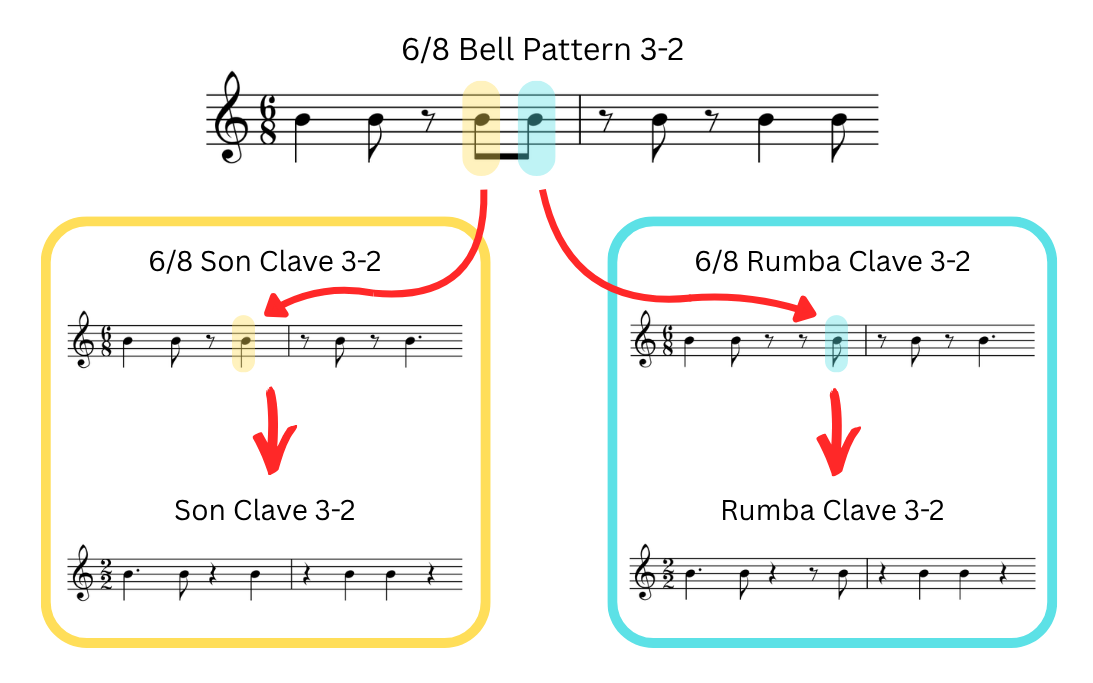
When looking at the enslaved African nations present in Cuba, their music shared a common characteristic: a two-bar cycle which was orientated by a guiding bell pattern. Regardless of which rhythm was used, most bell patterns made use of two unique bars so that the musicians could tell exactly where they were in the cycle, similar to a metronome in Western music. For many of the earlier Afro-Cuban folkloric styles the preferred option was the 6/8 bell pattern, but as Cuban music went through the binarization process transforming popular ternary time signatures to duple meters like 2/4, the 6/8 bell pattern was adapted into two unique rhythms. Some say this process began prior to the creation of rumba as there is evidence in Abakuá ceremonies of one of these rhythms, but it was in rumba that they became a critical part of Cuban music. Thanks to the inclusion of the clavijas into the rumba ensemble, the two new bell patterns were assigned to the instrument and it's likely due to this association that we now refer to both of the rhythms by the term clave. Although these days we use terms like “rumba clave” and “son clave” to differentiate the two rhythms, both were originally found in rumba and the names themselves didn’t signify the specific style allocation of each rhythm. Today, rumba clave is more often associated with styles which draw more heavily from Afro-Cuban culture like conga de comparsa, songo, and timba, while son clave is used with styles such as mambo, cha-cha-chá, and son montuno. Regardless of which clave pattern is being used, they all operate the same way in guiding the music. As clave extends over two bars, we identify a given bar by the number of rhythms that take place, resulting in one bar being called the three side, and the other, the two side. What this leaves us with is four possible variations: 2-3 Son, 3-2 Son, 2-3 Rumba, and 3-2 Rumba.
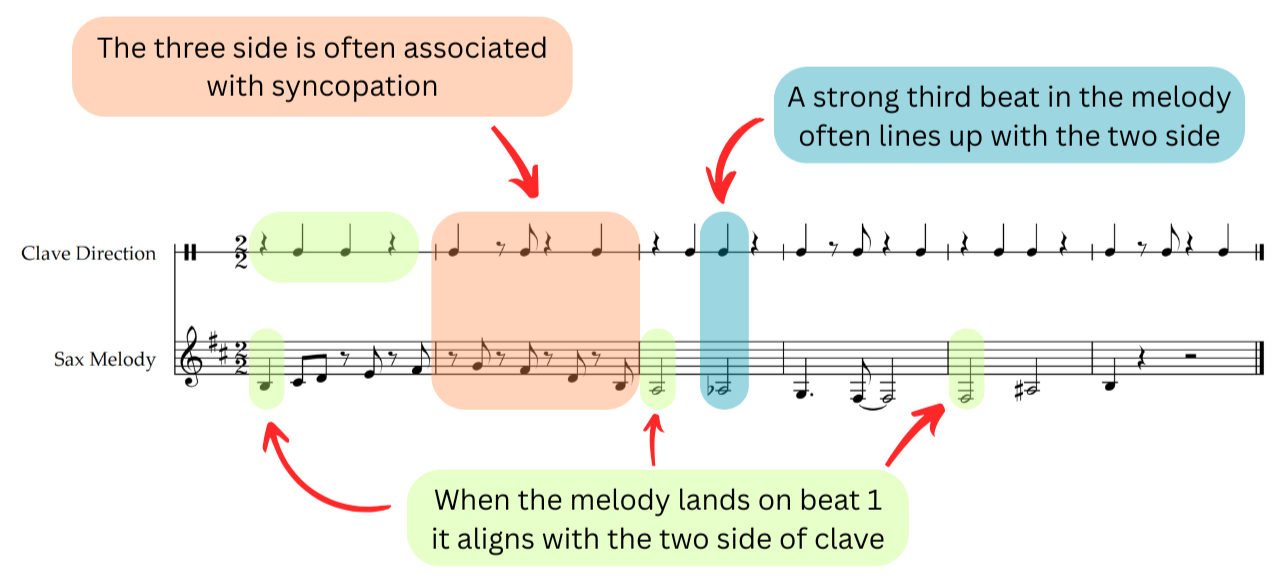
In general, the clave direction is defined by the melody, and once decided upon, is played in the same orientation throughout a whole piece. But that fact alone isn’t all that helpful if you have no clue what about the melody indicates the clave direction. Unfortunately, this is a skill which comes with prolonged exposure to the music. With that being said, there are a few general rules that can help put you on the right track but please note that many exceptions exist so the specific examples you are interested in may not follow these points exactly.
Melodies which start on beat one often are aligned with the two side
If the third beat of a given bar is emphasized it is often aligned with the two side
The two side is often associated with down beats whereas the three side is commonly more syncopated
Yo Soy La Rumba
As Performed By Machito & His Afro-Cubans
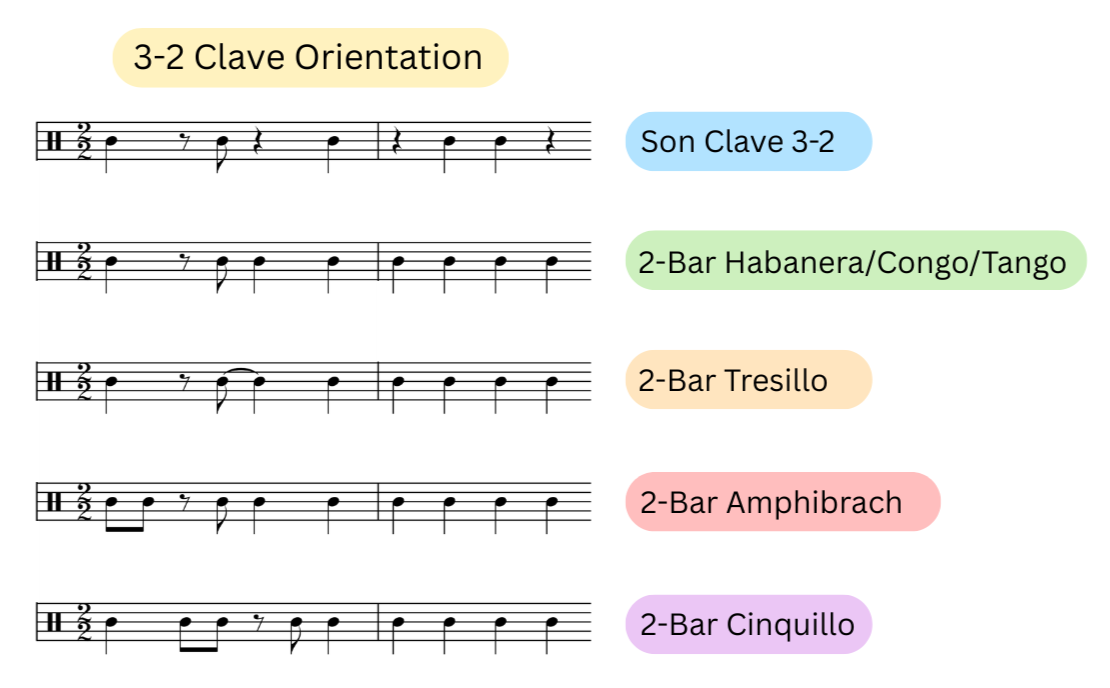
Outside of the melody, many of the various rhythm section parts can also imply clave direction with the most obvious being the claves as they play the rhythm verbatim. However, the presence of the claves is not necessary for clave direction to be implied and in many recordings the claves are actually omitted completely. As mentioned earlier, over time you will start to associate certain rhythms with clave directions which will help you work out the orientation of a given part. Personally, when I was starting out I found this much easier than following the melody and relied predominantly on a few popular percussion rhythms to help indicate the clave orientation for a certain piece. Looking back at the previous resource on danzón, we already know of a few two-bar rhythms that can help us identify clave direction. While these are not all that popular in modern percussion parts, they do still help us with certain styles such as contradanza, danza, and danzón, and offer a fantastic starting point for our list of reference rhythms.
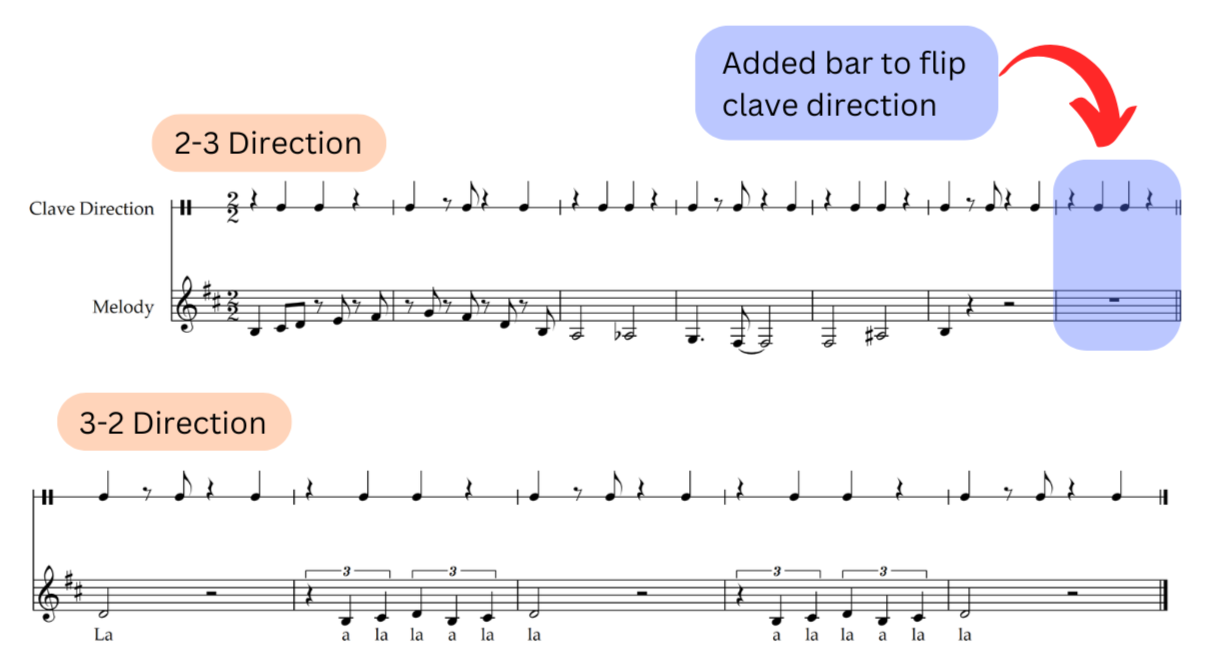
Another staple rule with clave is that one must never flip the direction or play cross-clave, that is, play a rhythm which implies the two side over the three side and vice versa. In the instance where a new section of a piece needs to change orientation, a singular bar can be added or subtracted to the form to allow for the clave to be reorientated naturally. On first impression this might make you think that the piece would feel unnatural, I at least did, but due to the strength of the two-bar cycle, in most cases it is barely even noticeable.
Yo Soy La Rumba
As Performed By Machito & His Afro-Cubans
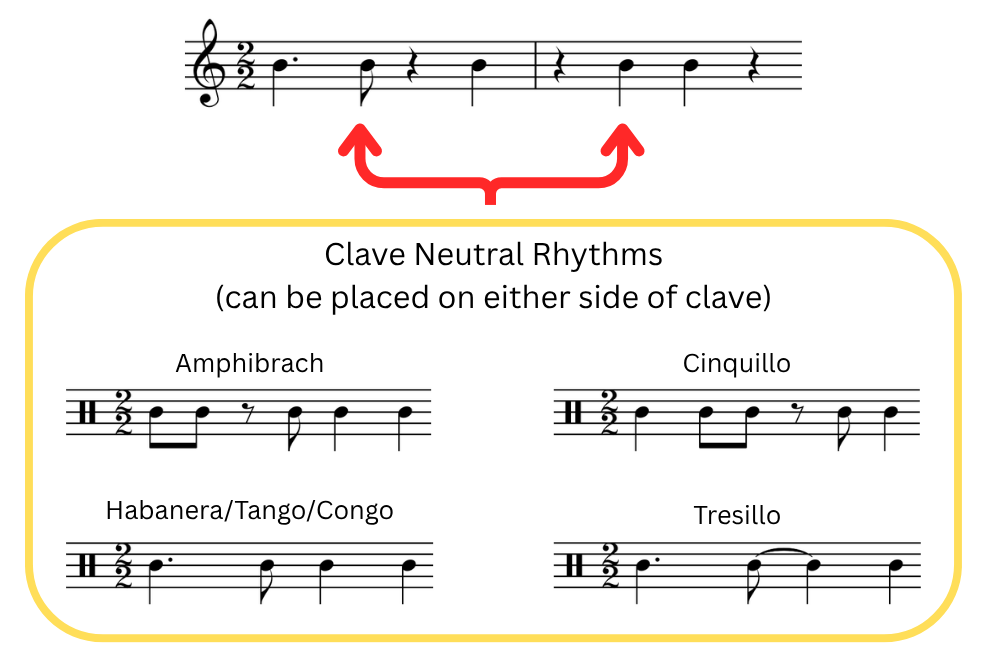
Although we have focused on implying clave direction, there are also rhythms which are considered clave neutral and can be used on either side of the cycle. Just like the two-bar rhythms, over time you’ll pick up a considerable list of neutral rhythms to add to your collection and through our exploration of danzón in the previous resource, we’ve already encountered four such rhythms: the habanera/tango/conga, tresillo, cinquillo, and amphibrach. These particular rhythms were a godsend for me early on as I knew I could put them in whatever orientation and they would work no matter what.
Hopefully with that brief explanation clave and clave direction make a little bit more sense. It definitely is a confusing topic if you’ve come from a background with no exposure to this sort of music, and even then it can be hard to explain in terms that are actually relatable. Thankfully, Mario Bauzá paved the way for us in the mid 20th century when he started integrating Cuban music with jazz and had to teach Western musicians about clave direction. This particular section is based on his method, specifically the idea of labelling clave direction with a two and three side. With that in mind, it’s time to start seeing clave in the original context of rumba!
Rumba
Rumba emerged in Cuba in the second half of the 19th century with multiple variations of the style being created in the Havana and Matanzas areas. Unfortunately, many of these have been lost with time but luckily there are some historical accounts that provide a brief glimpse into some of them.
El Papalote - where dancers imitated the movement of a kite
Mama Buela - where a male dancer acted as a little boy who didn’t want to go to school and was scolded by a female dancer who imitated his grandmother
A Caballo - where the dancers mimicked the movements of a horse
Lala No Save Acer Na - where the male dancer tried to teach the female dancer how to do household chores
In the last century these early variations have all been forgotten, but three still remain and are now the prominent versions associated with the style. Before we discuss the specifics of yambú, guaguancó, and columbia though, let’s first have a look at the common characteristics shared by all three.
Instrumentation & Roles
All rumba ensembles are made up of the same core instrumentation, with each instrument being assigned to a similar role across the three variations of the style.
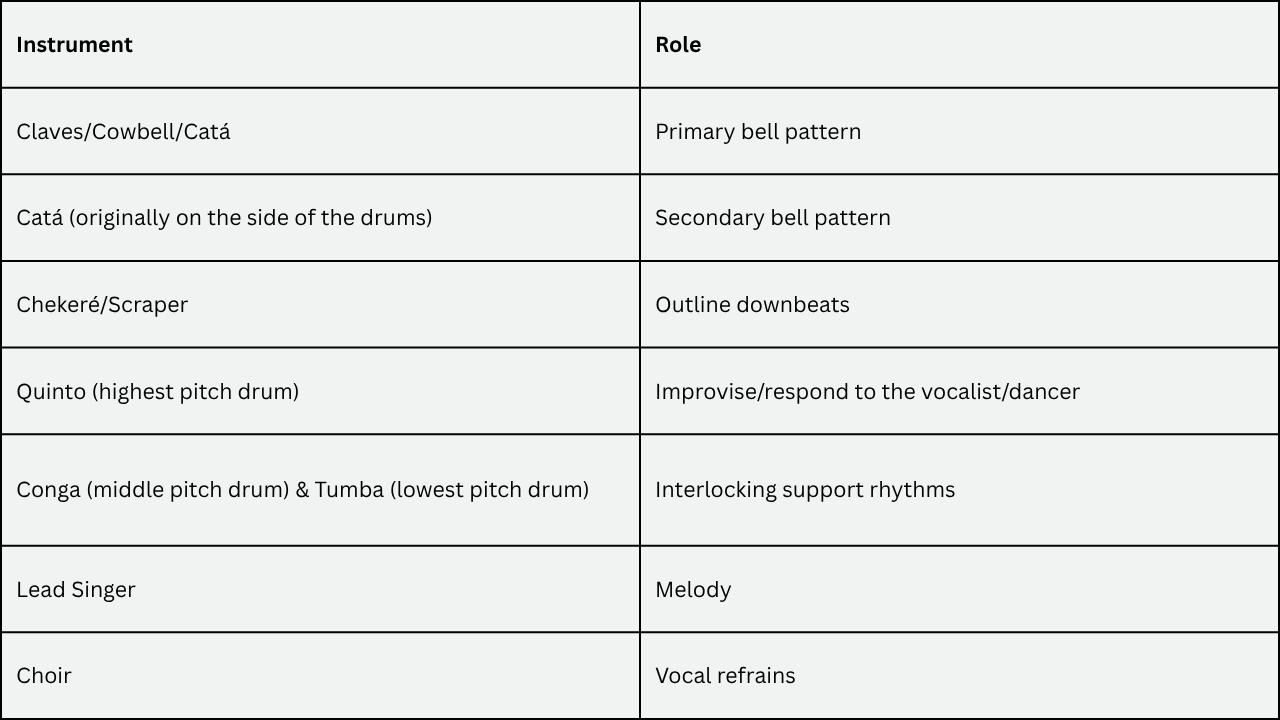
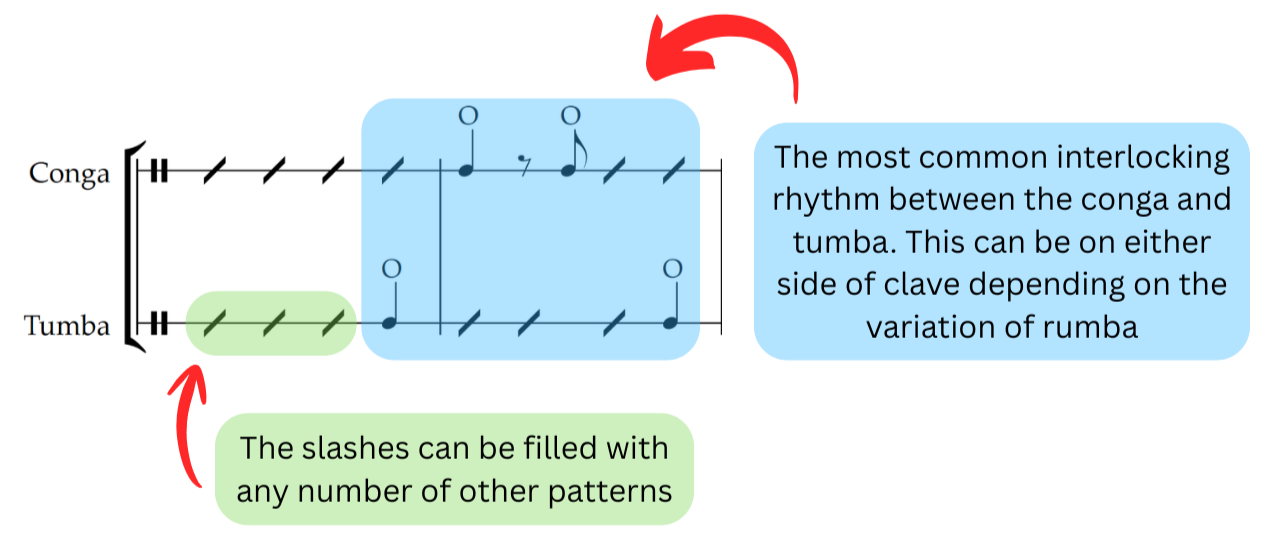
Somewhere in the transition between the Afro-Cuban folkloric styles and the creation of rumba, the roles of the drums were reversed. Instead of the lowest drum improvising, now the highest drum was responsible for interacting with the dancer and/or vocalist. The other two drums maintained the same role and provided a set of interlocking rhythms, which developed into a singular rhythm over time.
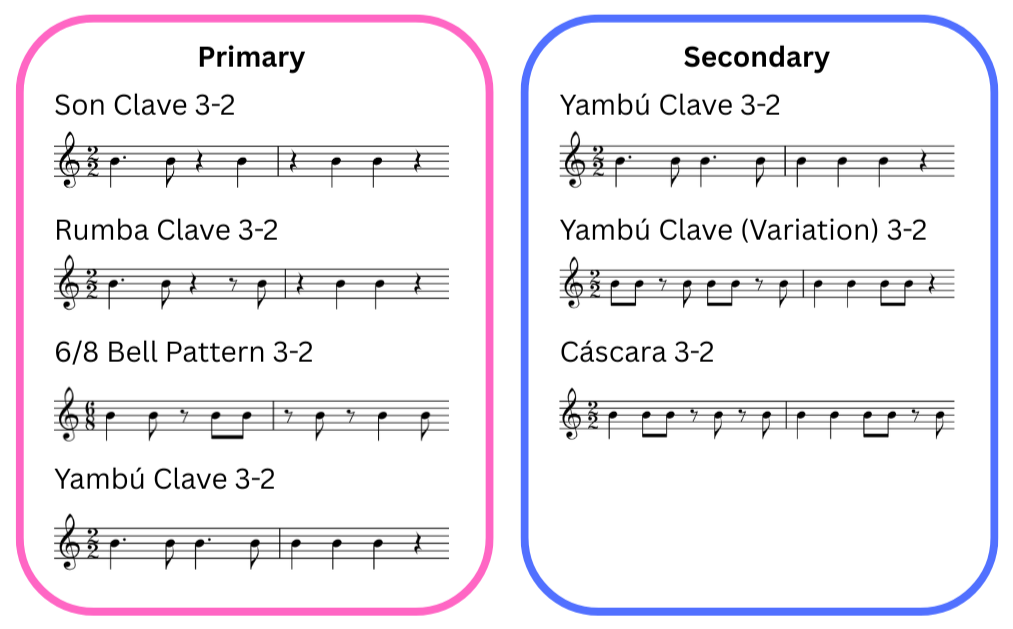
Turning to the bell patterns, there are many options available for both the primary and secondary parts. The four most common rhythms for the primary bell pattern include rumba clave, son clave, the 6/8 bell pattern (when the music is in a triple meter), and yambú clave. As for the secondary bell patterns, there are only two common options, the yambú clave and cáscara. So far we haven’t come across either of these last two rhythms in our exploration into rumba but as with the other bell patterns, both came from the many folkloric Afro-Cuban styles which fed into the style. Each of these five different bell patterns are also great additions to our list of clave orientated rhythms.
On top of the intricate layers of percussion are the vocals, divided into two components: the main singer and the choir, who are solely responsible for outlining both the melody and harmony in a piece. The main vocalist is tasked with establishing the key as well as improvising in the final section. In contrast, the choir sings refrains throughout the song, typically located after verses and in the final section where they respond to the improvisations of the lead singer. It is also common for the handheld percussion instruments, such as claves, chekerés, and scrapers, to be played by the vocalists.
Melody & Harmony
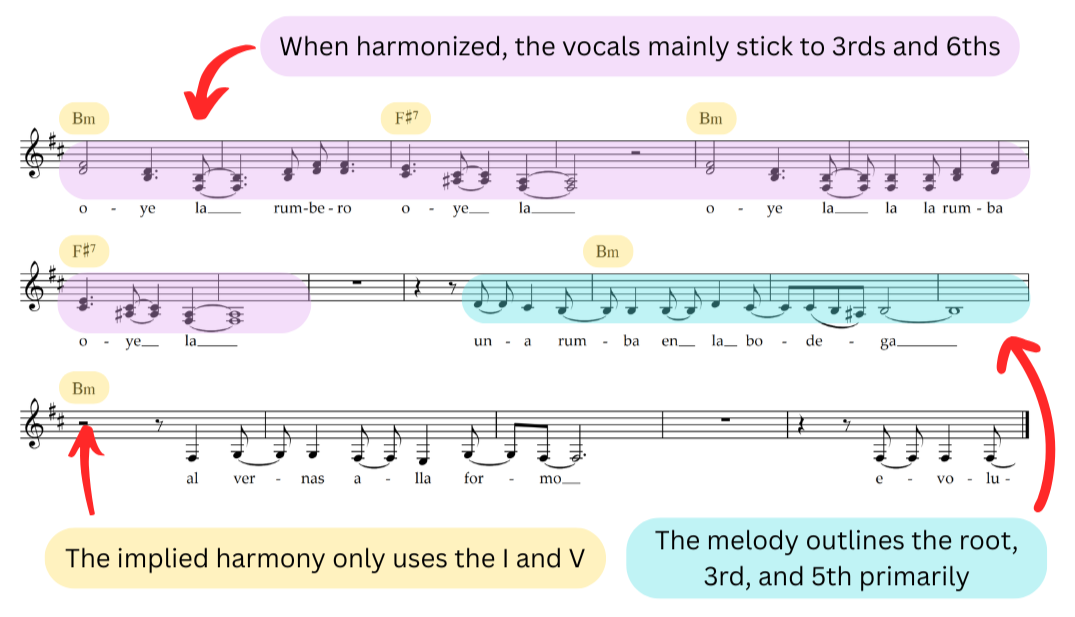
From a melodic standpoint, most rumbas are built around the major or minor scale and emphasize the root, 3rd, and 5th degree. Modulation is never used but chromaticism is sometimes present when approaching the 3rd and 5th degree of a triad. Harmonically, rumba also draws on early European conventions and only uses the I and V chords, which are outlined triadically in the vocal part. When a part is harmonized, almost always it is done using the interval of a 3rd or 6th.
Una Rumba en la Bodega
Alberto Zayas
Lyrics
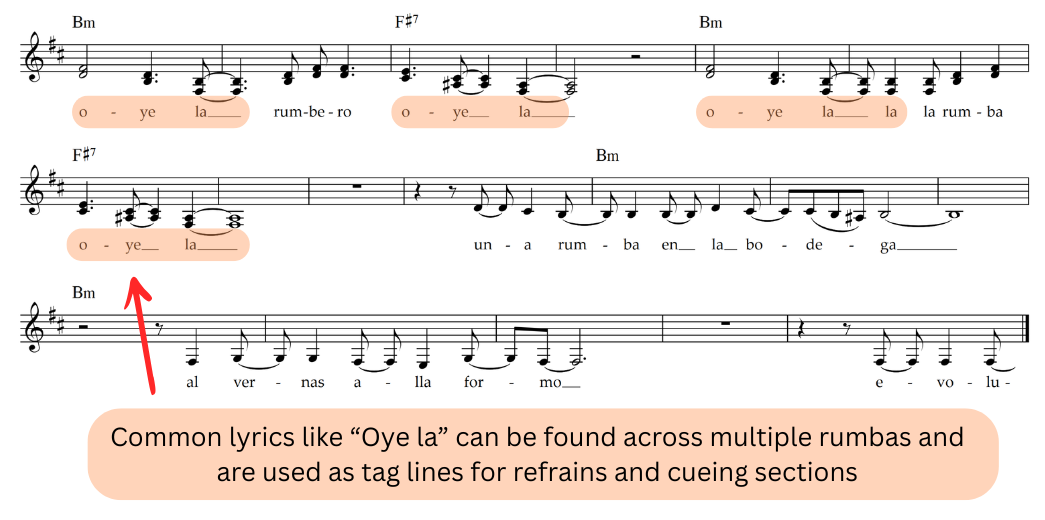
Lyrics play a key role in any rumba performance where they are used to cover a wide variety of topics which often relate to current events. For the most part they are in Spanish, with columbia occasionally making use of African-derived words. Certain phrases and tag lines are used by the lead singer to cue in the choir as well as provide markers to guide their improvisations such as "Que Bueno" and "Oye Lo." Much of the complexity of rumba comes from these improvisations which demonstrate the lyrical skill of the lead singer.
Una Rumba en la Bodega
Alberto Zayas
Form
Finally, the last characteristic to cover is form, which brings all of the previous elements together into a cohesive piece. Rumba can be broken down into three specific sections: La Diana, El Canto, and El Montuno (call and response). Each section follows a basic set of rules, however, individual groups may extend or reduce the duration of any one section to suit their needs. To begin a piece, the claves generally outline one full cycle to establish the tempo and in the second cycle are joined by the other percussion instruments. From this base, the first section of the piece, titled La Diana, is initiated by the lead vocalist, who sings various melodic fragments with gibberish lyrics to outline the overall key. Concluding the section is the first choral refrain which is cued by the lead singer providing a certain phrase or a related motif. In general, the refrain features parallel harmony in 3rds, 6ths, or octaves.
The second section, referred to as either the verse or El Canto, shares a similar contour where the lead singer takes the melody followed by a choral refrain. However, instead of singing random syllables, the lead vocalist uses strophic verses which follow common melodic conventions such as moving by step or triadically, minimal leaps, and sometimes making use of sequences. Choral refrains are interjected at the end of each verse, and in the case where the vocalist may opt for a non-strophic form, they are cued by specific phrases or taglines. Eventually, the lead singer signals for the ensemble to move on to the final section by establishing a simple phrase for the chorus to follow. From there the lead singer starts improvising and alternates either two, four, or eight bar phrases with the choir who repeat a single melodic idea. The overall tempo increases and the quinto is played more intensely, adding a new level of excitement to the music. Sometimes this final section is titled El Montuno, but to help provide contrast with later resources related to son and its associated styles, we will simply refer to it as the call and response section. To conclude a piece, the percussionists either stop playing or play a set of precomposed breaks called cierres that are cued by the quinto player.
Rumba is a complex style with many interweaving parts and a highly structured system of improvisation. Although there are only a few instruments involved, it represents a fusion of Afro-Cuban styles with different rhythms and influences coming from each of the African nations present in Cuba. Now that we’ve covered the core characteristics of the style, it is time to look at the three prominent variations by exploring the nuances and differences of each one. To begin with, let’s start with arguably the oldest variant, yambú.
Yambú
Yambú was one of the very first variations of rumba to appear and is believed to have been created in the 1870s with some historians even arguing that it may have been present earlier. As we will see with all three variations, yambú originated in the Havana and Matanzas area of Cuba, two prominent cities located on the west side of the island. This resulted in two flavors of the style being created, each with slight differences but also sharing a large overlap of similarities. Out of the three variations, yambú features the slowest tempo, landing at 66-88bpm. Due to its age, the variant was originally played on two cajones with one being the accompanying drum and the other the improvising quinto. Spoons were used to provide the bell pattern, and if a secondary pattern was added to the ensemble then the rhythm was played on either a bottle or the side of a cajon with a spoon.
The form of yambú has the same three distinct sections as mentioned earlier but with a few subtle differences. Of course, the lengths of each section may change between different songs, but often traditional yambú features a long initial La Diana, followed by a short choral refrain. The El Canto is typically made up of two decima forms and is followed by another long La Diana with a short choral refrain before finally moving to the call and response section. Additionally, the dancers only join in once the piece has reached the final section. Yambús also make use of similar tag lines to cue the choral refrains, such as the phrase “Que Bueno” or “Que Bueno e,” as well as “Oye Lo.”
Accompanying the music is a specific type of couples dance which resembles the Congolese yuka. Regardless of the age of the dancers, the movements mimic those of an older couple and are overly sensual compared to the sexual nature of other rumbas. The woman has the primary role and can use a handkerchief as a prop, with the man dancing respectfully toward the woman as well as moving slowly, bent over, and having wobbly knees. It is also common for the man to use a cane as a prop and to receive assistance from the woman. Generally, the dance concludes with the man putting his hands on the woman’s shoulders, leading them back to the crowd.
Yambú (Havana)
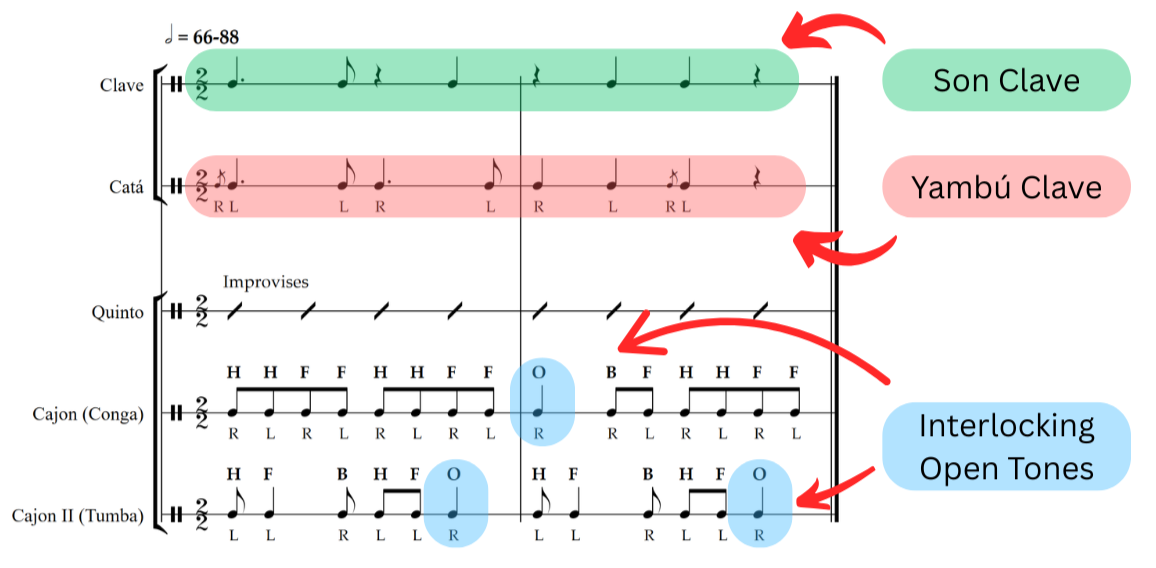
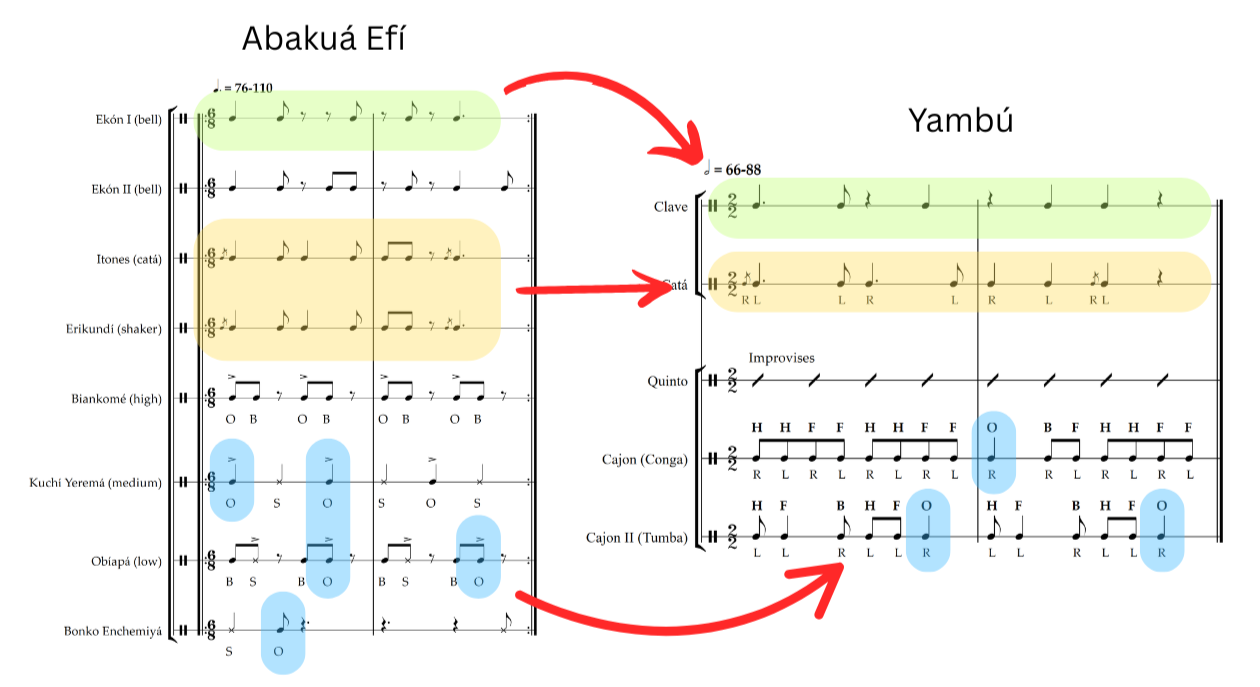
Taking a closer look at this particular example of yambú from Havana, there are a few key features to be aware of. Firstly, the bell patterns being used are the son clave and yambú clave, and the open tone motif is present in the two interlocking drum parts, albeit somewhat hidden amongst the other rhythms. But we can go one step further and connect some of the rhythms being used to certain Afro-Cuban folkloric styles. Both the bell patterns and overlapping open tones on the drums are present across many different Afro-Cuban cultures, but it just so happens that all of these just happen to appear together in certain Abakuá Efí ceremonies.
Yambú (Matanzas)
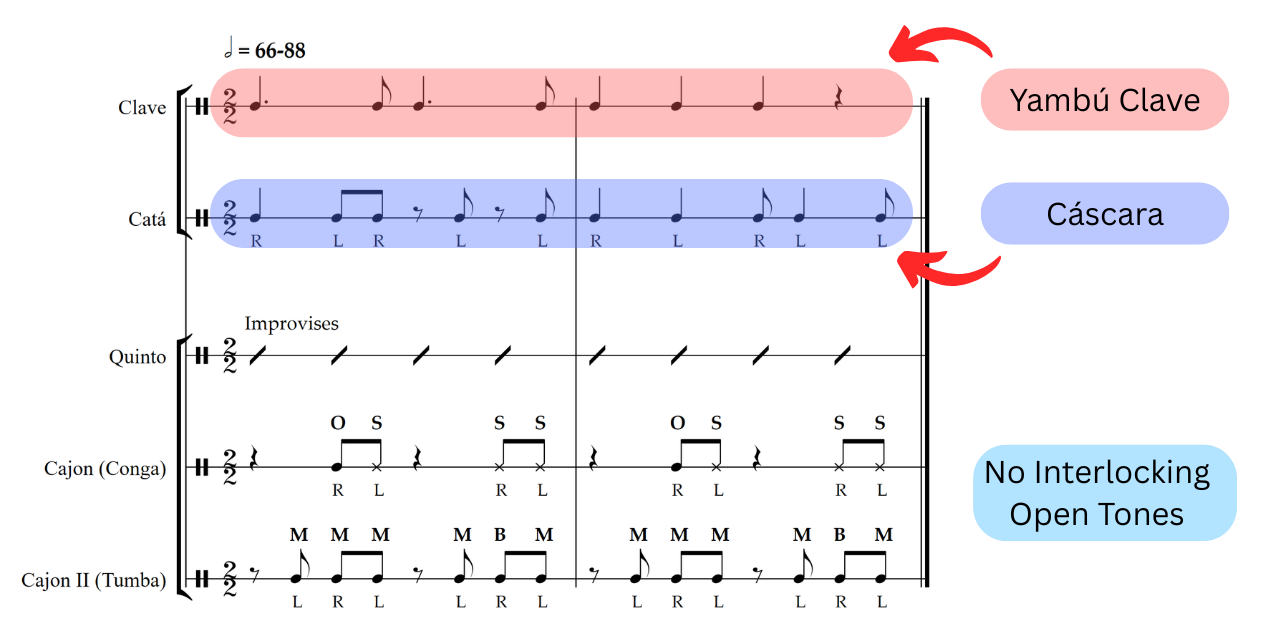
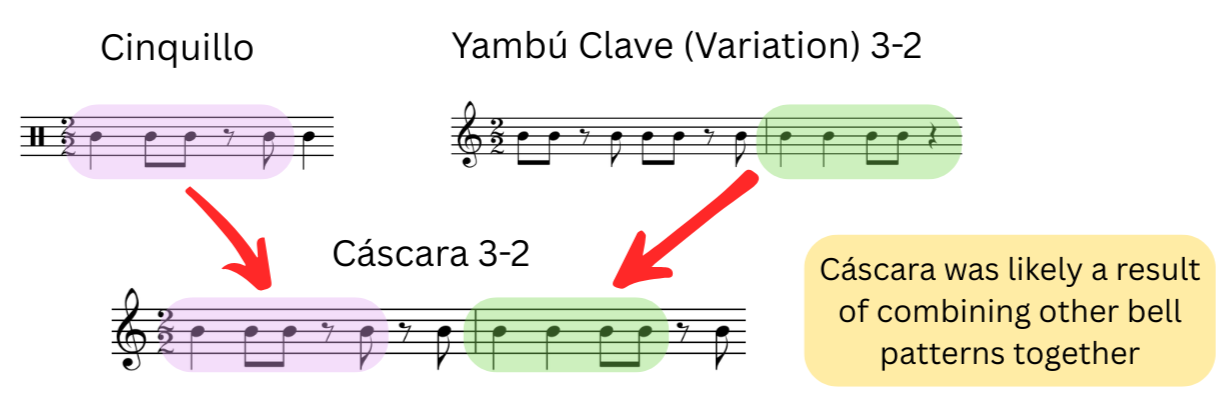
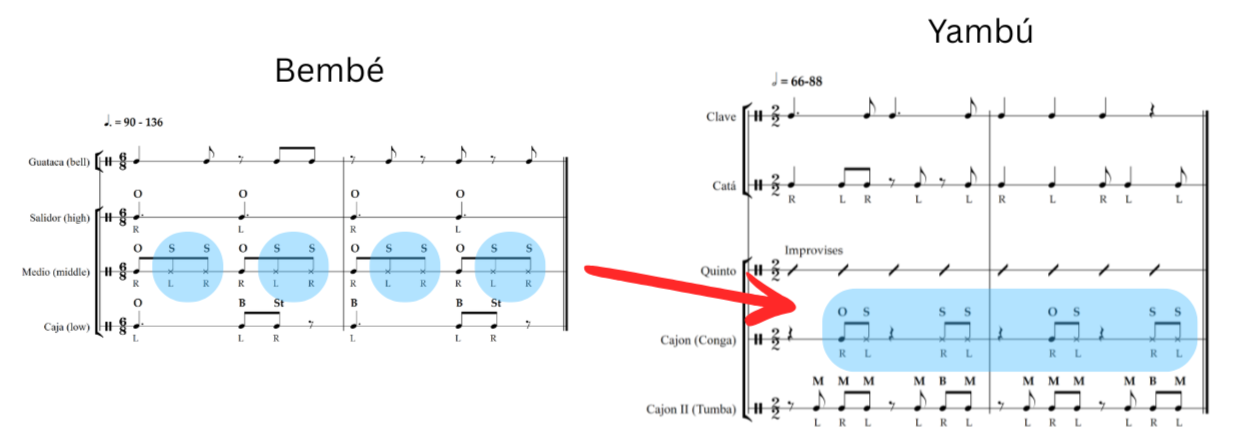
In contrast, this particular example of yambú from Matanzas features a different pair of bell patterns, combining the yambú clave with cáscara. Looking at the cajones, the open tone motif is not present and is instead replaced with two unique parts while the quinto improvises. Unlike the other variation, it is slightly more difficult to trace back all of the rhythms to certain Afro-Cuban styles with this example. The history of cáscara is unfortunately somewhat vague prior to the formation of rumba but based on the rhythm itself, it looks to be a combination of the cinquillo cell with any number of other bell patterns, likely being created as a fusion between certain Afro-Cuban rhythms. On the other hand, the cajon parts are likely derived from a number of different locations, with one example being the Yoruban bembé.
As you can see, yambú is full of links to the enslaved African nations that were brought to Cuba and helps showcase a natural evolution of their cultures into a combined Afro-Cuban identity. While yambú is likely to have been the earliest variant of rumba, over time it became faster and developed into a different sound altogether. So much so that we call this offshoot by a new name: guaguancó.
Guaguancó
Arriving in Cuba slightly later than yambú, guaguancó is believed to have emerged around 1880 in the Matanzas region but is most commonly associated with the turn of the century when it was a common style in both Havana and Matanzas. Like yambú, it started off with a simple instrumentation of cajones and spoons, but quickly picked up the conga drums (tumbadoras) and established the instrument as the primary drums for every variant of rumba. It is considerably faster than yambú, sitting anywhere between 80-140bpm, but still features many of the same qualities and rhythms of the previous variation.
Guaguancó took the couples dance element a step further, creating a more energetic style which was designed for younger people. The dance revolves around a particular movement called the vacunao, where the man uses a sudden symbolic gesture of possession at the woman’s genitals. The action itself could be a kick or a pelvic thrust as well as several other movements. In response, the woman protects her body in a motion called the botao, reacting with an action in a similar manner to the man’s attack. Both partners typically use handkerchiefs as props, with red being associated with men and yellow for women. The dance concludes once the man successfully catches the woman off guard and they leave the dancefloor arm in arm. Throughout the whole process, the quinto player is also watching the man and tries to pre-empt the vacunao in their improvisation, a skill which takes years to master and requires the quinto player to be ready at a moment’s notice. The element of the couples dance present in both yambú and guaguancó has its roots in many African cultures, specifically in the fertility dances we discussed in another resource. Although it is often seen as overtly sexual through a Western perspective, the dance itself represents the beauty of fertility in worldly areas such as harvesting crops as well as the beauty of new life.
While guaguancó does share many traits with yambú, they do have many differences such as form. The La Diana is much shorter and may feature an expressive poem that doesn’t rhyme, and the El Canto still usually contains two decimas but features another poem that doesn’t. However, the final section is very similar and choral refrains are spread throughout all three sections. Other differences found include its preference for rumba clave compared to the son clave found in yambú, as well as the flexibility to move the open tone motive on the supporting drums to either side of the clave cycle. If the rhythm lands on the 3 side it feels in-line with clave and is a characteristic of earlier guaguancós. Whereas if the rhythm lands on the 2 side it creates a nice level of syncopation which has become the norm over time.
Guaguancó (Havana)
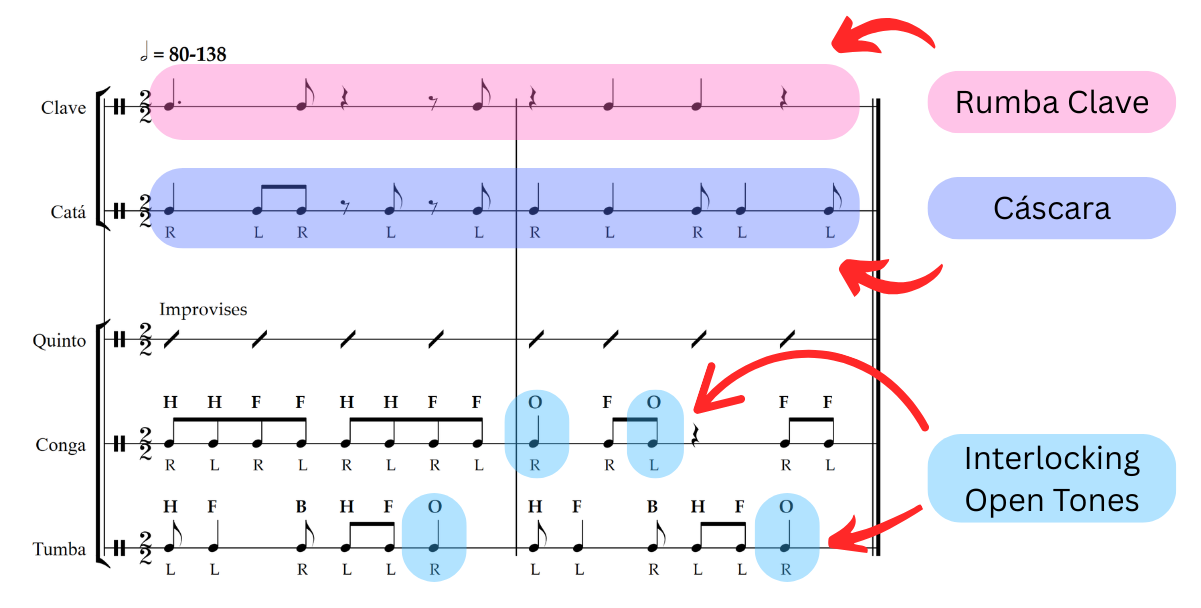
As we mentioned with yambú, two flavors exist for each variant of rumba, one being associated with Matanzas and the other with Havana. In the latter, the primary bell pattern is the rumba clave, with the secondary rhythm either being omitted or playing the yambú clave or cáscara. There are many different options for the supporting drums, but originally the conga and tumba part shared similar rhythms to what we saw in the yambú of Havana. Even though the two parts have developed into many different rhythms over time, they still maintain the open tone phrase which is now considered a major trait of guaguancó. As always, the quinto part improvises.
Guaguancó (Matanzas)
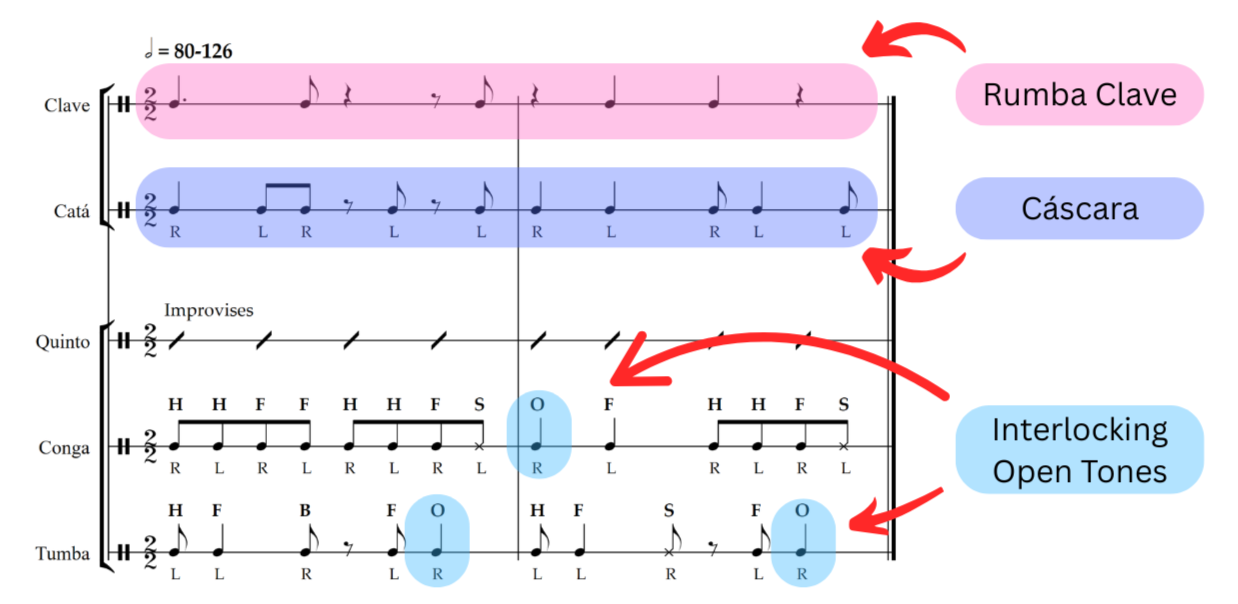
Moving on to the Matanzas variant, there is one major difference found in the open tone phrase between the tumba and conga. Unlike what we have seen before, the open tone on the and of two is omitted from the tumba part, creating a slight change to the overall feel. Similarly, to the Havana version of the style, both the supporting drums have many variations, and the bell patterns remain the same. Due to all of the parts being quite similar to yambú from Havana, the brief analysis of Afro-Cuban styles we did earlier is maintained for both the Havana and Matanzas versions of guaguancó.
Today guaguancó is considered the most popular style of rumba with many interpretations being found across Cuba. The brief examples we have covered represent only the tip of the iceberg and I challenge you to find other excerpts and compare the different characteristics. Alongside both yambú and guaguancó is columbia, one of the most challenging variations and the perfect style to finish off with.
Columbia
Unlike the previous two versions of rumba, columbia introduces many new characteristics from the dance to the music, and even what language the lyrics use. It is a unique style that is thought to have been created in the 1880s, with many believing that it actually emerged prior to yambú. Instead of being a couples dance, columbia features a single dancer who uses props such as a machete or knife. It is a highly virtuosic style of dance which draws on a large range of influences from Flamenco, Congolese, Abakuá, Tumba Francesa, and Yoruba traditions among others. The origin of the dance is believed to have come from an earlier ceremony called maní which was likely linked to the Ganga or Kongo people of Africa. Maní was similar to a king of the hill style game where men stood in a circle with a single person in the centre who would strike outward to defend their position. If the person chosen did not fall, they would replace the man in the middle and the game would continue until only one person remained. The dance was brutal and there are accounts of participants breaking bones, losing teeth and even eyes. This level of danger transferred to the most talented of columbia dancers such as Malanga, who would involve death defying stunts with blades while dancing.
On top of introducing several unique characteristics to rumba, columbia also breaks from some of the fundamental traits of the style. One such example is in the tonality of the melody. Instead of using a diatonic major or minor scale, columbia opts for a hexatonic scale with less emphasis on triadic movement and highlights the tonic and dominant pitches. In the same way yambú and guaguancó use chromaticism, sometimes a 7th is added to the six-note scale to allow for further embellishment by the vocalist. Another difference comes from the taglines used by the vocalist to cue in the choral refrains. Typically, these are short phrases built off of two or three syllables, but in columbia they are much longer. Not to mention that some lyrics are in African dialects alongside Spanish, giving the style a unique vocal sound.
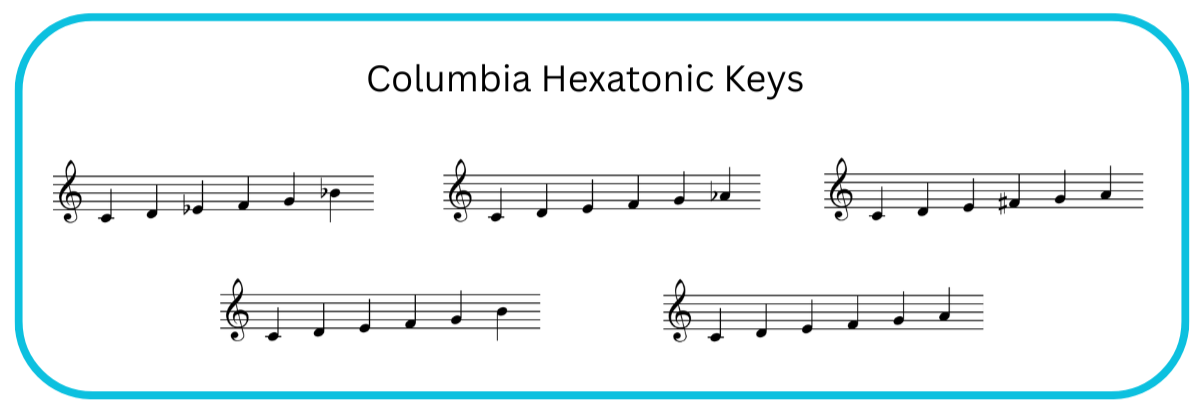
Columbia shares the same form structure as the other two variations of rumba but as we have seen with both yambú and guaguancó, features slightly different lengths for each section. The La Diana is quite long, uses words instead of nonsense syllables, and is finished with a choral refrain which leads the piece into an El Canto section comprised of four decimas. After another choral refrain the lead singer makes a long “Ahhhhh” sound which ushers in the final call and response section. Unlike other rumbas, the lyrics usually refer to various deities from Afro-Cuban religions and may feature words in those languages.
Columbia (Havana)
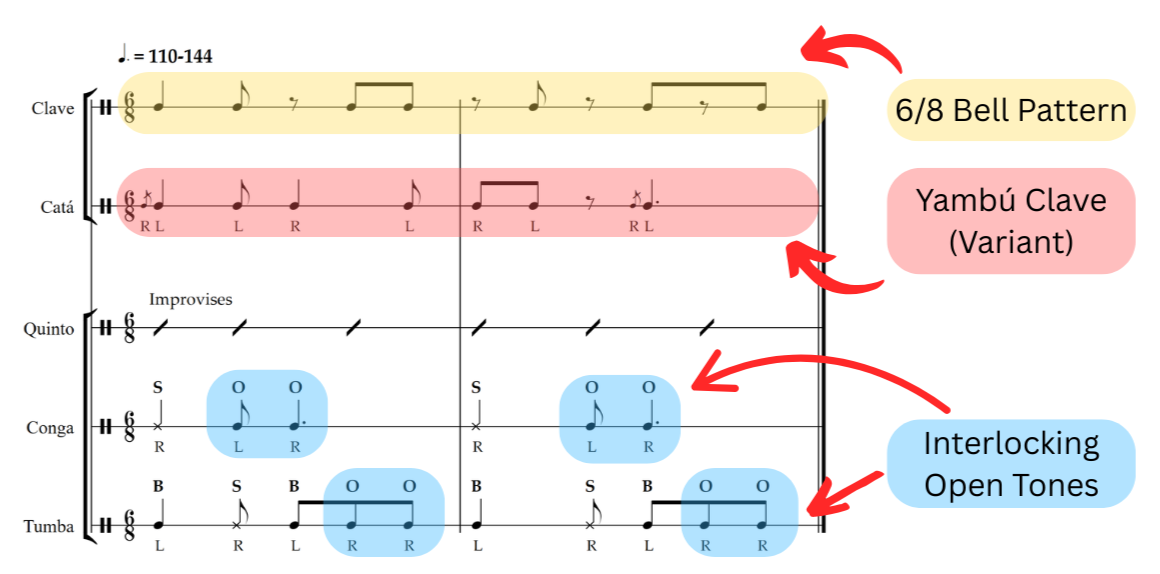
Moving on to the instrumental parts of columbia, the main contrast to the prior styles is that both the Havana and Matanzas variants are primarily in 6/8. In Havana, the 6/8 bell pattern is used alongside a 6/8 variation of the yambú clave. The two supporting drums still play a phrase of open tones but with a slightly altered rhythm. Many of these characteristics can be linked with earlier folkloric Afro-Cuban styles with the bell patterns sharing similarities to Abakuá ceremonies, while components of each of the drum parts can be found across all of the Afro-Cuban cultures.
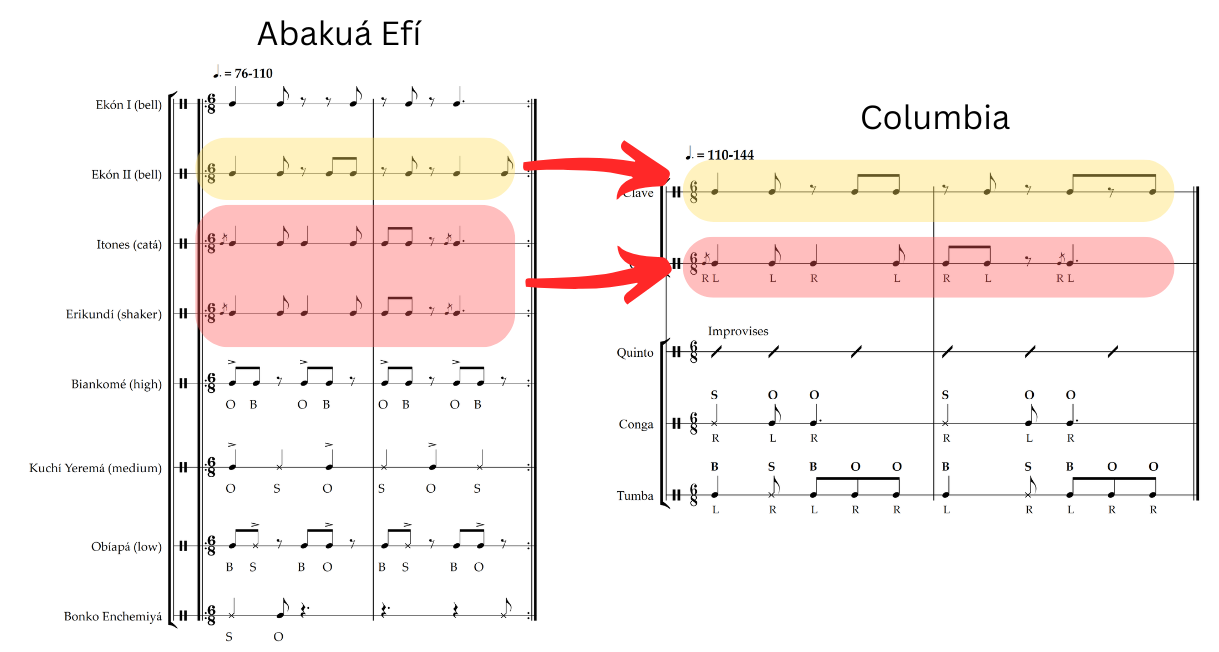
Columbia (Matanzas)
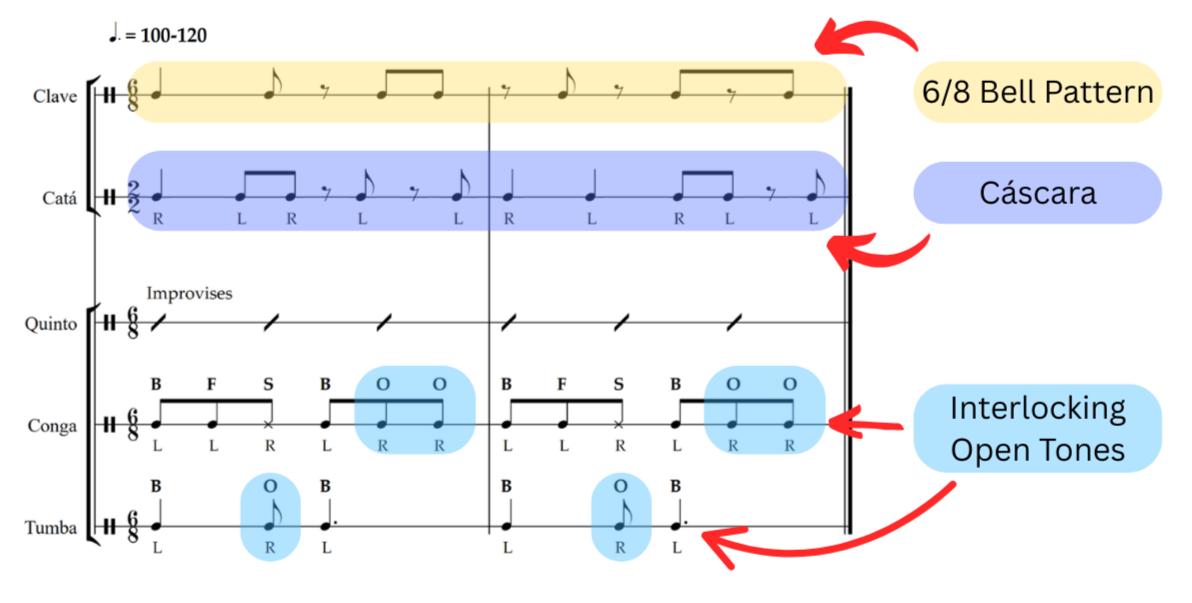
Looking at the Matanzas variant, we can see many similarities to the Havana version but with one major difference. The secondary bell pattern outlines either the yambú clave or cáscara in duple time while the rest of the ensemble plays in 6/8. This puts to the forefront one of the major African traits in Cuban music: polyrhythm. While this particular example has been chosen because it makes use of polyrhythm, it is a characteristic that is inherent to all Afro-Cuban music and not something that is unique to just one specific variation of rumba. Depending on the performers, polyrhythm could be used in all of the examples we have looked at so far and shouldn’t be only associated with columbia. One of the interesting elements about how polyrhythm is performed in Afro-Cuban music is that rhythms can be placed somewhat flexibly to avoid clashes. What I mean by this is that the polyrhythmic lines aren’t rigid and the musicians are allowed some leeway to make micro adjustments in order for rhythms to fit with the rest of the ensemble. As a result, the overall music is not quite in duple or triple time but somewhere in between, allowing all of the patterns to work together in harmony.
And with that, we have now looked at each of the three popular variations of rumba. However, there is one area that we haven’t really unpacked, a component to rumba that is quite complicated and is best kept to last now that we are familiar with the sound of the style. You’ll likely have noticed that in each example the quinto part has simply said “improvise,” with no more detail given. That’s because there is an entire vocabulary and system to improvisation in rumba, one which is comparable to the scope found in jazz. While it is simply not possible to do this topic justice in a singular section of a resource such as this, it is a significant component of rumba and must be explored to some degree.
Improvisation
Improvisation within the context of rumba is a complex system which has gone on to influence how conga players solo across multiple styles in Cuban music. Although I have been drawing attention to how the quinto improvises in a rumba ensemble up until now, improvisation can be found in a number of places such as with the lead singer as well as with the other instruments. The main difference is that only the quinto and lead singer have a large amount of freedom in their solos, whereas the supportive drum parts embellish their set rhythms and try to avoid playing on top of each other. How this plays out typically is that the tumba reacts to the quinto and in some instances a secondary reaction then comes from the conga. In almost all cases, this interaction lasts only a second or two and can feel quite subtle.
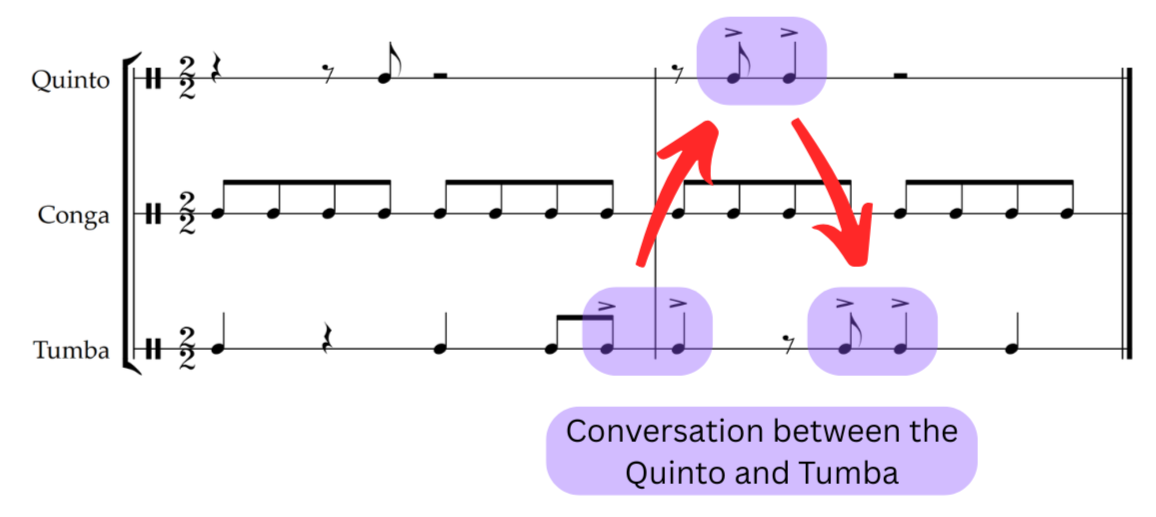
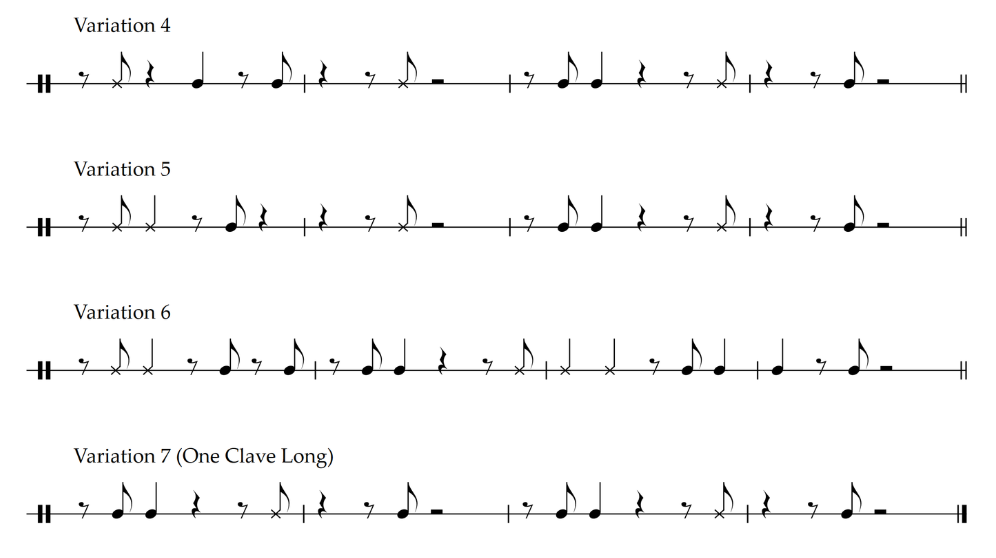
When looking at quinto solos, phrases can be broken into two categories which we will call rides and riffs thanks to the methodology of author Alex Hines (someone who has had a tremendous influence when putting this particular section together). A ride is a two to four bar phrase used as a timekeeping device between sections of improvisation, where the main accents of the pattern land in the gaps of the other supporting drums, creating a highly rhythmic conversation between all three instruments. They can also be used when the quintero simply wants to play time and avoid intruding on other members of the ensemble. A riff, however, is a soloistic phrase where a rhythmic cell is played in an improvisatory manner similar to how a horn player may use a certain scale sound to solo over in a jazz setting. Quinteros can group multiple riffs together to create phrases and often draw upon the traditional vocabulary of rumba to find inspiration when soloing. For someone to be a master of improvising in this style, they must weave flawlessly between riffs and rides while also following the arc of the piece and reacting to the dancers.
Like the three major forms of rumba, quinto improvisation is split into two categories, one associated with Matanzas and the other with Havana. In general, the Havana variant takes a more natural approach with a preference toward riffs, while the Matanzas variant is more structured and favors ride patterns in the La Diana and El Canto sections, with riffs in the call and response section. Breaking down the Matanzas style further, the rides are usually built on the rhythm of a displaced son clave pattern, where each accent naturally lands in a gap left by the ensemble. Using this cell, two notes are commonly omitted to form what is called the “bare-bones” ride, and from this rhythm comes many variations in ride patterns.
Quinto Ride Patterns
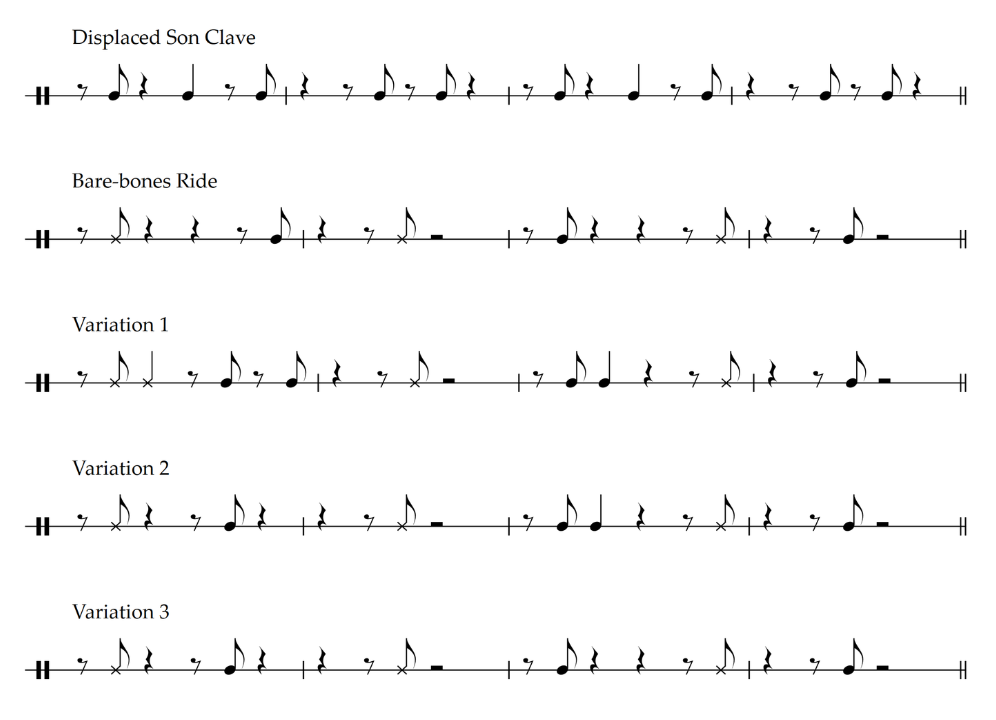
Quinto Riff Patterns
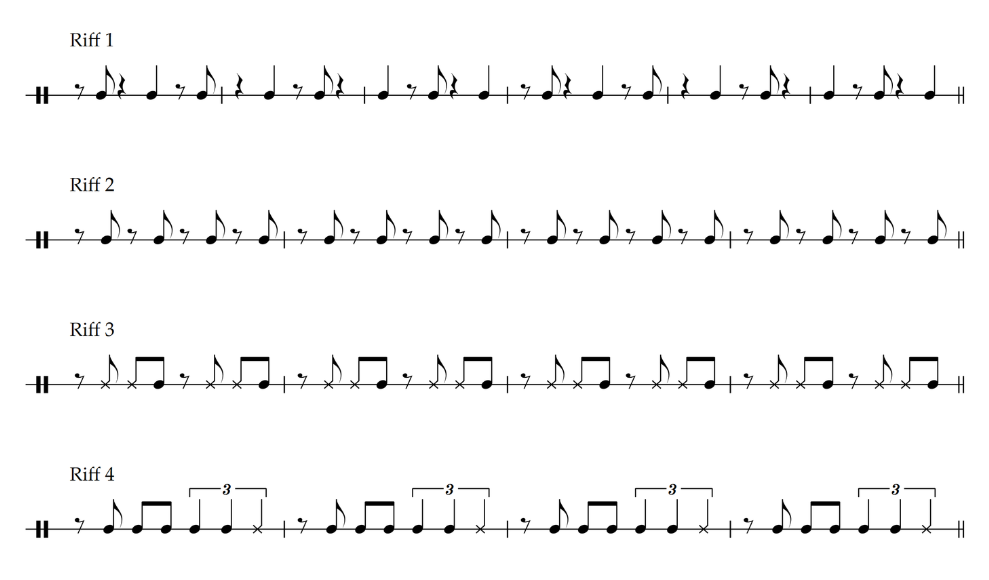
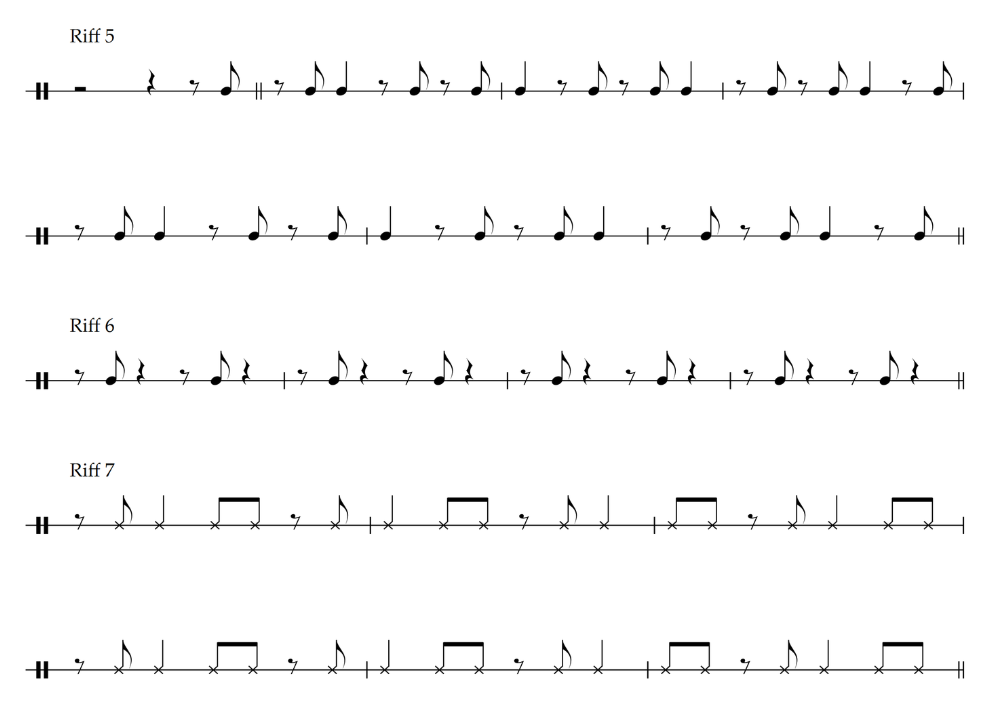
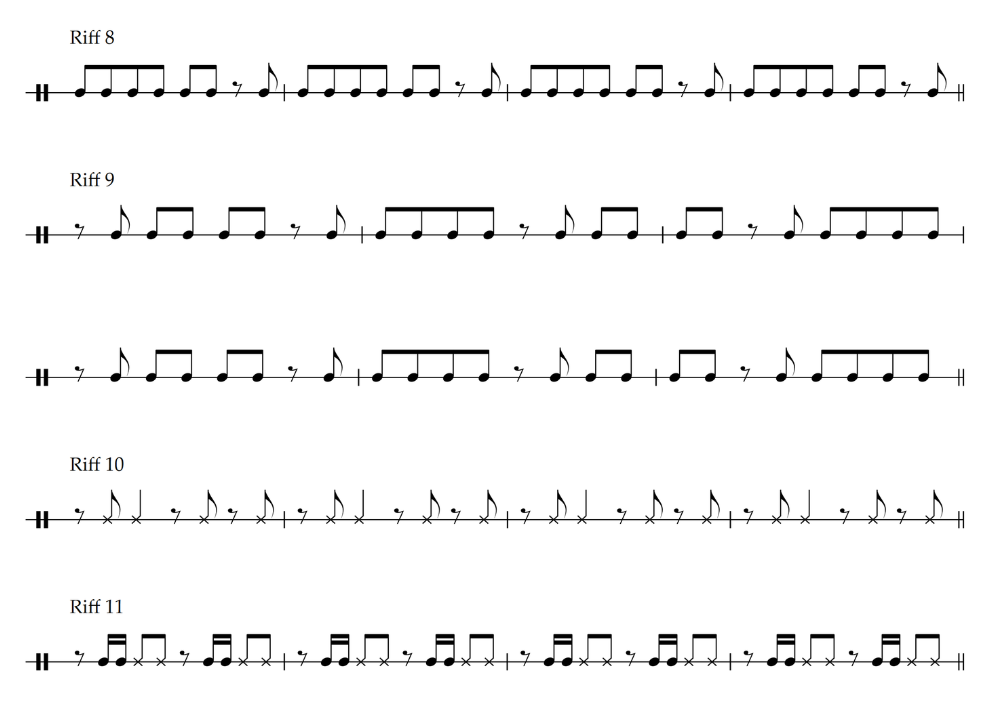
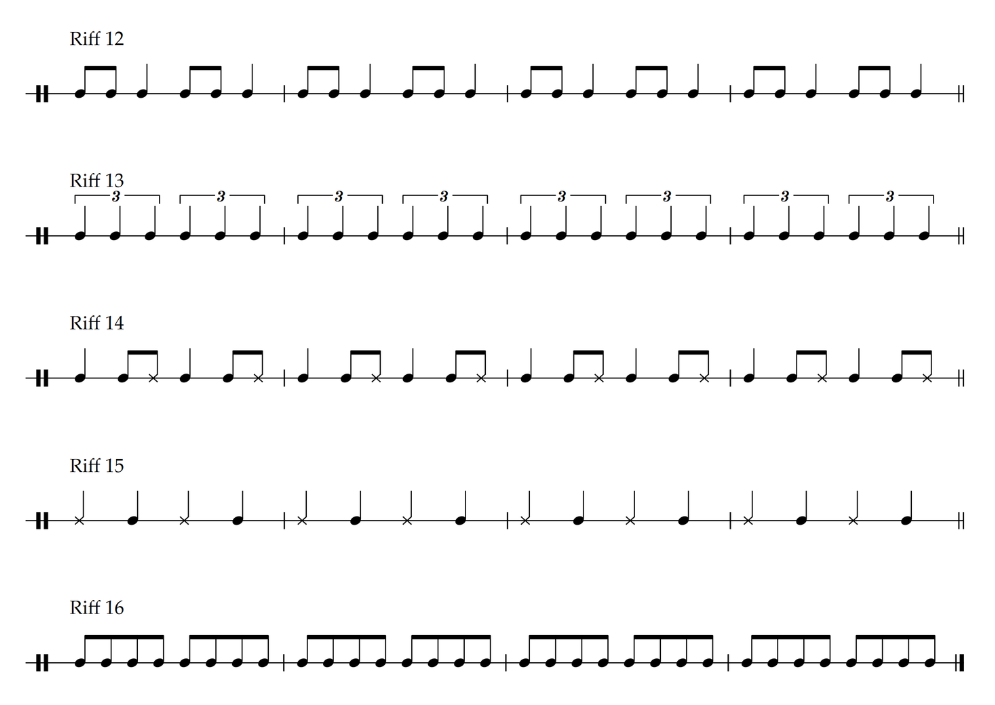
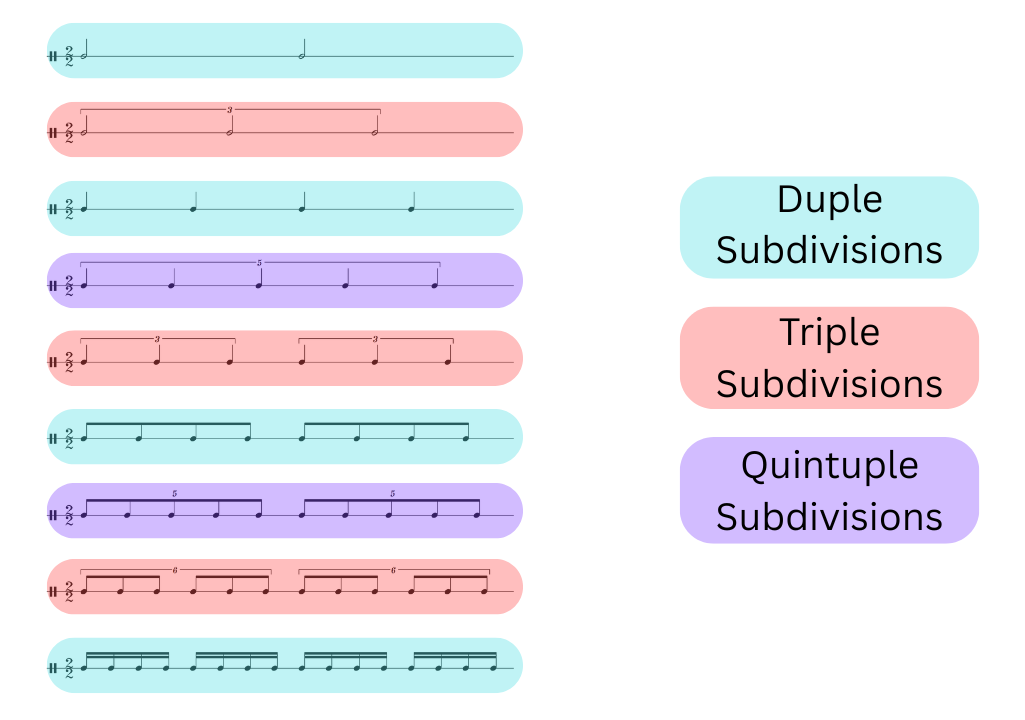
Typically, in rumba there is a quaver/eighth-note pulse felt throughout which forms a base level from which both the quintero and lead singer can improvise from. Most improvised phrases begin and finish at this level, with the musician being free to break from the quaver/eighth-note orientation in the middle of a phrase and explore various levels of subdivision. The most common being at the duple, triple, and quintuple levels. By moving from a quaver/eighth-note pattern into one of these levels and then concluding with another quaver/eighth-note based pattern, the improviser can create a fluid phrase which moves in and out of the common time feel and can pick up various degrees of tension.
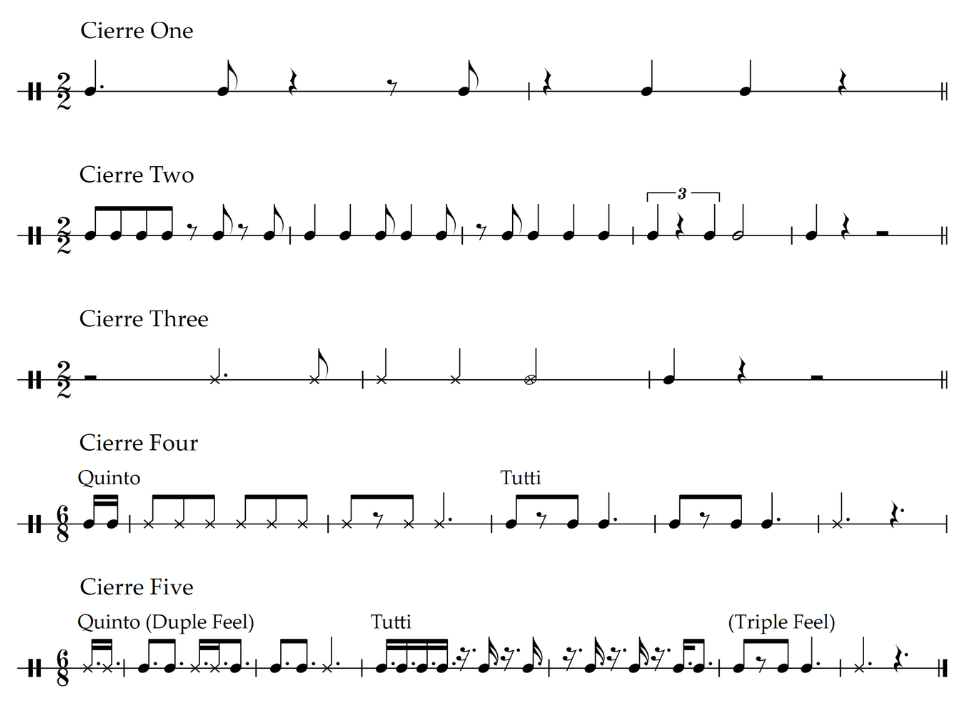
Finally, the quinto often cues the end of a piece by playing a pattern called a cierre. The closing pattern is found in two formats, one where all of the drums join the quinto immediately to play a two-bar rhythm which concludes the piece, or another where the quinto plays for two bars before the other drums join in. Both are common in rumba and it is dependent on the musicians as to which one they may choose.
Common Cierres
Improvisation is a complex layer in a style which is already made up of many influences and rules. It was created out of African traditions that evolved through Afro-Cuban fusion and has gone on to impact the improvisation styles of the congas, bongos, and timbales in all Cuban music. Although it may seem quite random to the untrained ear, by unpacking the tradition through certain techniques like riff and ride patterns, I hope that you can start to see just how intricate improvisation is in a rumba setting. I know that when I first came across this topic it blew my mind (and to be fair it still does) and as a major component of rumba it had to be included in this section albeit in a limited capacity. It also reveals a few other rhythms that can be added to our clave orientated list too!
Rumba is a tremendous Cuban style, one which never really received the limelight in Cuba due to the strict anti Afro-Cuban laws which came into effect after slavery was abolished, resulting in the first recordings being made close to 70 years after the initial formation of the style. As we have seen time and time again, the style itself features so many different layers of complexity and must be respected to the same degree as its Western music counterparts. We must also remember that it came out of the poorest and most discriminated people in Cuba who couldn’t even afford to buy an instrument, demonstrating the resilience of the Afro-Cuban people and reminding us that beauty can be found in all places. Hopefully through this exploration you’ve also been able to better understand clave, seeing how it came into existence, how it operates in a number of different places, and have gathered a few clave orientated rhythms along the way that you can start incorporating in your own writing!
The Takeaway
There is quite a large learning curve when it comes to understanding clave and using it correctly when composing. For me, it took many years to start to feel comfortable with the concept and then a few more to actually use clave orientated rhythms correctly in my own arrangements. What I found most helpful was understanding where clave came from and then slowly associating myself with orientated rhythms in different styles. Rumba was the biggest turning point in that journey and was the first style which really demonstrated all of the core concepts in a digestible manner. I also realized that rumba was actually one of the most impactful styles in Cuban music, and created the blueprint for the percussion vocabulary used in every style that came afterward. However, before continuing on that thread we need to jump across to another major component in Cuban music: vocals, and explore some of the foundational styles that established the vocal tradition on the island.