

Cuban Street Parades
& Their Infectious Music
While many Western musicians are aware of Brazilian Carnival or Mardi Gras in New Orleans, it seems that Cuba’s equivalent often goes unnoticed. And if the event itself is relatively unknown, it is easy to see how the accompanying music would be too. But have you ever heard of the conga line? Or perhaps the famous actor Desi Arnaz who starred in the television series I Love Lucy? If so, you’ve likely been exposed to elements of Cuban Conga or the conga de comparsa style without realizing it. In fact, there is also a crossover between the jazz big band tradition and the music played at the annual street parades of Cuba which is actually how I was first introduced to the artform.
Back in 2019 I decided to approach the Paris Cat Jazz Club in Melbourne, Australia with the idea of having a house big band. The owners agreed and before long I was organizing monthly shows at the venue, one of which was a celebration of Dizzy Gillespie’s life and music. I booked local heavyweight Mat Jodrell to play the role of Dizzy, and through our various conversations leading up to the event, a set list was drafted. One piece that Mat suggested was Toccata, a movement of the Gillespiana suite that Lalo Schifrin had written for Dizzy and his band in the late 1950s. Like many other obscure big band tunes, I was unable to find a copy online which left me with no choice but to transcribe the movement. I tried my best and fortunately the end result was good enough for the concert to go ahead successfully. So much so, that afterwards I had the idea of potentially performing the entire Gillespiana suite at a larger venue. Entertaining the idea further, I put out some feelers and realized that it could be done, resulting in another Dizzy concert being booked for early 2020.
For the original jazz club date, I had decided to only use a conventional four piece rhythm section even though Toccata and a number of other arrangements required additional percussion. The second time around though, I figured the music really did need those extra parts and if I was going to go to the effort of booking a larger venue I may as well do the same with the music. However, that led to a pretty significant issue. While I had a few years under my belt with big band arranging at the time, my knowledge about Latin styles and percussion grooves was almost nonexistent. To make things worse, at the end of 2019 I had been called out for my lack of knowledge of Latin music which had made me more aware than ever that I probably wasn’t the right person to transcribe the percussion parts for the suite. Looking at how I had overcome the issue in the past, I reached out to the Latin Jazz Lab Band director at my alma mater to see if he might be able to assist. Fortunately, he was happy to listen to the tracks and provide me with some pointers as to what was going on and what to tell the percussionists I had booked. Specifically, for the third movement titled Panamericana, he said that one of the rhythms was from conga de comparsa, a style I had never heard of and one I really hoped the musicians were aware of. Fortunately, they knew what I was talking about (even though I didn’t) and the night of the concert went by smoothly.
As the year progressed and the world went into lockdown, I started looking deeper into Cuban music. Having little to no knowledge about the island and its culture, I figured the best place to begin was with the terms I had run into up until that point. One of which being conga de comparsa. What I found was that it had an incredibly deep history that ranged centuries, was somewhat entangled with 20th century popular music in the United States, and had countless variations linked with individual neighborhoods around the country. After taking a few months getting to know the style, I had a listen back to Panamericana and could finally start to understand how it utilized certain rhythms from conga de comparsa. It was a wonderfully rewarding moment, and led me down a path to see just how much this obscure Cuban style had impacted jazz. While the results weren’t as revolutionary as I had originally hoped, there was still a significant enough integration into American music that ranged from popular artists like Cab Calloway to Judy Garland, and of course led to the widespread popularity of the conga line in Western culture.
Much can be said about conga de comparsa, however as an Australian with no link to Cuba other than my personal interest and a couple of friends, there is only so much I can go into with this resource. As with any Afro-Cuban specific style, there are much better people to unpack this topic such as the musicians that play conga de comparsa regularly. However, as someone that has tried to learn more about Cuba and its music over a number of years, sometimes access to these people can be quite difficult and there are limited educational resources written on the topic. My hope with this particular article is to help introduce you to the wonderful music of Cuba as well as some core characteristics that might give you a better idea about how the music works and how you may be able to capture some of its magic in your own writing. If you haven’t already, I would highly recommend reading my other resource on rumba which unpacks clave and how it operates within Cuban music, as well giving more context to the development of Afro-Cuban culture over the 18th and 19th centuries.
Processions, Comparsas & Congas
Like most Cuban music, there is a rich history behind conga de comparsa, one which involves strong Spanish and African influences and is believed to have been created somewhere between the 17th and 18th centuries. As we have explored a number of times in other resources, whether it be with the first African nations who were brought to Cuba or the development of rumba, cabildos played a central role in the development of Afro-Cuban culture and were the origin of many of the influential folkloric music styles on the island. Not only that but they also held secular street processions on Sundays and religious holidays. Quickly these were outlawed by the Spanish authorities, but they did allow one day a year, January 6th, for the street parades to take place. On Día de Reyes (Kings’ Day), cabildos around the island could demonstrate their culture openly, however this was mainly for the amusement of the Spanish leadership who considered the slaves subhuman and were primarily looking for examples of devotion from them. Nonetheless, these street parades were fantastic displays of African customs where slaves would dress in traditional costumes, dance, and play their own music.
For the most part, the tradition of holding processions came from the African influence in Cuba, where they were commonly used as a device to preserve the memory of past events. More so, these processions represented a form of symbolic land ownership for the participants, blessing the land so that they would have a bountiful harvest. With the transition to Cuba, the African slaves lost their right to own land, resulting in this association being transferred to the neighborhoods they lived in and creating a tradition where each cabildo had their own unique parade. Other African elements were also introduced such as the emblems that represented each neighborhood and the colors of their clothing. However, some historians believe there was a level of Spanish influence in the early processions as there were carnival festivities associated with Kings’ Day in Europe. While the traditions present in Cuba were clearly African, the fact that the Spanish rulers allowed them to take place at all is likely due to some form of similarity between the two cultures.
Outside of the Afro-Cuban cabildos, the idea of street parades from competing neighborhoods became popular across class and race lines, resulting in various groups forming through the 19th century. For instance, on top of the Afro-Cuban processions which played African based music, there were also white parades which performed Spanish music, white parades which imitated black music, and military parades which made use of instruments such as the trumpet, snare drum, and bass drum.
Once slavery was abolished in 1880, the processions became free of their once-a-year mandate but were quickly repressed by the Anti-African agenda of the Spanish authorities. Many of the participants of the parades were former slaves and those considered lower on the social ladder, the exact same type of people who had pushed for the independence of Cuba and who the Spanish wanted to control in fear of future uprisings. During this period a split between African and Spanish traditions was created, where the white members of Cuban society were allowed to parade on the streets and the Afro-Cubans were not. The white carnivals became known as comparsas while some Afro-Cuban groups referred to their own processions as congas. Quickly, the comparsas became associated with lavish carriages that featured popular salon dances of the time and expanded orchestras. On the other hand, congas were seen as a percussion driven dancing parade open to anyone. This lasted for a period of 20 years, until Cuba successfully gained its independence in 1902 and instated their first government.
With the new leadership came new rules, and after 150 years of discrimination, the Afro-Cuban street carnivals were finally permitted in Cuba. Unfortunately, between 1902 and 1937 the processions were intermittently prohibited by various leaders around the country, forcing the older, pre-1880 congas to only be performed in regional areas or to be banned completely. However, it was during this period that elements of the congas found their way into European and North American culture, creating a new craze for the music. Quite ironically, Desi Arnaz, the son of a Cuban leader who prohibited the carnivals, was one of the first to introduce the music and dance to the United States.
After the fall of the Machado administration in 1933 and the three years of political warfare that followed, the street parades finally re-emerged in 1937 unbarred by government restrictions. In the west, Havana featured elaborate comparsas with floats and ornate costumes while in the east, cities like Santiago de Cuba featured a mix of new and old parades. Thanks to the control of the Abakuá, regardless of the location, the carnivals retained their strong association with local neighborhoods, providing a multitude of different songs, outfits, and dances throughout the country. Generally, the name of the overall style of music associated with these events is conga de comparsa, but within that there are two main variations: conga habanera and conga oriental.
Conga Habanera
From 1937 onward, a hybrid of multiple carnival styles appeared in Havana, mixing the white comparsas of the late 19th century with Afro-Cuban music and featuring a combination of military instruments and everyday items. The result was a unique form of music that sounded quite different to the comparsas of the east and was played alongside large floats which paraded around the city.
Due to the size of the parades, many different instruments are used in conga habanera. The foundation of the ensemble is the same as rumba, with three different sized congas and a bell pattern. However, sometimes an additional conga is added, one which is much larger than the tumba and is called the rebajador. Alongside the four congas is a double-headed bass drum called the bombo which carries one of the most important rhythmic cells of the style and guides the dance movements of the procession. The low drum is played on a 45-degree angle and has two types of strokes, the open tone and muffled tone, the latter being created by one hand muting the skin of the drum. Typically, one hand uses a thick stick on the upward facing membrane, while the other hand is free to strike or mute the bottom-facing membrane. Finally, the last drum in the ensemble is the redoblante, a snare drum which came from the military influence in Havana. It gives conga habanera a march-like quality, similar to Brazilian samba, and is the major difference when comparing the style with conga oriental. Together, these six drums make up the backbone of the ensemble, providing an interlocking mesh of rhythms while the quinto improvises on top.
Moving to the metallic instruments, the primary bell pattern is played by the cowbell. Unlike rumba, the bell pattern moves between a higher and lower tone achievable by striking the cowbell closer to the heel for a higher tone and closer to the mouth for a lower tone. Alternatively, two different sized cowbells can be used to achieve the same effect. For the secondary bell pattern, a unique instrument is used, reflecting how Afro-Cubans made do with whatever materials they could. Instead of a catá or set of claves, sartenes are used, which are two inverted frying pans fastened to a wooden box and played with metal beaters. Rounding off the metallic section a metal shaker filled with metal beads called a maruga is used to outline the downbeats.
Conga Habanera
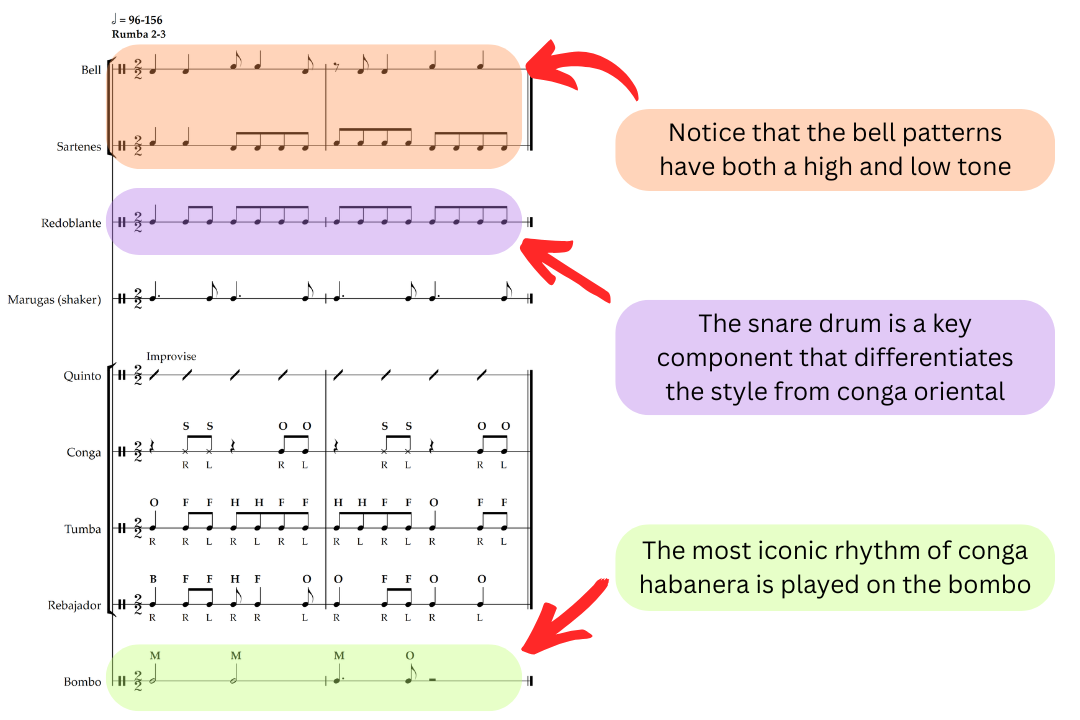
On top of the large percussion section are vocalists, who originally mimicked the format found in rumba with one lead singer and a choir. As the parades grew larger, the vocalists were replaced with brass instruments such as the trumpet, trombone and saxophone who could compete with the high volumes of the band. Eventually, with the creation of amplification, the vocalists rejoined the ensemble and today you see a mix of brass and singers.
Conga Oriental
The carnivals of the east followed a similar trajectory of those in Havana, being split into white and Afro-Cuban comparsas in the late 19th century. However, after the groups came back in the late 1940s, far more of the original Afro-Cuban culture remained, leading many Cubans to call conga oriental the real carnival of the island. Other than the obvious musical differences between the two sides of the country, those in the east paraded at a different time of the year. When the comparsas split following the abolition of slavery, the white groups performed during the lead up to Lent like those in the west, however, the Afro-Cuban carnivals performed in the summertime on religious holidays associated with Saint James, Saint John, and Saint Peter. Today, these carnivals are still performed in June and July whereas those in Havana have moved from January to August.
There are typically three types of parades which exist in Oriente: the paseo, which is very similar to those found in Havana and features elaborate floats and a wide range of musical styles such as timba and bolero; the comparsa, which is a choreographed street march that features Afro-Cuban traditions and is accompanied by conga oriental; and the conga, which may be similar to a comparsa but must involve audience participation and generally are far more sporadic than the other two types of parade.
Paseo
Comparsa
Conga
Generally, there are many different neighborhoods associated with both the congas and comparsas, representing a large array of musical styles. For example, the Tumba Francesa take part in the annual festivities as well as Carabalí groups which help offer an alternative perspective on their culture outside of the Abakuá. Other than those specific examples, most neighborhoods feature music with enough similarities that they can be roped under one style called conga oriental. Like conga habanera, the ensemble sizes of these parades are quite large with some comparsas featuring over thirty musicians. Typically, the instrumentation can be broken into three categories: drums, metals, and shakers.
Making up the bulk of the drum section, a unique narrow conical drum called the bocú is used. They have many similarities to the conga drums found in the west, however, are smaller and played under the arm or hanging from a strap. Like the drums used in rumba, bocús have two functions in the ensemble, where one smaller bocú is used to improvise and is called the quinto, while the others are called fondos and create an interlocking set of rhythms that fill in the sound of the ensemble. Some split the bocús into three categories, adding the title of requinto or salidor to the drums which play counterparts to the fondos, but this is not consistent across all comparsas. The other instrument is the bombo, which are the same as those used in Havana and historically came to Cuba with the refugees fleeing the Haitian Revolution. However, in Oriente there are multiple sizes of bombos which are used: the requinto (highest); the tambora or redoblante (middle), and the pilón (lowest), all of which are played with both a stick and hand like conga habanero. The overall role of the bombos is to mark the march of the conga and should always be able to be heard above the other instruments.
Moving to the metals, the most favorable instrument to use is a large tractor break drum called the llanta which is commonly referred to as the campana. Originally the sartenes were used but in 1940 were replaced by the llantas due to being too cumbersome. Together, the multiple bell parts create an interlocking effect similar to what is found in the bocús and provide a unique texture which marks the tempo of the comparsa. For the final section of the ensemble, two different sorts of shakers are used: the marugas, a metal tube filled with metal beads; and cha-chás, woven basket shakers filled with many possible objects like bottle caps and beads.
Conga Oriental
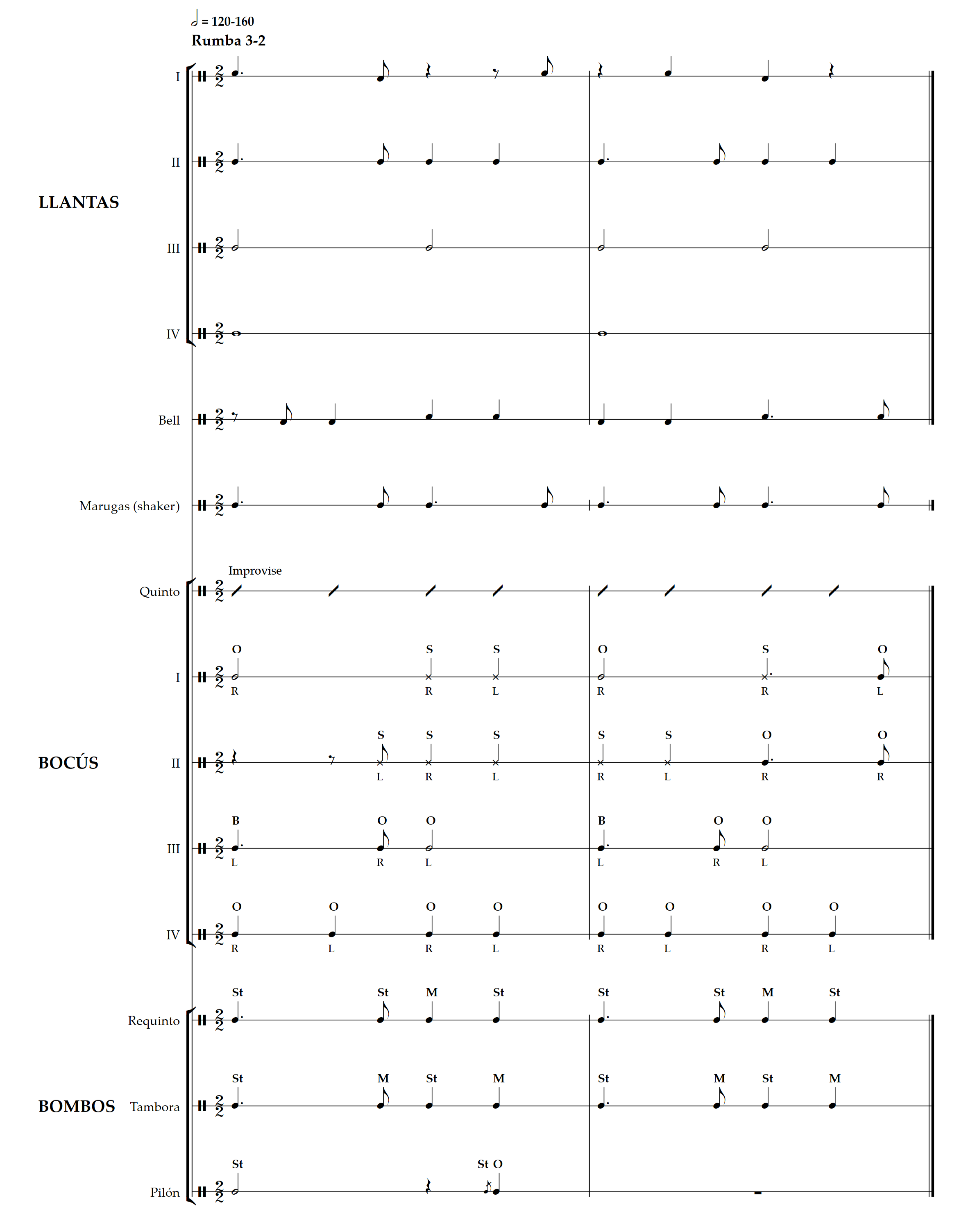
On top of the large percussion battery is a single melodic instrument called the corneta china, whose nasal, oboe-like texture is one of the major characteristics that defines conga oriental. In the second half of the 19th century, the Spanish started to employ Chinese immigrants to work in the sugar plantations as a replacement for the freed slaves. With the introduction of Chinese culture came the Cantonese instrument, and by 1915 it had travelled with soldiers and migrant workers from the west side of the island to the east. At first it was only used by one neighborhood, but quickly was picked up by rival comparsas in the coming years. Interestingly, although the corneta china was introduced to Cuba in Havana and Matanzas, it is only found in conga oriental. The instrument itself is very difficult to play and only features five notes which are used to open parades in the east. Many ensembles draw from a collection of stock melodies for their comparsas but others do feature original material to help their neighborhood stand out.
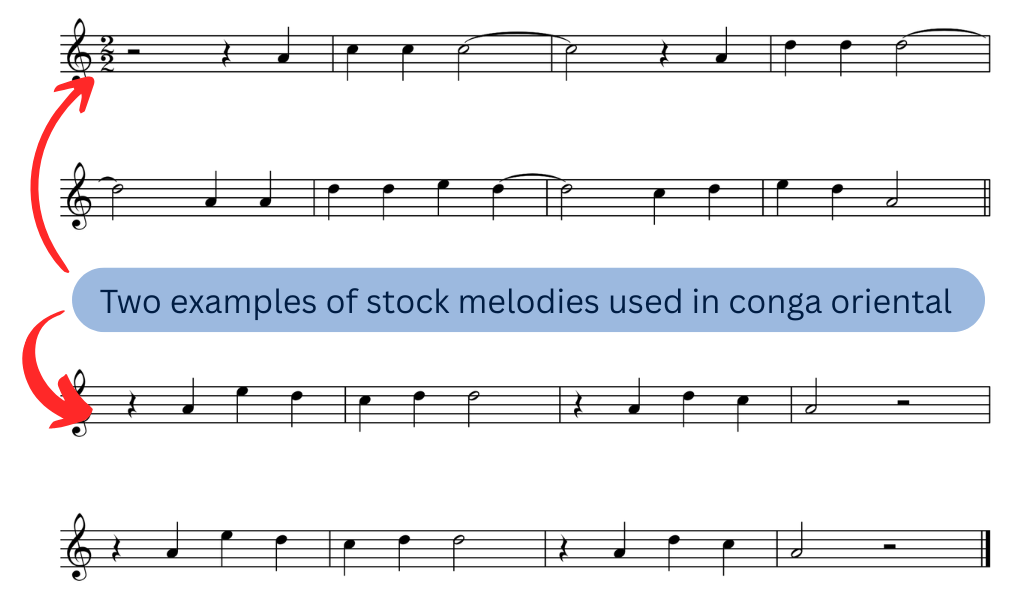
For the most part, the vocal part of conga oriental is left to the crowd to participate, where they alternate lines with the corneta china. Like the melodies, known stock lyrics are used to help include everyone who attends the parade. Some comparsas do write original lyrics, however, these are often for competition purposes only and are less likely to be used for a general gathering.
Finally, the last component of conga oriental is the dance which accompanies the conga. Called the arrollando, the dance is a quasi-march where individuals sway their hips in a figure eight motion and hold their arms at a 90-degree angle. When the music is exciting the participants may raise their hands, such as for a high-pitched note from the cornetta china or for their favorite melody. Individuals are not considered to be in the conga until they start dancing, with other members calling on them to join the arrollando.
Conga Santiaguera
While it would be difficult to show all of the differences between each variation of conga oriental, looking at one particular example from an eastern city will help illustrate just how different they can sound from one another, even when coming from the same region of the country. Specifically, we will be looking at congo santiaguera from Santiago de Cuba, but we must also remember that this is still a generalization of the many neighborhoods that play this music in the city.
In Santiago de Cuba there is a longstanding tradition called La Invasion, where the most well-known conga groups visit other neighborhoods and compete with one another. The terms are simple and the winner is whoever draws the largest crowd. Originally this process was quite long with comparsas travelling across the city to many neighborhoods, but today only lasts for five or so hours and begins in the early afternoon. As you can imagine, even five hours of playing music in the Cuban summer would be incredibly taxing on any musician.
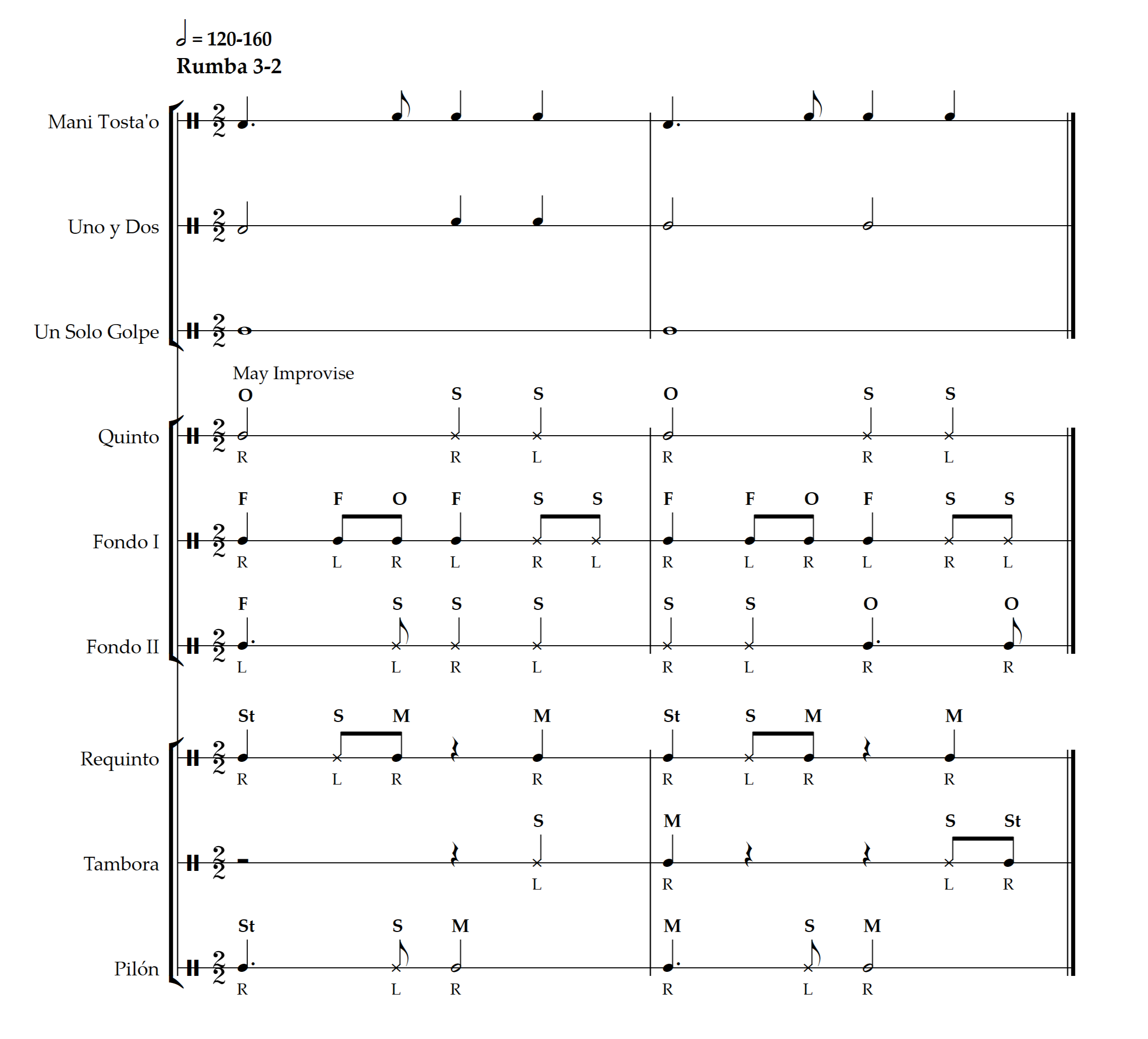
The music follows a similar approach to what we have seen in conga oriental, however, can be broken into three distinct sections: pilón, columbia, and masón. Pilón is the foundational groove that is played for the bulk of the parade and features a similar lineup of instruments to conga oriental but with more defined roles. Once again the naming conventions found in Cuban music strike again, and here we see the section name using the exact same word as the lowest bombo. Hopefully through the context given, it will be obvious which one is being referred to but I apologize in advance if it is confusing. The section is believed to have been created in 1914 and takes influences from an Afro-Haitian ceremony called gagá which arrived in 1910 when a new wave of Haitian immigrants came to Cuba to work on the sugar plantations. Typically, there are three campanas, each of different sizes and play supporting rhythms to each other. The maní tosta’o is the smallest and highest pitch bell and has the most rhythmic part, while the second part is assigned to the middle-sized bell called the uno y dos. To complete the section the third part is given to the largest bell called the un solo golpe or cán.
Moving to the drum section, conga santiaguera makes use of the same bombos and bocús found in conga oriental. There are typically four bombos in one ensemble, made up of one pilón, a requinto, and two tamboras. It is also normal for a conga to consist of fifteen or more bocús split into three parts, including the quinto which improvises, and two different sets of interlocking rhythms divided between the section. As always, the group is joined by the corneta china and vocals from the crowd to make up the melodic component of the style.
Pilón
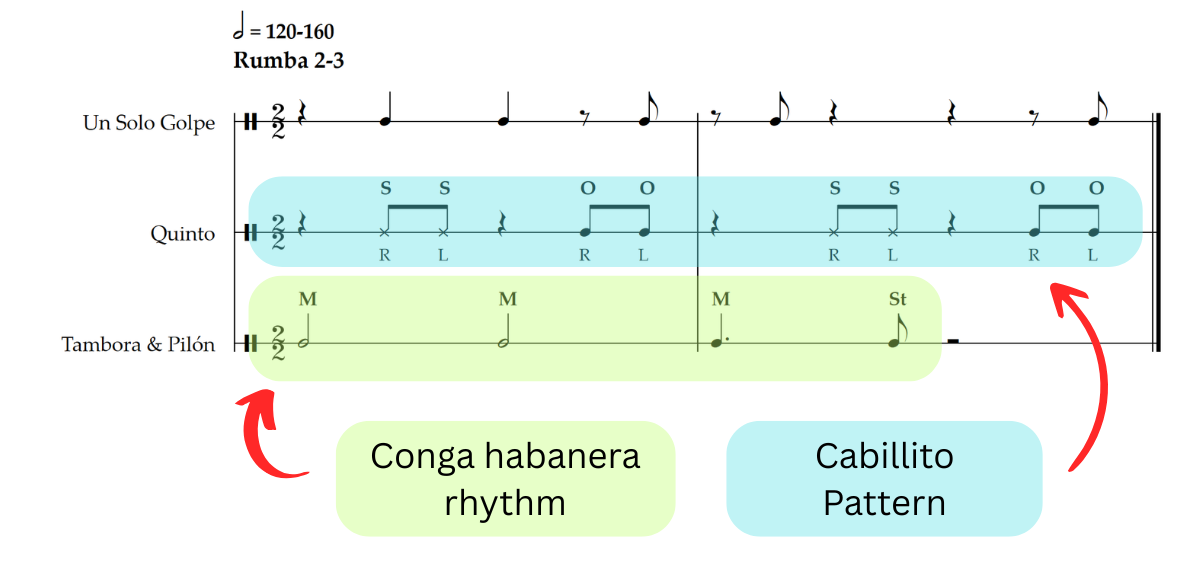
The other two sections of conga santiaguera are not played nearly as often and are commonly reserved for when the conga arrives in a new neighborhood. Although it shares the same name as a form of rumba, the columbia found in conga santiaguera is quite different and draws upon influences from conga habanera, specifically the bass drum pattern found. The name may have come from a similar background to rumba columbia, and some say one of the bell patterns is derived from rumba, but there are no historical records which prove either point. It is believed to have appeared in Santiago de Cuba in 1913 after ex-soldiers brought it to the area from Matanzas. For the most part, many of the instruments play the same rhythms as the pilón section but with three notable changes, the most important being the bombo part. The two tamboras and the pilón outline the bombo part found in conga harbanera, while the un solo golpe bell changes to a new pattern that is far more syncopated. Lastly, the quinto may change to a new rhythm called the caballito but has the choice to continue improvising if so desired.
Columbia
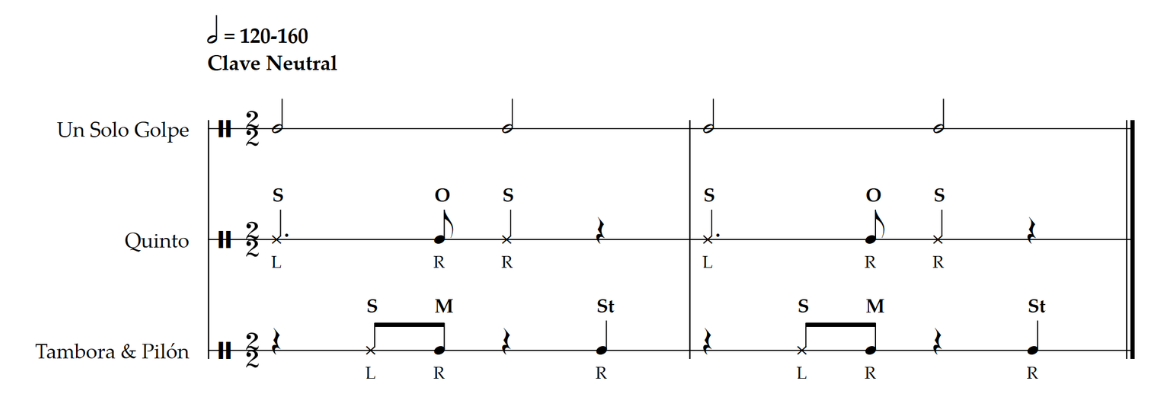
The third section, masón, is directly linked to the Tumba Francesa, drawing influence from the cinquillo rhythm as well as using the same name as one of the associated folkloric styles. Like columbia, the main difference that occurs is in the un solo golpe, pilón and tamboras. The bell pattern simplifies, while the bombos outline a simplified cinquillo. In recent years the quinto has also adopted a new pattern, but this has not been standardized across the different neighborhoods in Santiago de Cuba.
Masón
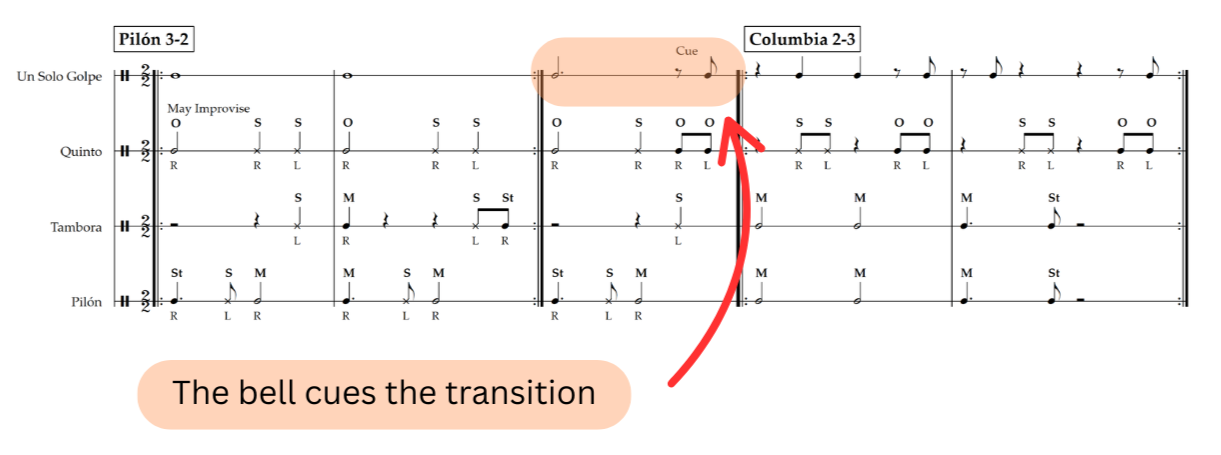
Generally, pilón is the default section used in conga santiaguera, but in the instance where columbia and masón are incorporated, they often follow a typical three-part cycle made up of pilón-columbia-masón-pilón. Between each section is a brief transition signalled by the un solo golpe which occurs over a single bar, except for the final shift back to pilón which is marked by a call and response between the pilón and tambora bombos.
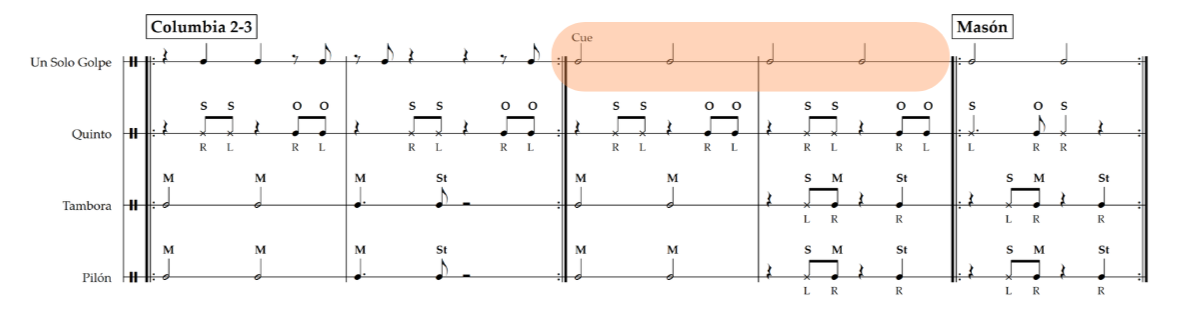
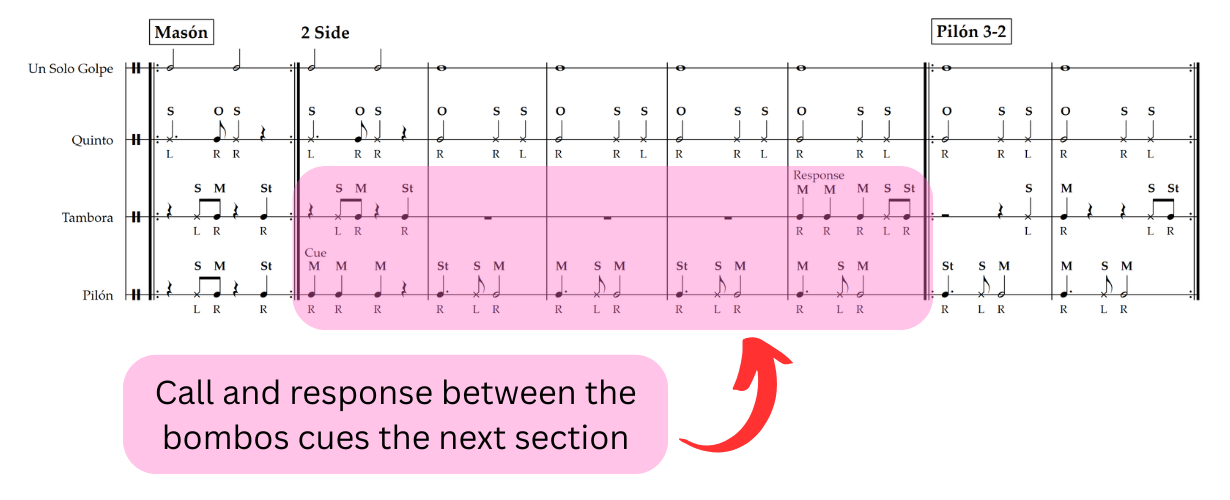
Conga santiaguera is a complex art form which clearly demonstrates how there are many musical differences between cities in the same region of Cuba. From this foundation, there are further variations associated with each neighborhood in the city, providing several more layers of complexity to the style and giving the music a more personalized approach. Looking at the overall perspective, the interconnected network of styles associated with conga de comparsa can compete with any other major style complex found in Cuba as well as be seen as an extension of the rumba family. As you can imagine, with a body of styles this large there are multiple influences which led to the version of conga de comparsa we hear today, many of which coming from the original cabildos found throughout the island. However, it should also be considered that the artform originated in Cuba at the same time as many of the folkloric Afro-Cuban styles, allowing it to be seen as having one foot in the folkloric side of Cuban music with the other in the post-1880 creolized styles.
Conga
Moving away from the street parades of Cuba, elements of conga de comparsa found their way into the Western world through two artists in the first half of the 20th century. The first was Eliseo Grenet who was born in 1893 in Havana and was a popular Cuban composer in the 20th century. During the Machado era of Cuban politics, he incorporated controversial opinions into his theatrical works which saw him exiled from the country in 1932. Initially, Grenet moved to Spain but after finding some success with his compositions he decided to relocate to Paris where he became part of a house band with his brother at the La Cueva club. It was at this club that Grenet introduced aspects of conga habanera to Europeans by integrating them in a small group setting, with the prominent bass drum rhythm and chain-like dance becoming hugely popular in the city. As conga de comparsa moved away from Cuba, it began being known as conga or sometimes the salon conga. To keep things simple, in this section any time I refer to “conga” I am specifically referring to the new variation of the music played in the Western world.
Unfortunately, it is quite difficult to know exactly what early conga sounded like due to a lack of recordings by Grenet in the 30s, but over time specific characteristics have become the norm. The most significant is the rhythmic cell commonly played in the bombo part of conga habanera. Instead of it being restricted to just one instrument, in conga it was featured as the dominant rhythm across the ensemble. Interestingly, no other major cells transferred to the style from the Cuban comparsas, and for the most part, conga followed the conventional harmonic progressions and melodic rules present in early 20th century Western popular music.
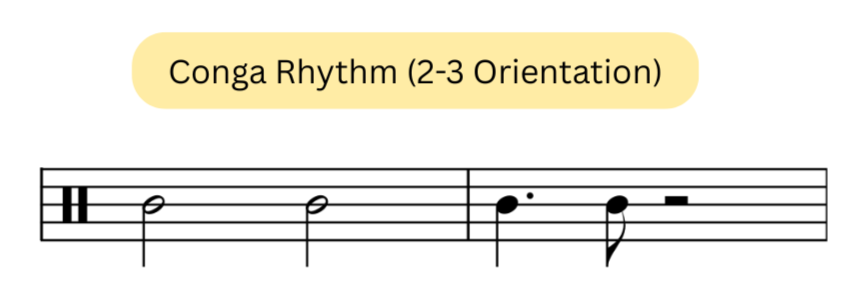
One distinguishing factor came from the lyrics, which departed from the conventions of the Cuban comparsas and focussed on exploiting Afro-Cuban imagery to provoke a sense of exoticism for the white European audiences. It is unfortunate that a clear connection of this sort of behavior can be made to the early Kings’ Day celebrations and the late 19th century white comparsas in Cuba where Afro-Cuban culture was highlighted purely from a racialized standpoint. Ironically, while congas became increasingly popular in Europe, the real congas in Cuba were prohibited from parading by white leaders.
Alongside conga was a dance adopted from Cuba, and although we didn’t discuss the specifics of the dance earlier, you are likely already familiar with it. The conga line is a simple dance figure where a dancer holds the shoulders of the person in front and moves with the bass drum rhythm. Similar to how the tango took France by storm in the 1910s, the conga boomed in the 30s thanks to the small group variant that Grenet had created. It was so popular in fact that Grenet wrote a conga in a major motion picture at the time by Josephine Baker, titled Princess Tam-Tam while in Paris.
After seeing the popularity of conga in France, Grenet took the style to London where it was cemented in European popular culture forever. He also travelled to New York City where he introduced conga to the United States at a cabaret club called Yumuri in 1936, which later was renamed Birdland. However, the style didn’t become popular across the country until another gentleman by the name of Desi Arnaz introduced it to Miami a year later.
Desi Arnaz was born in Santiago de Cuba in 1917 and was the son of the mayor of Santiago de Cuba during Machado’s era of Cuban politics. Although much can be said about the Machado administration, what is most relevant to this resource is that Arnaz’s father was part of a political group which consistently banned Afro-Cuban congas throughout the country. Once Machado was overthrown in 1933, Arnaz’s father was jailed for six months and then exiled, resulting in his whole family moving to Miami the same year. After graduating high school, Arnaz started working as a professional singer in the Miami music scene and quickly found a job working with Xavier Cugat, a famed Cuban band leader who helped introduce Cuban music into the United States. Due to the popularity of Cugat around the country, he syndicated his band into five ensembles which covered Miami, Boston, Chicago, Los Angeles, and Philadelphia. With Arnaz already being heavily connected in Miami, he became the front man for the new orchestra, and it was during the very first concert with the band that he introduced conga to Miami.
Over the years, the exact story of how Arnaz introduced the style has become somewhat of a myth as there are a few interpretations to the exact story. In Arnaz’s autobiography he mentions that the band had been booked to play at a new club in Miami Beach on New Years eve in 1937. Cugat was meant to send him a band during the week, however in reality, five musicians unfamiliar with Latin music showed up hours before the gig. Faced with a major issue, Arnaz is quoted with saying that his “mind did a flashback to the yearly carnivals in Santiago, when thousands of people in the streets form a conga line, and they go all over the town, singing and dancing for 3 days and nights.” With only a short period of time to teach the band any sort of Cuban music, he instructed them to all play the core bass drum pattern from conga habanera. The result was a huge success for Arnaz and the introduction of conga to Miami. The way Arnaz phrases the story, he makes it seem as if he came up with the idea on the spot, but in reality, he definitely would have played congas with Cugat’s band in New York as well as been aware of Grenet’s success with the style. After a fantastic New Year’s Eve performance, the new club named itself the La Conga and before long another version of the club opened up in New York under the same name.
The popularity of conga in the United States led to masses of tourists visiting Cuba to see the elaborate floats and comparsas, but initially they were surprised to find that they were still prohibited. In 1938 the parades became legal again and a wave of new congafied music hit the United States from Cuba. The most popular being Rafael Ortiz’s Uno, dos y tres.
One year later, in 1939, Arnaz moved to New York City where he landed a major role in a new musical by Rodgers and Hart called Too Many Girls. He quickly approached the musical director about incorporating conga into the musical, and before long the final song of the first act titled Harvard Look Out was changed to add the style. While maintaining a career on Broadway, he also would perform at the La Conga across town, often rushing to the club to play after he was finished with the musical. The success of Too Many Girls led to Arnaz’s first movie deal in 1940, where he travelled to Hollywood to star in a film version of the musical. Although there are no recordings of Harvard Look Out as a conga, the style was also incorporated into the movie in other ways.
That same year another movie called Strike Up the Band was released featuring a musical number sung by Judy Garland called Do the La Conga” If you look at the title closely, you can see that it is specifically relating to the La Conga club and Arnaz’s influence around the United States.
In only four years, conga had taken the United States by storm, and even though it is not as common today in Western countries, the effect lives on through the common knowledge of the conga line dance. Thanks to this period we also get a fantastic crossover between conga and jazz, a particular sound that I have really enjoyed ever since coming across Lalo Schifrin’s Panamericana. In some examples such as those by Xavier Cugat or Desi Arnaz, only one rhythm is utilized, but looking to Cab Calloway and Dizzy Gillespie, specifically those closer to the Afro-Cuban culture present in New York City at the time, you can see a few more layers of the original conga de comparsa rhythms start to be integrated. For example, in Panamericana one of the bell patterns is lifted directly from conga habanera.
These specific examples provide one solution to incorporating elements of conga de comparsa into our own compositions and arrangements. However, as we can see by comparing conga with conga de comparsa, only a small amount of the original style is captured when doing so. Unfortunately, due to the nature of conga de comparsa being played in such a large ensemble with so many different percussion instruments, it can be hard to capture authentically in a Western setting. What I have found to work the best is to isolate the key rhythms and textures that define the style, such as the bombo part and interlocking bell patterns which transfer nicely to the bass drum and cymbals on a conventional drum set. Although it doesn’t replicate the size and power of a comparsa, it does at least enforce the iconic rhythms with similar textures. It should also be noted that being an Afro-Cuban style, conga de comparsa is usually accompanied by rumba clave when the rhythm is present. Building off of the previous resource on rumba, due to there being so many new rhythms introduced across the variations of the style, I would highly recommend noting the clave direction of your favorites and adding them alongside the other clave orientated rhythms we discussed with rumba. That way you will have an even larger variety of rhythms to choose from when writing without having to worry about crossing clave.
The Takeaway
Conga de comparsa is yet another fascinating Afro-Cuban style filled with fantastic rhythms and textures. Whether it be the driving snare drum of conga habanera or the rich polyrhythmic bells of conga oriental, each variation has its own unique identity. While many of the unique characteristics are somewhat difficult to transfer to other settings, there are enough standout patterns that can be captured to help provide that signature conga sound. From here we set our sights on one of, if not the most influential Cuban style of all time. A style which introduced the world to the montuno and redefined the entire musical landscape of Latin America.