

How Four Rhythms Helped
Create An Iconic Latin Sound
Prior to my deep dive into Cuban music I would often hear various names and terms thrown around, never really understanding what they meant. While I had heard of styles like son and cha-cha-chá, I didn’t know what differentiated them from one another, let alone how to identify them when I listened to a piece. One day while talking with a colleague, they mentioned how some of the more popular Cuban styles actually came from the danzón, but once again I still had no clue what that name meant. For me, the only thing I knew about danzón was a piece by the same title, Danzón No. 2 by Arturo Márquez, which I had stumbled upon years earlier thanks to a brief obsession with the conductor Gustavo Dudamel. I figured there was some connection between the two but of course had no idea what exactly that might be.
As I journeyed back into the earlier music of Cuba, what I found was that a number of books started by looking at a style named contradanza. Having no knowledge of Cuban music I figured why not follow the authors along and see what they had to say about the topic. Quite quickly it became apparent that contradanza was a creolized European style which actually transitioned into what is now known as danzón. The style even went on to inform the creation of mambo and cha-cha-chá too. Although less popular today, contradanza was a foundational style for one of the major branches of Cuban music and many of the characteristics found in Latin music today can be traced back to the style, such as the creation of the timbales.
After reading a little bit more about contradanza I knew that I had to spend some time listening to the music and try to absorb the elements the authors had described. What I realized was that contradanza was a hybrid of baroque music and a sound I generally associated with Latin music. It’s hard to describe the style succinctly without going into more detail about the many characteristics found in the music (don’t worry we’ll cover these in more detail shortly), but listening to examples by Saumell and Cervantes revealed the origins of a sound which I had often associated with styles like ragtime and tango. I was immediately hooked and realized that I found this variation of European classical music a lot more interesting than the many classical pieces of the same era I had analyzed while attending university.
A key component behind the sound of contradanza were four rhythms that had been transplanted from a variety of Afro-Cuban folkloric music. Thanks to creolization, the popularity of contradanza, and the significance of the styles which were later developed from contradanza, these particular rhythms can now be heard throughout Latin music and have even had an impact on Western music too. Personally, understanding these rhythms and just how much they saturated Cuban music was one of the first major breakthroughs I had and helped me start to traverse the increasingly complex rhythmic vocabulary that Latin music is known for. Not only that, but as I read more and learnt about how contradanza evolved into danza and eventually danzón, I came to realize the significance both lyrics and dancing had on the naming conventions of Latin American styles. An epiphany which made understanding the wide range of Cuban music that bit easier.
Just as these rhythms helped me, my hope with writing this resource is that I might be able to aid others looking to make sense of Cuban music. Following the same manner I ran into the four rhythms, we will be looking at the development of danzón and unpacking the amazing characteristics that resulted from creolization in Cuba. There’s a lot to cover as we will specifically be looking at contradanza, danza, and danzón, but as someone who once was completely unfamiliar with this family of styles, I hope you’ll find the same level of joy I did when learning about this music. More so, understanding danzón is critical for understanding why later styles like mambo and cha-cha-chá sound the way they do, something I will touch on in more detail in another resource. So without further ado, let’s get started!
Contradanza
If you’re like me, contradanza may be a style that you have yet to come across in your musical journey, and if you’ve read the previous resource on the three major influences that exist within Latin music, you’ll be familiar with my approach when tackling an unfamiliar style. However, for those that may not have looked at it or have simply forgotten, I think a critical part of understanding music is to try and make sense of the culture which created a given style as music is often the byproduct of certain historical contexts. In the case of contradanza, it didn’t simply begin existing one day, it was created as a result of hundreds of years of musical development across two continents which were brought together in Cuba thanks to the transatlantic slave trade.
Originally, contradanza was known as the country dance and was a popular English dance format in the 15th century. Instead of focusing on just one style of dance, the format featured a mixture of popular dances at the time such as the jig and reel, which would be performed alongside a set piece of music. Eventually the format was adopted by the French in the second half of the 17th century, who added their own dances and created slight alterations to the style. As a result, two distinct versions existed, the English country dance, and the French contredanse. The primary difference between the two was that the French focused on having two lines of dancers face off with each other, whereas the English variation was built around four couples in a square format. However, it should be noted that both styles of dance were present in either style, and this distinction is purely to show the preference of the countries at the time. For instance, the French had a square dance called the quadrille which was quite popular and was used in contredanse.
In 1701 Spain received a new monarch, Philip V from the House of Bourbon, a descendant of a French dynasty which brought a new wave of influences into the Iberian Peninsula. Specifically, the French contredanse, which can be dated back to as early as 1714 in Spain. On its arrival, the style once again was translated into a new language, becoming known as contradanza and would eventually make its way to the Spanish colonies in the Americas. Although there are records of contradanza in Spain, its transition to Cuba is far more difficult to pinpoint, with many contradicting views on how it arrived on the island. One of the possible explanations, and arguably the most likely, is that it was brought to the port city of Havana with the Spanish in the 1700s. However, there are also theories that it arrived with the British when they occupied Cuba in 1762. Both theories have it entering the occident in the mid 18th century, which is highly likely, yet still contested by some scholars. The Haitian Revolution also brought a variant of contradanza to the east of Cuba, with some arguing that it may not have entered the western cities until the beginning of the 19th century thanks to internal migration within the country. But, this is pretty unlikely and I personally lean in the direction of the first theory. Regardless of how it got to Cuba, contradanza was there by the 1800s, when it became the major dance style for the country.
The style was danced by everyone, from the high-class Europeans to the poor slaves, with each group adding their own flavor to the format. Interestingly, the music that accompanied the dancers was not fixed to one instrumentation, with the social class of participants affecting the orchestration choice more so than any other factor. It was common for the highest economic tier to have classical chamber ensembles perform, while the middle class were more likely to opt for percussion and a guitar. Contradanzas were even published in the local newspapers around the island, allowing enthusiasts to play them on their personal pianos, something which was relatively new to Cuba at the time.
Thanks to the format allowing for multiple different dance steps, there were three favored options used: the line dance (the most popular), the circle, and quadrille variants. Eventually four common dance figures became the staple of the style, each lasting approximately eight bars.
Paseo (promenade) - The entrance of the dancers, typically danced over the A section
Cadena (chain) - A line dance would form with the lead couple being mimicked down the line
Sostenido (sustained) - The dancers would hold before returning to one of the other three sections
Cedazo (sieve) - The dancers would break off into individual couples similar to a waltz but in duple time
Other dance figures were often used such as the puente, allemanda, and molino, with some being able to be incorporated into the cadena. Check out the video below for an example of contradanza dancing but please note that the musical accompaniment is an approximation of what it may have sounded like in the 1800s.
One of the difficulties we face when trying to understand the musical components of older styles is that sometimes we don’t exactly know how they sounded. With contradanza, most of the sheet music that remains today are primarily notated for piano, the preferred way of publishing music in the 1800s, which leaves much to be desired in the area of orchestration. Furthermore, we know that the style was popular in a diverse range of communities, meaning that it most likely sounded different depending on the class and ethnicity of the people involved. Some pieces offer small insights such as markings which indicate horns on the melody, but for the most part, we can only guess based on the ranges and common classical composition techniques used at the time. Bearing that in mind, whenever you listen to an audio example of an orchestra trying to recreate contradanza, just know that it may not be entirely accurate in terms of orchestration.
Fortunately, we are aware of at least the basic instrumentation commonly used to play contradanza for the upper class. Known as the orquesta típica, the ensemble was made up of six to twelve musicians, including two clarinets, four violins, a flute or piccolo, trombone, ophicleide, contrabass, kettledrums, and was eventually joined by the guiro and/or quijada (a percussion instrument made from the jawbone of a donkey). From this particular ensemble we get many of the instrumental influences on Cuban music, primarily the violin, flute, and kettledrums, which later became the timbales. Unlike later derivative styles like danzón, how exactly each of the wind instruments were used is anyone’s guess. However, it is likely that the same conventions seen in danzón may have held true for contradanza and offer a great starting point for those looking to authentically replicate or perform the style. Characteristics such as the B section being assigned to the clarinet, but before we get there it might be worthwhile to look more closely at the structure of contradanza.
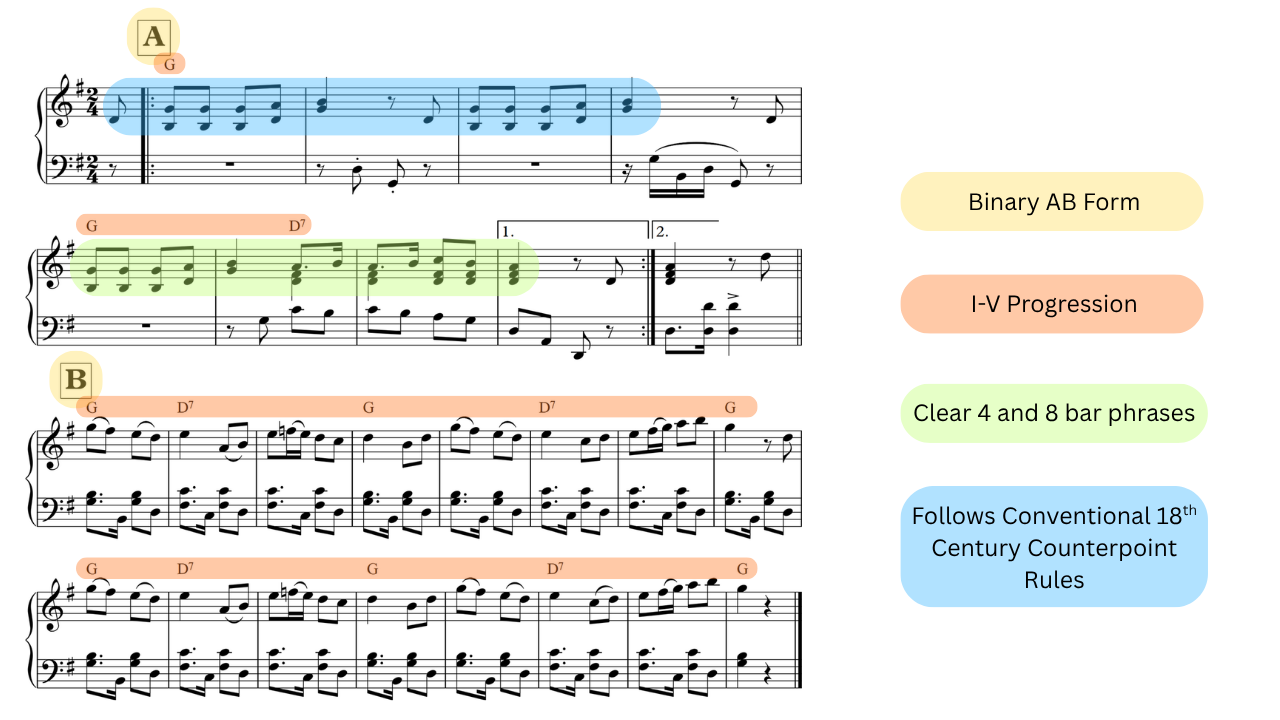
Like many European styles of the time, contradanza made use of a binary form (AB), with each section lasting for a total of 16 bars. Alternatively, composers had the freedom to write either the A or B as a smaller 8 bar section which would then be repeated, eg. AABB, with the main rule being that the collective form still equalled 32 bars in total. This form would then be repeated as many times as the accompanying dancers wanted
Harmonically, contradanza is quite similar to other classical styles of the 18th and 19th centuries, with earlier pieces focusing on diatonic chord progressions built off the I and V chords. As European music became more harmonically adventurous in the 1800s so did contradanza, which mimicked the use of secondary key centers, inversions, and a larger pallet of diatonic options. The melody followed a similar trend, with compositions being built in clear 4 or 8 bar phrases with little or no modulation or harmonic complexity. When the melody was harmonized, it mainly followed 18th century contrapuntal rules with secondary lines being voiced a 3rd or 6th away.
Shifting to time signatures, the majority of contradanzas were in duple meter, with a small number being written in 6/8. Although the first known Cuban contradanza was published in 1803, it is believed that the earlier versions of the style may have been written in 3/4 with a strong use of hemiolas. Unfortunately, there are no records of what this music may have sounded like, but other styles such as punto guajiro and guaracha can help offer insights about how the music of Cuba evolved in the 17th century, with there clearly being a shift from triple to duple meter taking place.
Collectively, all of these characteristics came together to form the contradanza style. If you scour the many examples that still exist today, you’ll find time after time that they all share these same traits but I figured why not use an example of the first published contradanza, San Pascual Bailon, to help us see them in action. Of course the orchestration still remains somewhat of a mystery but this recording by Rotterdam Conservatory’s orquesta típica does provide a pretty good insight into the overall sound.
San Pascual Bailon
Anonymous
If you look closely at the example you might notice that there is one characteristic that we haven’t addressed just yet, specifically something that leans into the core topic of this entire resource. But in order to look at the rhythm of contradanza properly, a little more background is required and we need to delve into how Afro-Cuban music became intertwined with the European country dance format. The process of creolization is not something that can be explained in a short format as identifying singular moments where whole cultures blended together is next to impossible. In the case of Cuba, two types of fusion had to take place, one between the cultures of the African slaves to create a distinct Afro-Cuban tradition, and another between the Spanish colonizers and the newly established Afro-Cuban culture. To add yet another layer to the equation, creolization took place in all of the colonies of the Americas, sometimes also integrating the native influence as well as the numerous European influences too, and due to the consistent trade between the ports as well as major events like the Haitian Revolution, all of these components played a role in the development of Cuban music. All of that is to say, this process took a long time to occur and unfortunately often is simplified to the point of saying European harmony met African rhythm. However, the reality is so much more interesting and is necessary to discuss when trying to understand just how intertwined the rhythms found in contradanza are to the entirety of Cuban music and Latin American music as a whole. While this topic is probably better discussed in a longer form, such as a book, by a more knowledgeable author, I’ll try my best to touch on the major points I found helpful.
Creolization & The Four Rhythms
The first step to understanding creolization is that it can be described rather simply as the process of two or more cultures coming together and forming a unique byproduct based on the characteristics of each culture. As was just mentioned, in Cuba this was primarily between the Spanish and Afro-Cuban traditions. But in order for creolization to happen, something had to take place for these two musical cultures to interact with one another. Of course, in this case the answer may be somewhat obvious if you are familiar with the history of the Americas over the last five centuries: slavery. However, slavery only goes so far to explain how creolization came about in Cuba, and there is more nuance to the situation.
More specifically, one way creolization took place was through plantation owners having their slaves trained to play European instruments purely to have an ensemble to perform on their property. Thanks to the earlier form of Spanish slavery prior to the 19th century, slaves were permitted to purchase their freedom which resulted in European instruments and styles being integrated into the free black population of Cuba over time. As the upper class didn’t view music as an elite occupation, freed slaves were able to work in the music industry, a job which put many Afro-Cubans in the presence of the wealthy, even if they were not of the same socioeconomic status.
During this period a stereotype was created for black musicians, one which still exists today, which is that the color of their skin makes them inherently better at playing music. In Cuba, Afro-Cuban musicians had to work exceptionally hard to be noticed and employed by the white population, to the point that they had to be operating above the musical status quo. Some ensembles would memorize their music, an act which was interpreted as the performers being naturally skilled and unable to read any notation. However, in the end it was an example of how the white culture used systematic racism to justify why Afro-Cubans may be able to perform better than their white counterparts. Simply put, the Afro-Cubans had to work extremely hard to be noticed and earn an income, which resulted in them being technically proficient on their instrument of choice.
As the Afro-Cubans made up the bulk of professional musicians in Cuba, they started to integrate key rhythms into contradanza, four of them to be specific. There may have been other rhythms that they initially experimented with, but particularly the habanera/tango/congo rhythm caught on in Cuban culture, adding a fiery characteristic to an already popular dance. By the mid 19th century, composers had started to use these creolized rhythms within their contradanzas and a new set of standard rules began to emerge. But before we get to that, I think it’s time to start looking at a few of the rhythms.
To start off with we are going to focus on two specific rhythms, the habanera/tango/congo and the tresillo. Due to the prominence in which these rhythms can be found outside of Latin America, such as in Asian, African, and European cultures, we can not call them inherently Cuban. But it was most likely through the creolization which happened in Cuba which introduced the rhythms to Latin American music, and from today’s perspective we can see just how deeply the habanera/tango/congo and tresillo have been integrated into Northern, Central, and Southern American culture.
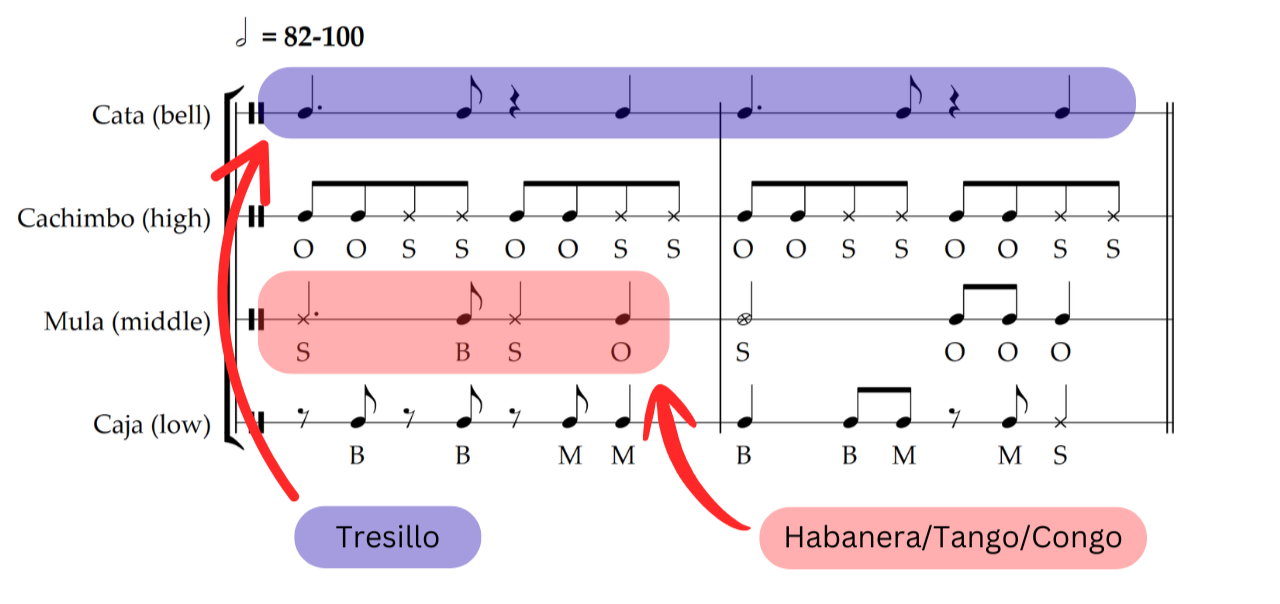
Originally the habanera/tango/congo was most likely called the tango rhythmic cell, but although they share the same name, this rhythm predates the creation of the Argentine dance. It can be found primarily in the music of the African nations which were brought to Cuba, but researchers believe it was also present in Spanish music as early as 1755. Dance manuals from this period show written melody lines with rhythms similar enough to the cell that we can’t rule out the possibility of it already existing in Spain before the creolization process in Cuba. As you’ve likely noticed, this particular rhythm now is referred to commonly by three different names. For much of the 20th century it went by the habanera title in reference to the association with Havana, but due to the rhythm existing in so many cultures, these days it has a broader range of titles.
The tresillo on the other hand is usually only referred to by the one name which translates to the word triplet. While the rhythm itself is not a triplet when seen in a duple meter, it does originally come from music in 6/8 and would have been felt like a triplet in Afro-Cuban folkloric music. The two rhythms are quite similar to one another with the only difference being the addition of a tie between the and-of-2 and beat 3 in the tresillo.
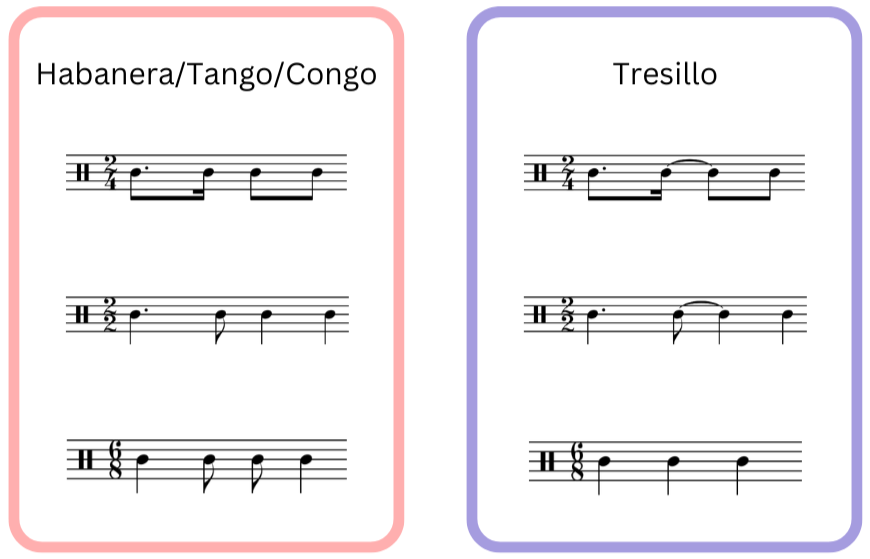
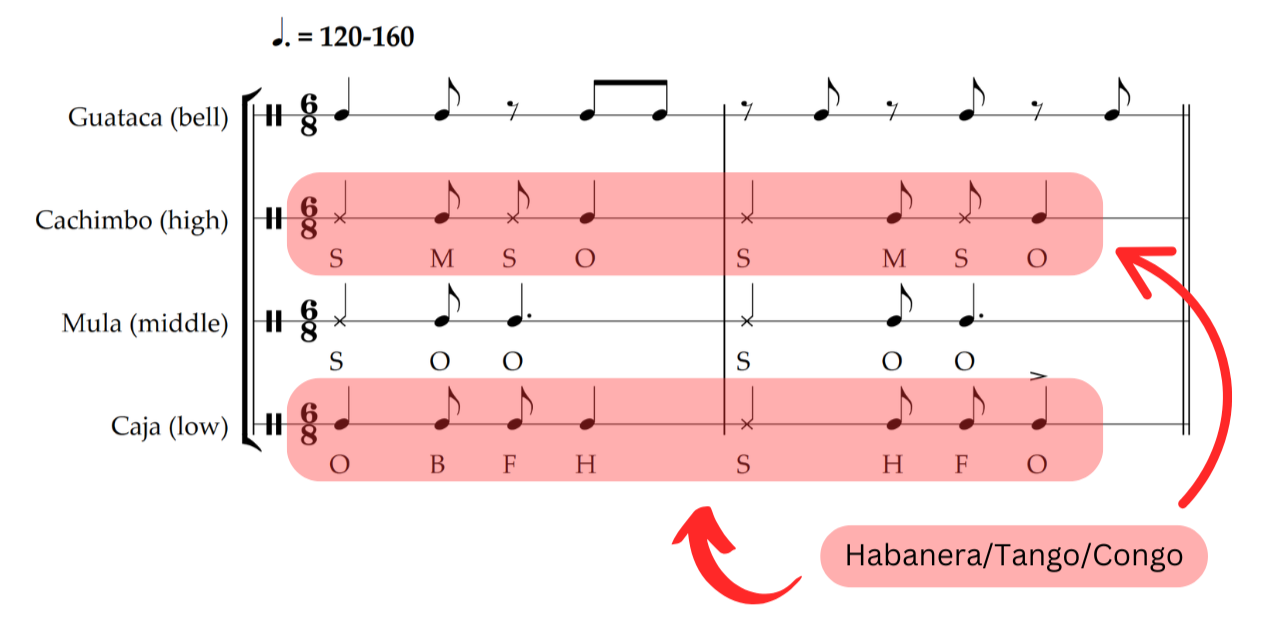
The integration of these rhythms didn’t take place over night and to better understand their entry into Cuban culture we must dissect the musical styles which entered the island. Unfortunately, we don’t have access to any of the early contradanza manuscripts found in Spain during the 1700s, but we do have multiple Afro-Cuban styles that we can analyze, such as the various examples covered in the previous resource. Being mindful of the length of this particular reading, I’ve only chosen a few to unpack but I would definitely suggest going back and looking at some of the previous examples of folkloric styles discussed in the other article to see if you can find any more examples for yourself. What you’ll find is that no matter which African nation you choose, these rhythms are present across the board. It is also worth noting that these rhythms generally come in two formats, one in duple meter and another in triple (as seen in the earlier graphic). These days the rhythms generally are used in the duple format but when looking at the folkloric styles you’ll see that they also were present in 6/8.
Palo
Makuta
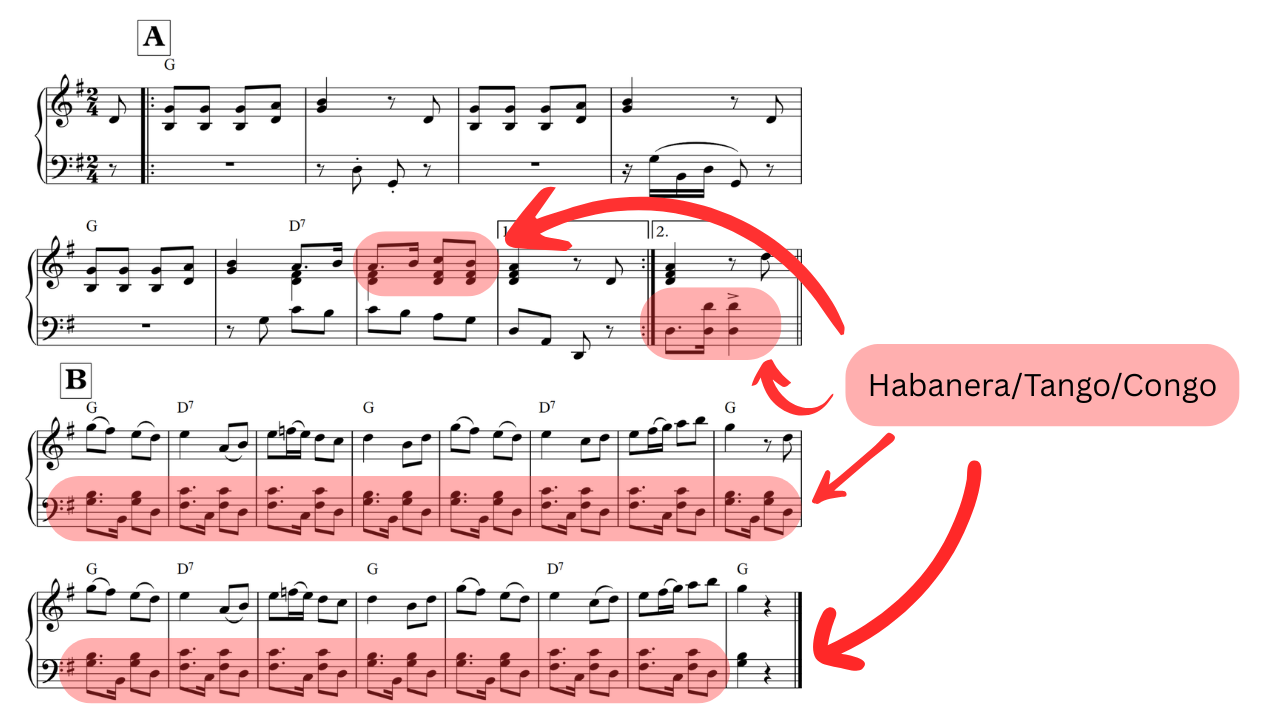
We can see that these rhythms were present in Afro-Cuban culture and we know that Afro-Cuban’s made up the majority of professional musicians in Cuba in the 19th century, but we haven’t talked about the critical juncture point where the habanera/tango/congo and tresillo crossed over into contradanza. While the orquesta típica most likely started purely with European instruments, over time the musicians began adding auxiliary percussion instruments to accompany the music. Joining the kettle drum, the guiro and quijada became commonplace and would often perform the habanera/tango/congo and/or tresillo alongside the written music. Exactly how this played out is hard to say, but we do know that it was an accepted practice, so much so that eventually the rhythms started to be picked up by the composers. What had once been a primarily Afro-Cuban rhythm mainly associated with a minor percussion instrument became a primary characteristic of the music, being utilized in the melody, counterlines, and bass. Looking back at San Pascual Bailon you can see that the B section is dominated by the habanera/tango/congo in the bass, a quality which would become shared with many of the contradanzas composed afterwards.
San Pascual Bailon
Anonymous
When you compare 19th century contradanza to European classical music, you begin to see how the Afro-Cuban interjection created a more syncopated style. Of course, this is comparing published contradanzas from the 19th century to composers such as Beethoven, and as we have discussed, it is likely that for the better half of the 1700s, contradanza was already starting to integrate these rhythms. Ultimately offering a much larger distinction between the two cultures, one which is evident when comparing contradanzas to works in the 18th century by the likes of Bach or Mozart. However, the habanera/tango/congo and tresillo were only two rhythms that emerged in the Cuban contradanza, and alongside them were two others which further differentiated the style from the earlier French contredanse and the English country dance. But just like before, there’s a little bit of context to unpack to understand how the cinquillo and amphibrach made it into Cuban music.
When looking at Cuban music, it can be easy to generalize the creolization process purely by time period, thinking that all rhythms were simply brought by the Afro-Cubans into contradanza. While that is true, the process of how they became incorporated is slightly different. Due to the island being divided into the east and west with a large mountain range in-between, the Afro-Cuban cultures were quite different around the country. Everything we’ve discussed so far regarding the habanera/tango/congo and tresillo generally took place in the western part of Cuba where the major trade ports were located. But to truly understand how all four rhythms merged with contradanza we now need to explore what took place in the east and spend some time unpacking one of the more impactful events of the last few hundred years: the Haitian Revolution.
Without going into too much detail, Saint Domingue (modern day Haiti) was a French colony just to the east of Cuba. Like many European colonies at the time, the country was home to many different exports such as coffee, cotton, and indigo, but by far the most profitable crop was sugar. Thanks to this singular crop, in the 1780s Saint Domingue became the most profitable place in the Western world. The French capitalized on the demand for the crop and imported wave after wave of slaves to the island. These people came from Senegambia all the way to Angola, with the Congolese making up most of the slave population. However, the African culture which had the largest influence on the colony was from the Fon empire, also known as the Dahomey. By 1789 there were approximately 500,000 slaves working on 8512 plantations in Saint Domingue, compared to about 30-40,000 Europeans and 28-40,000 free people of color. The colony was generating absurd amounts of money as sugar became more popular in Europe, resulting in extravagant cities being built which housed theatres and cafes. Some even compared it to Paris, calling it the Pearl of the Antilles.
Unfortunately, for the French to generate such extreme wealth, something in the system had to be compensated. Not surprisingly, it was the slaves, who were treated even more harshly than other European colonies. That isn’t to say that other European colonies treated their slaves well, it is just to highlight how cruel the French were to the slaves of Saint Domingue. Due to the demand for sugar, plantation owners could treat their slaves as dispensable assets, where it was cheaper to simply work a slave to death and replace them than it was to look after them in the long-term. I will spare you the horrific accounts which come from this period of time due to their graphic nature, but just know that it truly was a despicable time and the slaves were treated much worse than what most people today realize.
After decades of terrible treatment and inspired by the French Revolution of 1789, the slaves of Saint Domingue revolted. For over a decade the colony saw violent uprisings which eventually led to a full takeover by the enslaved population. The only successful slave revolution to take place. As a result of the rebellion, tens of thousands of refugees fled Saint Domingue, a mix of Europeans, free people of color, and slaves, who left for the surrounding countries. The majority landed in eastern Cuba, where over 30,000 were believed to have landed, arriving in bulk in 1803. Half of the refugees settled in Santiago de Cuba, with the remaining people being distributed across Guantánamo, Baracoa, and other places on the island. Regardless of their background or class, all of these refugees became known as Francescas in Cuba.
Once the revolution had come to an end, the newly established country of Haiti was left with no major economic system and an unstable political structure. The slaves who had successfully revolted had been left with a country that’s economy was built around slave labor, one which had never educated the African slaves, and a population which spoke a unique language that wasn’t used elsewhere. To add to the already terrible situation, governments around the world did not recognize the Republic of Haiti as a new country immediately, such as the United States who acknowledged the country in 1862, 58 years after it was created. Other colonies didn’t want to trade with Haiti due to the mystery behind Haitian Vodou, but also because they were afraid that the slave revolution may spread to their plantations. The result of all these events led to Haiti going through two centuries of instability where political leaders were constantly killed and replaced, a terrible set of circumstances which can still be seen in the country to this day. The Haitian Revolution sent shockwaves through the New World, and led all slave owning colonies to buckle down, afraid that a repeat may happen at their own plantations. The effects of this one event can be seen in all the countries of the Americas, especially Cuba, and created the foundation for an exciting century of musical development in the eastern region of the island.
The people of eastern Cuba played a major role in developing many of the musical styles to come out of the island. Although the area began being populated at a similar time to the western towns, far fewer people travelled to the east due to the difficult route through the forest and mountains. As a result, the initial population of the region were primarily made up of small farmers or runaway slaves and smugglers as opposed to the multiple classes found in the west. Additionally, there was significantly less infrastructure which led to the eastern area being seen as somewhat of a backwater part of the country, far less desirable compared to cities like Havana or Matanzas.
Prior to the Haitian Revolution, one of the major eastern cities was Santiago de Cuba, with a modest population of about 10,000. In 1766, the city faced a destructive earthquake which although devastating, created the ideal situation for the city to be reshaped by the incoming Francescas. Once the refugees started arriving, Santiago de Cuba became the primary home for many of them and started to take on an Afro-French influence. New buildings were erected, a revitalised system of commerce was created, and a large focus on the arts was introduced to the city. The Francescas were made up of many different classes of people, from plantation owners to slaves, each of which had an impact on the culture of the island. Importantly to this resource, with the refugees came their love for the French contredanse, and it wasn’t long before the Francesas held balls in Santiago de Cuba. For the most part, the English style of contradanza, specifically the line dance form, was the popular format in Havana, but with the introduction of the Francesas, the French quadrille began taking Oriente by storm. It is likely that this style already existed in Havana, but with the new French influence in the east, it began having a much larger impact on the island. And just like we saw with the two rhythms in the west, the eastern version of contradanza started to pick up rhythms from the Afro-Haitian culture.
Like the habanera/tango/congo and tresillo rhythms, there were two more prominent cells which came to Cuba through slavery, the cinquillo and the amphibrach. Both of which existed in the Afro-Cuban cultures prior to the Haitian Revolution but were further reinforced by the Francescas at the start of the 19th century. The cinquillo is quite a unique rhythm, found prominently in Dahomey music, with a name that translates to quintuplet. These days the rhythm is clearly not a quintuplet, but like the tresillo, perhaps once was a true quintuplet prior to being duplicized. In fact, to complicate the matter further, in many 6/8 Afro-Cuban styles the cinquillo is not a true quintuplet and instead makes use of grace notes.
Moving to the amphibrach, this particular rhythm is simply a variation of the habanera/tango/congo and the name is purely an academic creation. Personally, I think of it as interchangeable with the habanera/tango/congo but to help differentiate the two, in this resource I will abide by the term used in most music history and theory books. Unlike the other three rhythms, the amphibrach doesn’t appear as commonly in the major Afro-Cuban cultures and is instead present in West African Ewe and Dogon music, two nations which came to Cuba in much smaller numbers.
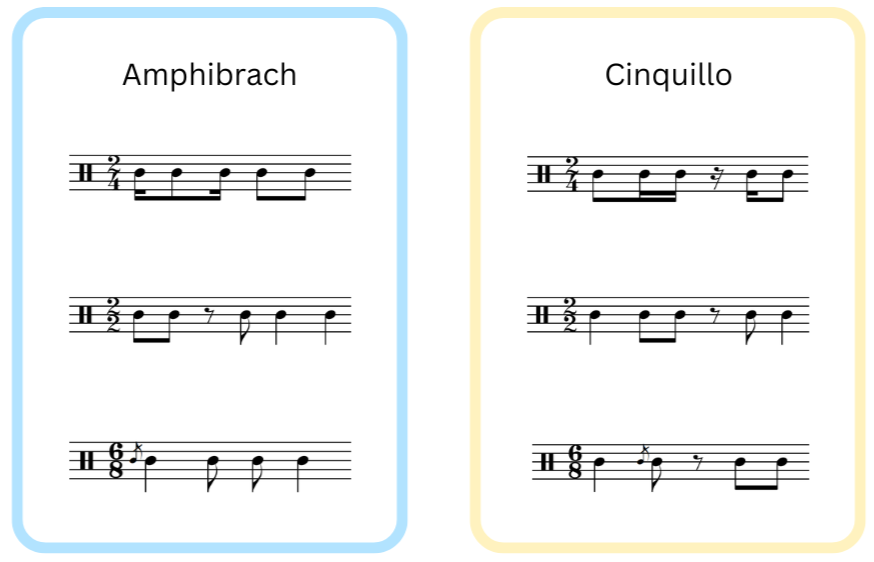
Similar to earlier, I find it helpful to see exactly what Afro-Cuban styles made use of these rhythms to help inform the journey they took from folkloric music to Cuban music. However, this time around the example will be drawn from a style more closely associated with the eastern regions of Cuba: Tumba Francesa, to further establish the connection between Afro-Haitian music and the island.
Tumba Francesa
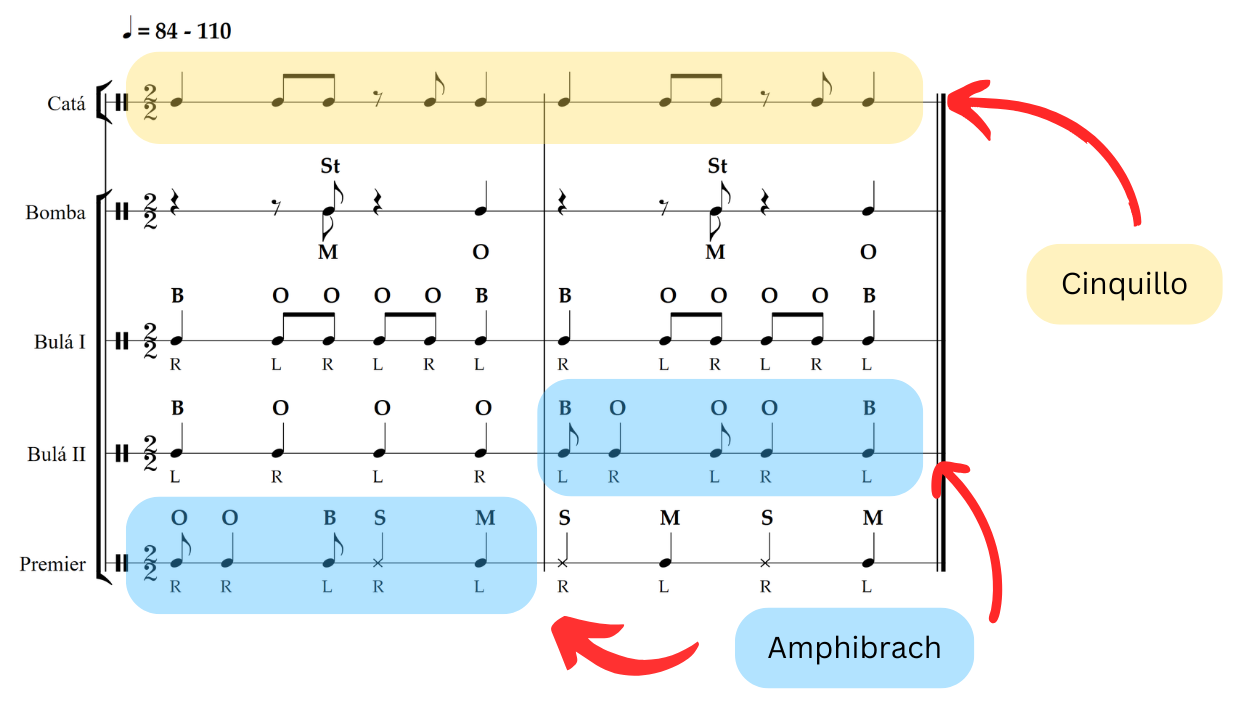
An interesting result of the terrain which divided Cuba was that for decades the music on either side of the country developed in different directions. While it was possible to hear the cinquillo and amphibrach in the west, the two rhythms were considerably more prominent in the eastern variant of contradanza. As you may have guessed, eventually the cultures of both the east and west eventually came together, thanks to the few people who decided to make the journey across the island. One such group of people which frequented the different cities of Cuba, as well as other Caribbean islands, were the Spanish military bands, who more than once helped introduce new rhythms from either side of the mountains. In the case of contradanza, there are records from 1836 which indicate that the cinquillo was adapted to the repertoire of a military band visiting Santiago de Cuba when the band director, Juan Casamitjana heard the rhythm in a street parade. From there, you can imagine that the rhythm was played wherever the band went, helping to transplant the cinquillo from east to west. The rhythms weren’t the only influence that was brought from the east, with instruments also making the journey. One of the most popular examples is an inherently African instrument, the guiro, which started out predominantly in eastern Cuba but picked up popularity across the island over the 19th century.
By 1852, the influence of the Afro-Haitian refugees had arrived in Havana in the form of the guiro, cinquillo, and amphibrach. Of course, it is highly likely that the west had these influences already, whether it be through the Afro-Cuban cultures already present or by earlier travellers from the east. But 1852 is when we start to see a major influx in the two rhythmic cells being used in published contradanzas, as well as the inclusion of the guiro in the orquesta típica. A fantastic example of this rhythmic fusion is José Fernández de Coca’s contradanza Cambujá, where all four rhythms are present.
Cambujá
José Fernández de Coca
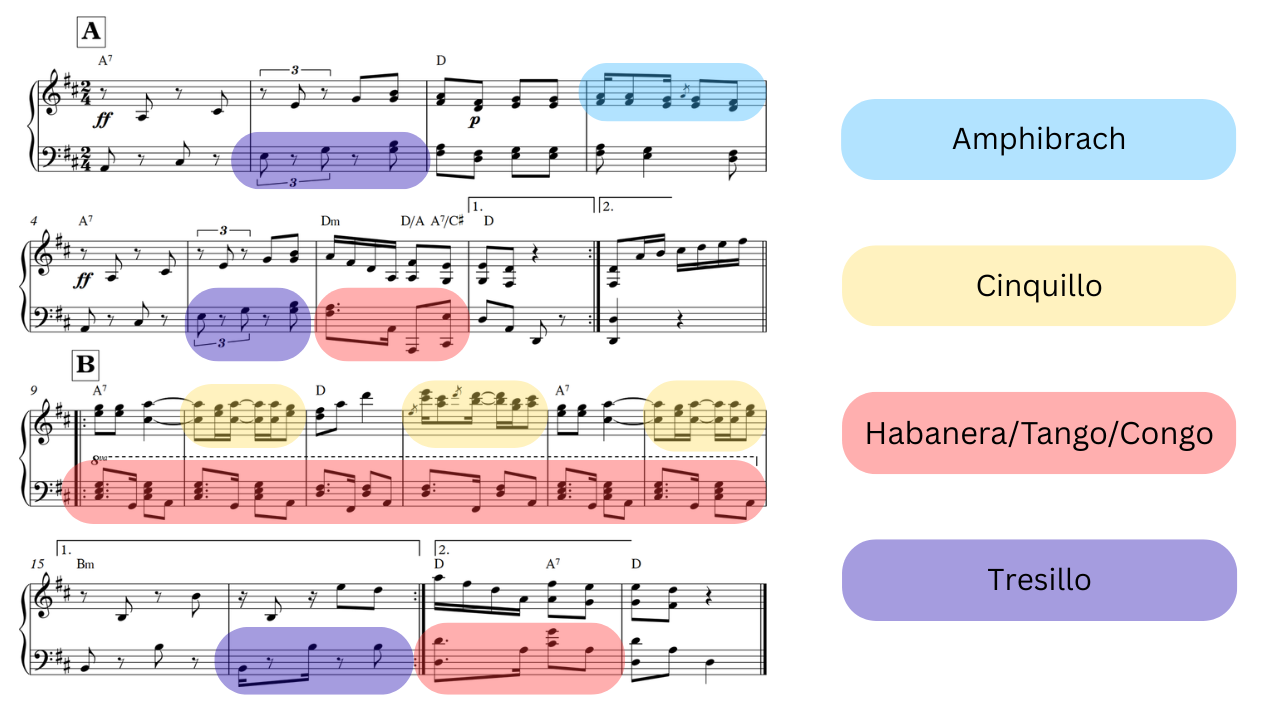
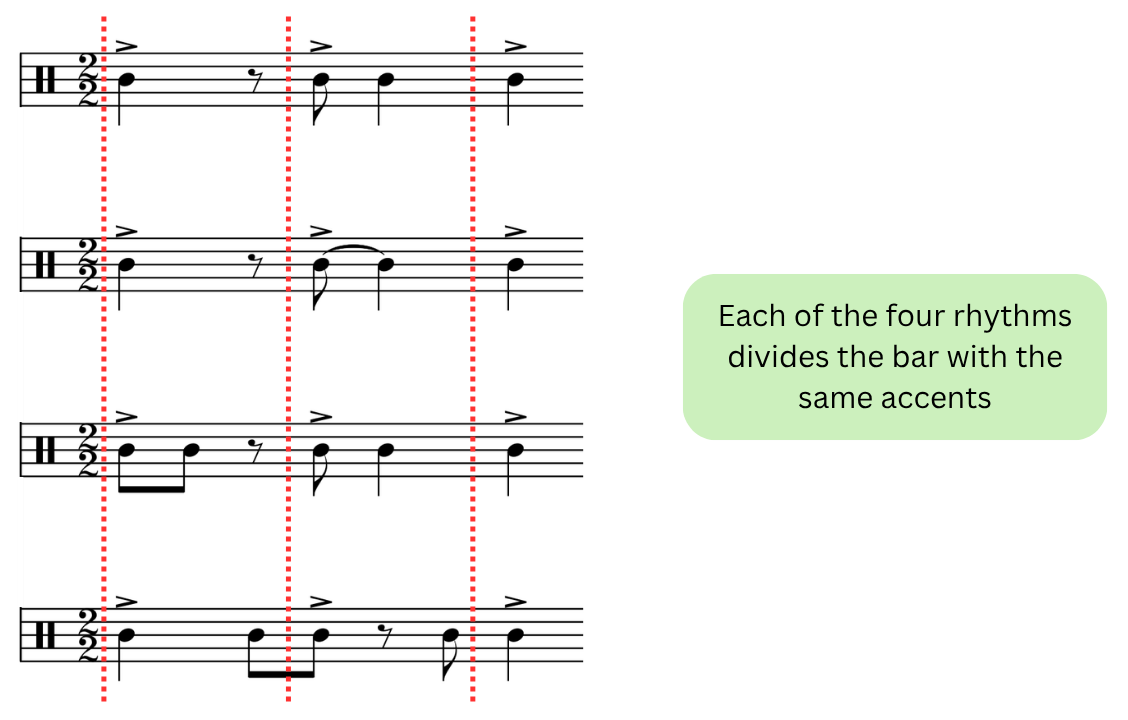
If we look closely at how the rhythms are used in the piece, what we see is that they are actually in a two-bar format, almost as if they may be implying a clave direction. Now we won’t be unpacking the complexities of clave in this particular resource but what is important about this observation is that it showcases how each of the four rhythms can be utilized in a different way to what we have previously discussed. Although each of the four rhythms are unique, they all share a similar quality, more specifically, they all divide the bar with the same eighth note/quaver subdivision: 3-3-2 (best displayed by the tresillo). Interestingly, despite having this particular set of accents which follows the exact same accent as the 3 side of son clave, all four rhythms are thought of as being clave neutral and can be used in any combination without the worry of crossing clave.
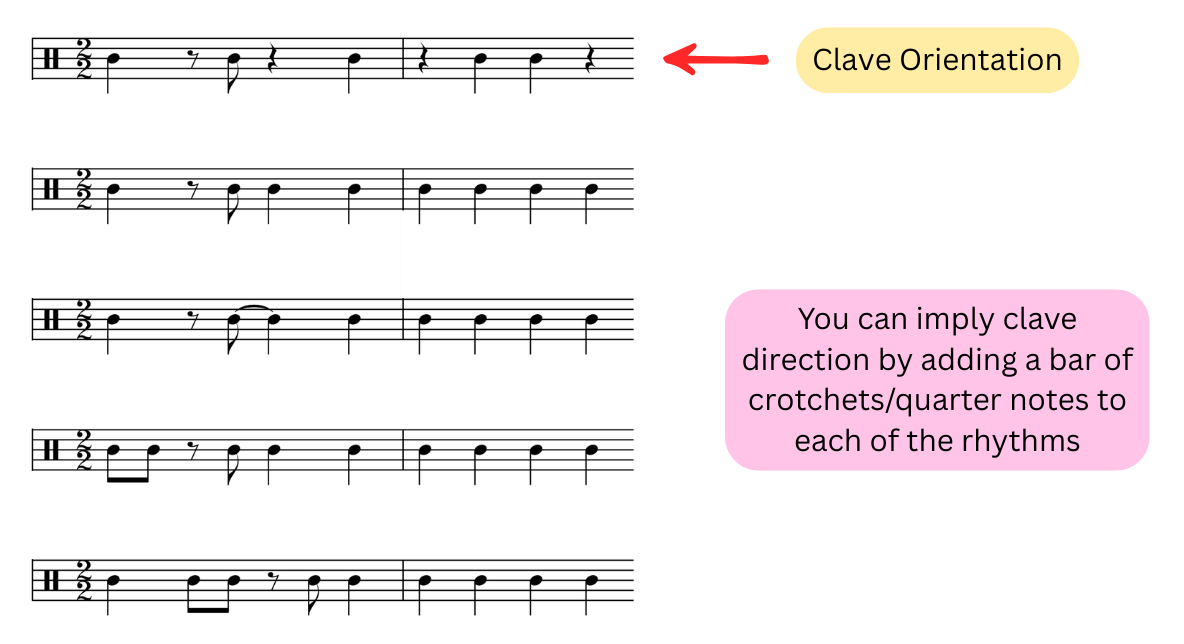
Cambujá, on the other hand, used these rhythms in a two-bar format by adding a second bar to each of the rhythms which created a two-bar lilt, a distinctly African and Afro-Cuban trait. To do so, the rhythmic cells alternated with a bar of quarter notes/crotchets to create a new two-bar variation. As a result, the original four rhythms now took on a clave direction, reinforcing the 3 side with the additional bar falling on the 2 side. However, don’t worry too much about trying to understand clave at this stage as we will look more closely at how it functions in another resource. The takeaway here is that there are now two formats for each of the rhythms, a one-bar variation and a two-bar variation.
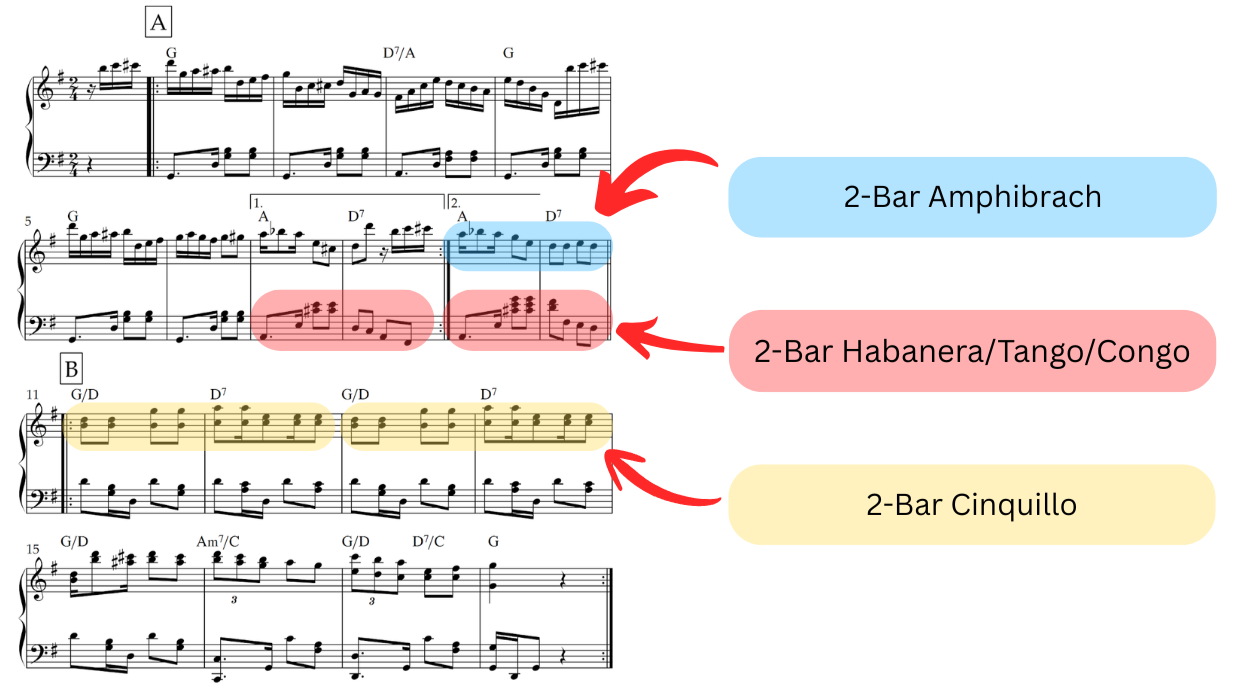
It is unlikely that Fernández was the first person to utilize this sound in a contradanza, but it is a great example of how by the mid 19th century these rhythmic variations had started to be implemented into formal compositions. By looking at another composition of his, specifically the B section, we can see a two bar variation of the cinquillo cell quite clearly.
Ave María Gallo
José Fernández de Coca
Unfortunately, all of this music was written prior to recording technology meaning we don’t know exactly what it sounded like. However, we do know that alongside the written contradanza parts the percussionists would often play these four rhythms in either the one or two bar variations. Based on the Afro-Cuban traditions that were present at the time, it is likely even clave patterns or other bell patterns were also played in contradanzas too, but sadly none of the published sheet music comes with directions for the percussion parts.
As you can see, the middle of the 19th century was an exciting time for musical development in Cuba. With the characteristics of eastern contradanza having made it to Havana in the west, the stage was set for the style to evolve further. But perhaps not how you might expect. Instead of progressing in a similar fashion to what we have just explored with Cuban creolization, the dance format of contradanza shifted, and with it came a new style name.
Danza & Habanera
When it has come to naming conventions we haven’t really run into too much trouble so far. With that said, one of the most confusing aspects of Latin American music are the style names, especially if you don’t speak Spanish. What exactly differentiates one style from another may not be that obvious and can be the point of hours of frustration. I’ve been there many times and I hope that I can help you avoid the situation where possible. The reason I bring this up is because we are now about to cover a new style which sounds identical to the contradanza examples we just looked at. To make matters worse, many of the surrounding colonies shared similar musical developments or were directly influenced by Cuba, creating music that sounded the same but was referred to by completely different names. For example, Cuban contradanza was called merengue elsewhere and danza in Puerto Rico. Additionally, depending on the background of a certain author or the origin of a document, a reference to a style may not be the same from one source to another and can lead you astray. All situations I’ve come across and something which always makes this music that much more confusing to learn.
Getting back to the music more specifically, as we have just seen, the Cuban contradanza came a long way from the early English country dance format that it was originally based on. It now had creolized rhythms and Afro-Cuban percussion, and in general sounded a lot closer to something we might now associate with Latin music. However, while the musical characteristics were evolving, the accompanying dance format was also going in new directions. It was no secret that the cedazo, the eight-bar section where partners broke away from the group to dance as a couple, was the favored dance figure of contradanza. As a result, over time this figure grew longer and eventually stretched to 16 bars to cover the entire B section of a piece. The dancers would race through the other three figures (the paseo, cadena, and sostenido) in the A section to allow for the maximum amount of time to dance the cedazo. Eventually, the cadena and sostenido disappeared, leaving the cedazo to be danced primarily over all sections with the paseo being used as a chance to rest when needed. With this shift in the dance format, a new name began to be attached to the style: danza.
What makes the difference between danza and contradanza confusing is that the two words are used almost interchangeably. While there is a difference between the dance format of the two styles, the same can’t be said musically. Some composers kept referring to their pieces as contradanzas while others used the newer danza. For our purposes, it doesn’t really matter, and I personally think of danza as describing the point when contradanza started to have the cinquillo more commonly in the published sheet music around the 1840s-50s. As long as you are aware that the name is generally associated with a change in the dance format, that will hopefully be enough to get you through most of the literature on the topic. Outside of the change in the dance format, there were other minor differences which included the tempo, with danza being slightly slower than contradanza, as well as the A section sometimes being in 2/4 while the B section was in 6/8.
No Me Toques
Ignacio Cervantes
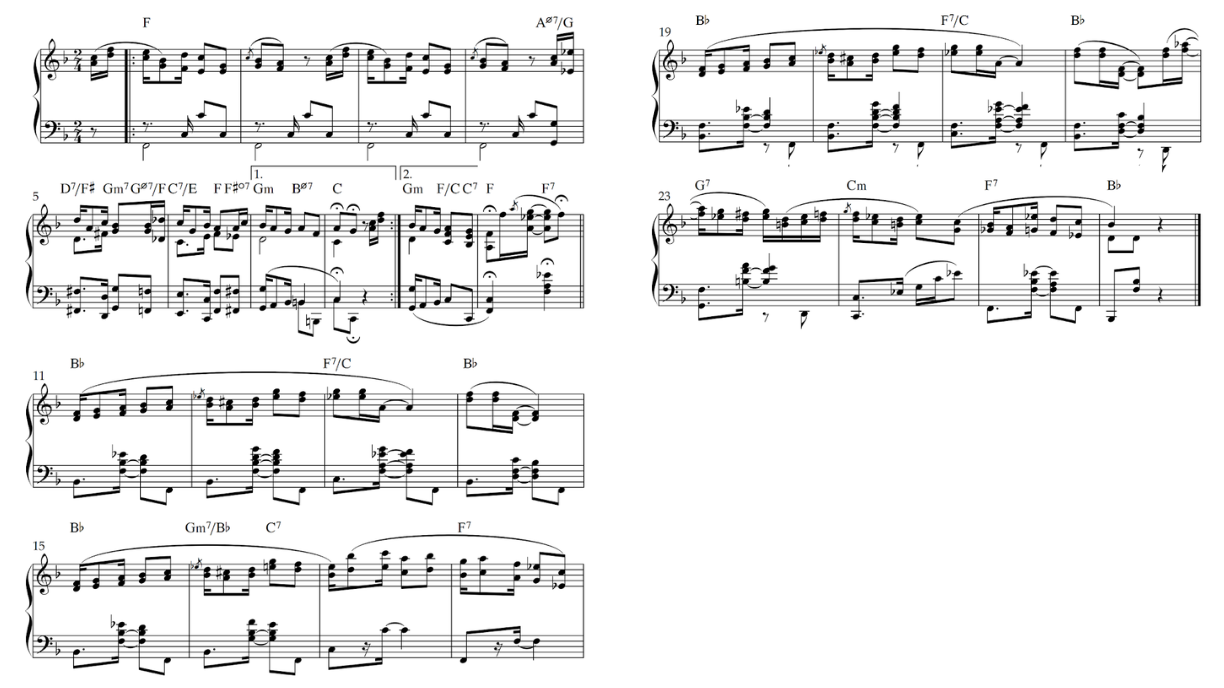
Up until now, contradanza and danza have featured an instrumental accompaniment, but in 1841 a new variation of the style was debuted in Havana which added vocals. While El Amor En El Baile may not have been the first contradanza with an accompanying vocal part as prior to 1841 there had been examples with short vocal phrases added to the B section, the composition would have been one of the first full length contradanzas to have vocals throughout. Just like how a change in the dance format led to a new style name being created, the addition of vocals turned the contradanza/danza into the habanera. Not to be confused with the rhythm which shares the same name.
Just when you thought these name changes were starting to make sense, I should mention that depending on the source, some authors do refer to the non-vocal contradanza/danza as habanera. Which means we now have three possible names, all found in Cuba, which can refer to exactly the same style. Although there is some confusion when trying to decipher which style a historian may actually be referring to, the titles contradanza, danza, and habanera all relate to very similar music with only slight variations and in the music world there isn’t a major issue with using the three names interchangeably.
And just like that, you now know all that you need to in order to replicate contradanza, danza, and habanera. But we are not done yet, because all three of these styles were stepping stones for the creation of the first national style of Cuba. A foundational piece of Cuban culture which went on to shape the sound of many of the most popular Latin styles of the 20th century. You’ve seen me refer to it a few times already in this resource and now it’s time to tackle what is so special about danzón.
Danzón
The second half of the 19th century was an interesting time in Cuban history, specifically 1880 which was a very important year for the country. It contained one of the single most impactful events for the island, something which contributed vastly to Cuban music and resulted in the creation of dozens of new styles including danzón. What I am referring to is the year that slavery was abolished.
Thanks to a number of revolts spanning from Spain to Puerto Rico in the prior decades, the Afro-Cubans in the east were inspired to rise up against slavery and fought for Cuba to be an independent country. Unfortunately the resulting war ended in failure for the Afro-Cubans, with the government still remaining in place. However, The Ten Years’ War did impact the Spanish crown significantly, who did not want to risk losing Cuba through possible future uprisings. To help remove any incentive for Afro-Cubans to seek independence again, Spain chose to abolish slavery as it was the primary reason for people of color to side with the independence movement. Although plantation owners heavily disagreed with the ruling, the operations in the country were still profitable which meant Spain was still able to make money from the colony.
With the abolition of slavery came a new era for Cuba, one which saw large numbers of freed slaves move to western cities. Havana’s population exploded and thrown together housing was erected on the outside of the city, similar to the favela found in modern day Rio De Janeiro. Cabildos were shut down by the Spanish who saw them as unnecessary as well as potential meeting places for revolutionaries. Some became social clubs and others disappeared entirely, forcing religious activities to move into private homes and ushering in a further level of secrecy for most Afro-Cuban religions. Once the dust had settled and the Afro-Cuban’s actually felt free, a new wave of Cuban music began to be created, one which incorporated centuries of Cuban creolization and was not bound by the restrictions of slavery. The result was the creation of multiple styles, many of which are the foundational styles for Cuban music today, including the main topic of this resource: danzón.
Emerging during the 1870s, the style started to be associated with the abolition of slavery, becoming somewhat of a national sound for the people of Cuba to rally under. While danzón was a natural continuation of contradanza and danza, it actually received far more attention due to the period it came to fruition. Like many other styles such as rumba, danzón is often said to have been created in 1880 to align with the end of slavery, but in reality there are published examples of danzónes from the previous decade and it is likely that the style was being played earlier than that. For example, Las Alturas de Simpson was written in 1877, debuted in 1879 by Miguel Failde, and is considered to be the first official danzón. Although there are disputes as to whether the style existed before this premier, historians agree that the performance represented the start of the danzón era, one which stretched until the 1940s.
As danzón comes from the contradanza family, many of the elements we covered earlier are still present. Melodically and harmonically, the style reflected the European classical tradition, and as such, became more colorful than the earlier contradanzas which relied more on I and V chords. Melodies were often harmonized in 3rds and 6ths in line with 18th century counterpoint rules, and trumpet lines were often harmonized in 5ths. Interestingly, due to the popularity of the style, composers were under massive time constraints to meet the demand for new music, and in turn began to use common melodies with their pieces to save time. Turning to rhythm, danzón embraced the major rhythmic cells of danza, to the point where much of the style was saturated with them. Notably, the cinquillo was used more often than earlier styles, reflecting the popularity of the rhythm after the eastern influence came to Havana. For the most part, danzónes were also in duple time and performed at a slower tempo than danzas.
One of the unique factors that helped danzón stand out as a musical style was the extension of the form. Instead of using a binary form like before, there was now an added C section which shifted the AABB structure to an ABACA rondo form. The inclusion of this new section allowed more time for dancing as well as for more musical development, with the A being similar to the A of contradanza and being assigned a full orchestral texture while the B was assigned to the clarinet and the C assigned to the violin. As we saw with the transition between contradanza and danza earlier, the dancing once again evolved between the danza and danzón, removing all but the paseo and cedazo figures. Danzón was now primarily a couple’s dance, with the paseo only being used as a rest for the dancers.
Las Alturas de Simpson
Miguel Failde
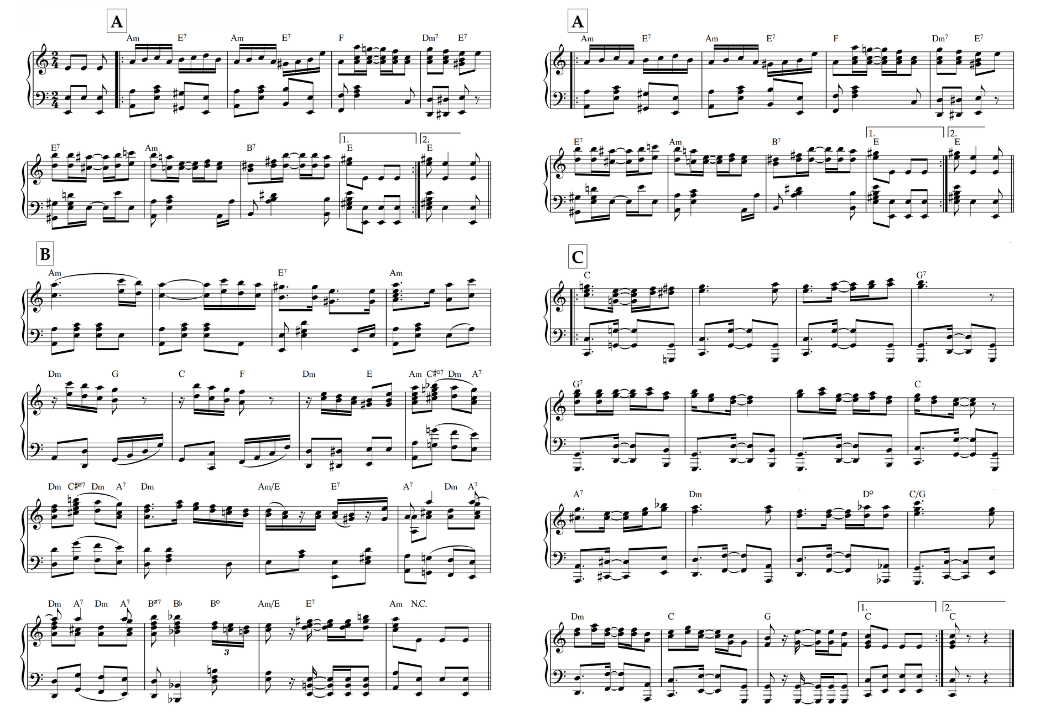
Like before, the prominent instrumentation for danzón was the orquesta típica. Although there were now more detailed orchestration instructions for the ensemble, one aspect that still alludes us is exactly what the percussion would play. An informed guess would suggest that the timbales and guiro would play in a similar manner to danza and often play either a single or two-bar variant of the cinquillo rhythm. Of course we will never know for sure due to no information being present on the sheet music which remains, but I think this is a pretty safe presumption. However, by prioritizing a two bar rhythmic cell, there could have been some degree of clave direction implied alongside the melody. Using El Bombín De Barreto as a case study, after listening to a dozen or so different interpretations, there is no agreed upon two bar orientation of the cinquillo rhythm. Some use the rhythm more freely while others adhere to a more strict two bar cycle. What this tells us is that it is unlikely that a strict two-bar clave cycle was being applied to an entire piece. Of course the primary performers of danzón were Afro-Cubans, so it would be silly to think aspects like clave did not impact the music to some degree, we just will never know for sure and the earliest recordings of the style do not provide any level of consistency with the percussion parts. What authentic recordings we do have are usually from the early 20th century and feature a different ensemble type, the charanga, that we will cover elsewhere once we start discussing how danzón turned into mambo.
Now danzón wasn’t just popular in Cuba and actually found quite the reputation elsewhere in the Americas. Thanks to a composer by the name of Louis Gottschalk, elements of the style were introduced to the United States, where they actually helped play a role in the development of jazz by way of ragtime (you can read more about that in my resource on Early Jazz). But the style didn’t just travel north, with contradanza, danza, and danzón all being transplanted across the colonies of the Caribbean, Central, and South America. As creolization between African and European cultures took place anywhere slavery existed, exactly how much the influence came directly from Cuban music is hard to gauge. However, many of the core components we have covered can be seen in dozens of other Latin American styles in the same time period, specifically with use of the habanera/tango/congo, tresillo, cinquillo, and amphibrach rhythms. Some examples include Argentine tango, Puerto Rican bomba, Jamaican mento, and calypso from Trinidad and Tobago.
Danzón was an exciting style of music, one which celebrated centuries of creolization in Cuba and that all Cubans could enjoy, no matter their background. Due to the significance of the styles related to danzón (contradanza, danza, habanera, mambo, cha-cha-chá etc.), it is considered one of the major branches of Cuban music, with this body of styles often being referred to as the danzón complex. But before we can continue with the journey danzón took from contradanza to cha-cha-chá, there are some necessary detours we must make. Up first is a tremendously important style which paved the way for the rhythms and roles of Cuban percussion instruments and is filled with overlapping parts and polyrhythms: rumba.
The Takeaway
Contradanza, danza, and danzón changed the Cuban musical landscape forever, and offer a great insight into the creolization process, clearly connecting the African influences with more modern-day styles. For me, these three styles played a prominent role in understanding Cuban music and were the first Latin styles I started to really understand. As they were built from many of the same concepts covered in Western music theory and classical music classes, I found it much easier to digest the subtle differences that came from Cuban creolization. Specifically, it was through contradanza that I was introduced to the four key rhythms, an element which transformed my approach to writing Latin styles forever. Not only did these three styles change my outlook on Latin music, they also redefined my thoughts on jazz history by offering a stepping stone into the music of New Orleans at the start of the 20th century. I hope through this resource I’ve been able to bring you along the same journey I got to experience all those years ago and now with this topic firmly covered, we are perfectly primed to dive into the deep end of Cuban music!