

The Origins of the Montuno
& How to Write One
When you think about Latin music there is one particular pattern which seems to be universally loved. Whether it be the rhythmic variety or its place in a groove, the montuno has become a quintessential ingredient found in almost every Latin style. Without knowing it, by the time I had hit my teenage years I had already been exposed to montunos countless times, whether it be with Santana’s Smooth or the Cat Empire’s self titled album. I had also encountered them in various playing situations, to the point where I knew what the word montuno represented musically, however that was as deep as my understanding of the pattern went. It wasn’t until I finally started looking at Cuban music in more depth that I began to understand not only how to construct a montuno but also what led to the pattern existing in the first place.
To my surprise, what I found was a deep lineage of styles associated with the mountainous regions of east Cuba, each of which developing the montuno into what we hear today. More so, I found a connection between the African nations which were brought to Cuba and how the montuno was simply an extension of a musical tradition that had existed for centuries prior to slavery. After spending some time with the history and styles such as nengón, kiribá, and changüí, I started to understand the components behind crafting a montuno. How at its core, a montuno is a small number of notes, usually the fundamental tones from a given chord, that are played over a syncopated one or two bar rhythm. However, I also found that depending on the context, the specific rhythms could change and that there was considerable flexibility to what could be called a montuno. Not to mention that it often operated as a rhythmic and harmonic complement to the other parts in a given ensemble.
Eventually my pursuits took me to one of the most influential Cuban styles of all time, son, which became the primary delivery device for the montuno around the world. I discovered that not only did the montuno start to be transplanted across Cuban music, but so did other aspects of son such as the bass rhythms and bongó parts. Thanks to one style, every other popular Latin style changed and gave us the foundation for the Latin music that exists today.
In order to fully understand the role of a montuno as well the many variations that one can use, this particular resource will trace the history of the pattern, going back to where it all began and unpacking how different Cuban styles have utilized it. Because there are an overwhelming number of variations possible today, we will specifically be focusing on the styles which led to the creation of son as well as the variations of son in the early 20th century. Importantly, we won't just be looking at montunos but also the many other characteristics of these styles to help provide a deeper contextual understanding. But don't worry, over the span of four or five different resources we will look at the development of montunos from the start of the 1900s all the way to today, with this particular article opening the conversation and another on timba and modern Cuban music concluding it. As you will see, there is quite a bit to discuss, so without further ado, let’s jump in and explore the montuno.
Humble Origins
Like many aspects of Cuban music, the story of the montuno begins in Sub-Saharan Africa prior to the beginning of the slave trade. As we discussed in another resource, within Africa at the time existed a number of diverse cultures, with many of the Sub-Saharan nations sharing various musical characteristics. Of particular importance to the montuno was an instrument called the mbira, a thumb piano related to the more commonly known kalimba, that was used to play repetitive sequences of notes. Fortunately for us, even though recording technology didn’t exist hundreds of years ago, the instrument is used in a similar capacity today, allowing some level of insight into what these patterns may have sounded like. As the instrument comes from a non-Western background and makes use of an entirely different system to justify both the rhythm and tuning, it would be a disservice to the mbira and the various African cultures that use it to try and convert what is being played into Western music notation. However, what we can pick up from listening to examples is that there are consistent streams of notes with some level of repetition taking place, a characteristic that travelled with the African slaves to Cuba starting in the 16th century.
Like many elements of African culture, the original instruments from Africa were not allowed on the voyage to the Americas, resulting in African slaves creating new instruments wherever they were taken. A fantastic example of this in Cuban music is the creation of the conga, which we explored in more detail in the resource covering rumba. However, sometimes a new instrument wasn’t created at all and instead the musical patterns that were once played in Africa were captured through a different manner entirely. This is exactly what took place in eastern Cuba, where the music of the mbira was transplanted onto a new instrument called the tres. While the tres is now quite a common instrument in Latin music, it wasn’t something I had come across until I started researching Cuban music. As such, it might be worthwhile to take a brief detour and unpack the instrument in more detail.
The tres is an Afro-Cuban stringed instrument which features three pairs of double strings and is slightly smaller than a modern acoustic guitar. It likely originated from the city of Baracoa in the Guantánamo region in the 1890s, a town which played a large role in defining the precursor styles of son as we will see later. Some historians believe it came from the bandurria, an instrument with close ties to the punto guajiro style (which we briefly looked at in an earlier resource) which also features multiple sets of double strings, but others argue that it has more humble origins like the conga. Unlike guitar, the gauge of the strings is much heavier and are played purely with downstrokes of the pick, resulting in a thicker, more percussive tone that is used for single note lines over the conventional chordal approach of other related instruments. The three doubled strings are a mixture of unison and octaves usually tuned triadically, the most popular being gG-cc-Ee, with the outer pairs in octaves and the middle pair in unison. By tuning some strings in octaves, the tres can play lines that feel like they ascend or descend for what can seem like an infinite period. For instance, the tresero could emphasize the lower octave in an ascending line and then repeat the exact same pattern in the higher octave to create a phrase which spans two octaves without the player shifting position. This technique offers the musician multiple options and helps add variety into their playing.
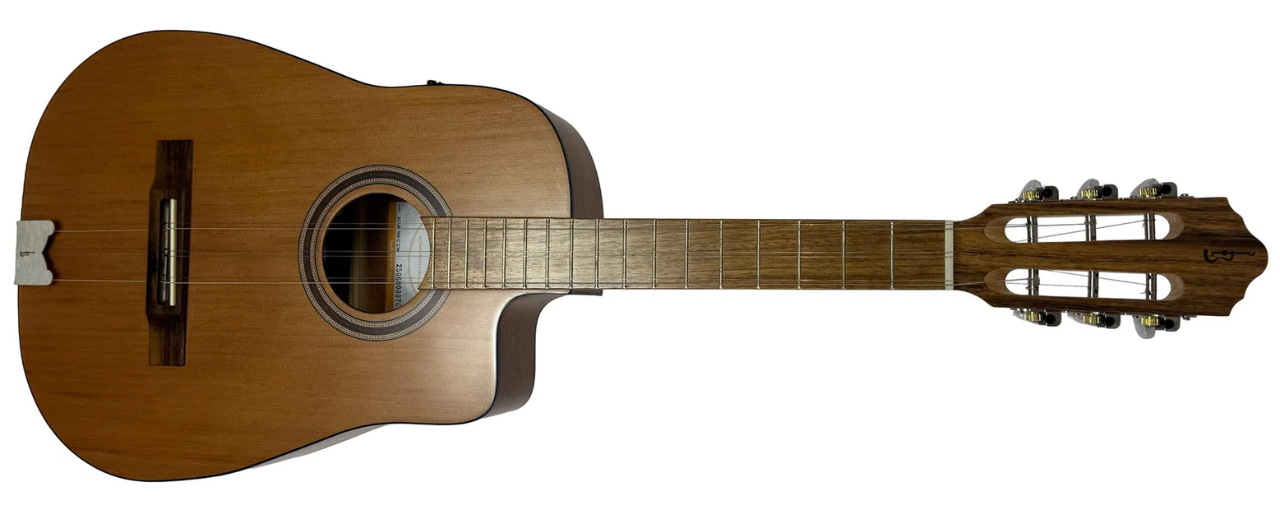
Jumping back into the montuno conversation, the tres is often assigned specific repetitive patterns or phrases called guajeos. Originally these would have mimicked the same lines the mbira played in Africa but over time they changed into the highly syncopated rhythms we hear today. While many people aren’t familiar with the word guajeo, it is interchangeable with what the Western world calls an ostinato, and after the creation of the son montuno style where the piano replaced the tres, is often referred to as montuno in the context of Latin music.
Personally, I find it absolutely fascinating how the modern montuno was a result of the original mbira patterns crossing continents and changing instruments, but perhaps more important to this resource is the actual change in music which accompanied this development. To fully understand how the montuno evolved, we have to go back to the early styles of eastern Cuba, specifically nengón, kiribá, and changüí, three styles which established the rules for the tres and the rhythms it played, as well as created the blueprint for many of the common rhythm section roles that still exist today in Cuban music. Notably, these three styles blended together to create the early variations of son, similar to how contradanza eventually led to the creation of danzón. Unlike rumba and the other styles that came from the western cities, the eastern portion of the island was not touched by as many new waves of slavery, resulting in a very different sound of music being created. We saw this briefly in the comparison between conga habanera and conga oriental in a previous resource, but the difference is quite noticeable when looking at the styles surrounding the montuno and how they compare to the other prominent Cuban music at the time.
Nengón & Kiribá
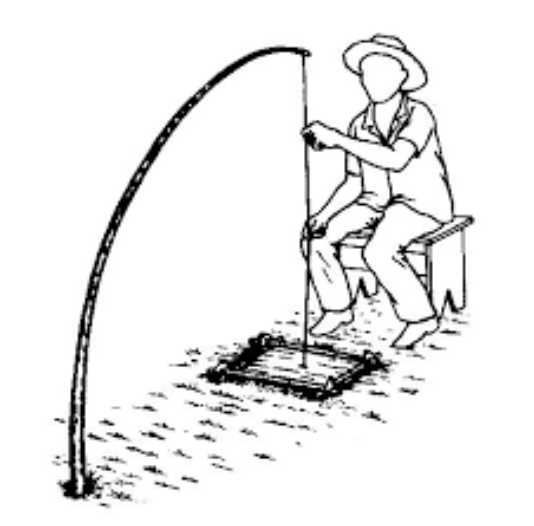
Out of the three styles, nengón is thought to be the oldest and can be seen as the precursor to the other two. It was created in the city of Baracoa, specifically in the El Cuerco neighbourhood, but unfortunately a formal date can not be attributed to the style due to the lack of historical records. As some historians believe changüí was referenced as early as the 1860s by local musicians, it can be assumed that nengón predated that period even though the first formal date associated with the style was in 1898. Regardless, there are many historical elements of the style that are more commonly known that we can focus on. Like most Afro-Cuban regional music, nengón accompanied local parties and featured instruments made of everyday materials. In the beginning, the style featured the tingo talango (arguably the best name for an instrument I’ve ever come across) or tumbandera, an earth bow of African origin that produced a low bass frequency and was played alongside a small drum called the bunga. Over time the instrumentation changed to incorporate the tres, maracas, and three distinct vocal roles, and by 1925, well after son was established, nengón ensembles replaced the tingo talango with the marimbula, a large bass mbira, as well as added the bongó and guitar. Due to there being no recordings of the early variations of the style, we will be primarily looking at this later version of nengón for analytical purposes.
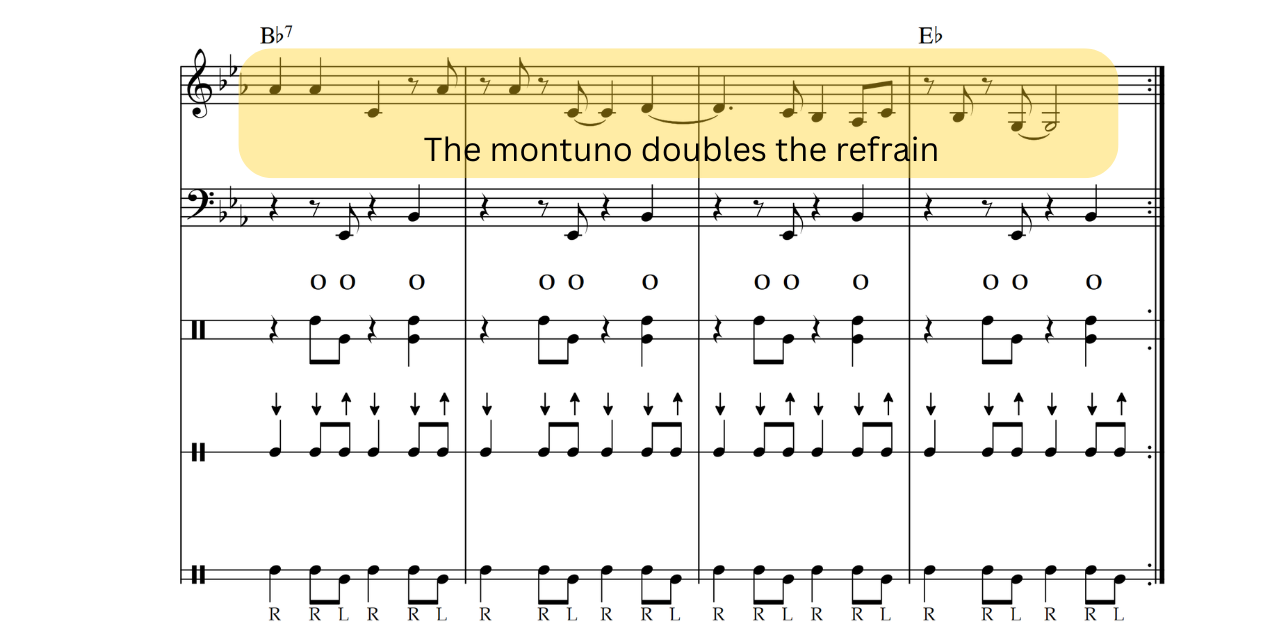
In contrast to other Afro-Cuban styles such as rumba or conga de comparsa which primarily feature non-harmonic instruments, nengón stands out by including the tres with an accompanying bass instrument. As a result, the style has an established sense of harmony outside of the accompanying vocals and is one of, if not the only, early Afro-Cuban styles to feature harmonic accompaniment. Between the two instruments a two bar chord progression is created, typically outlining a I-V movement in line with many of the other Cuban styles of the period. As we mentioned earlier, the tres established the progression through a repetitive single note line, a guajeo, rather than strumming chords. The most common option was for the guajeo to double the choral refrain as well as reinforce the harmonic progression, resulting in the first template we can copy when writing our own montunos.
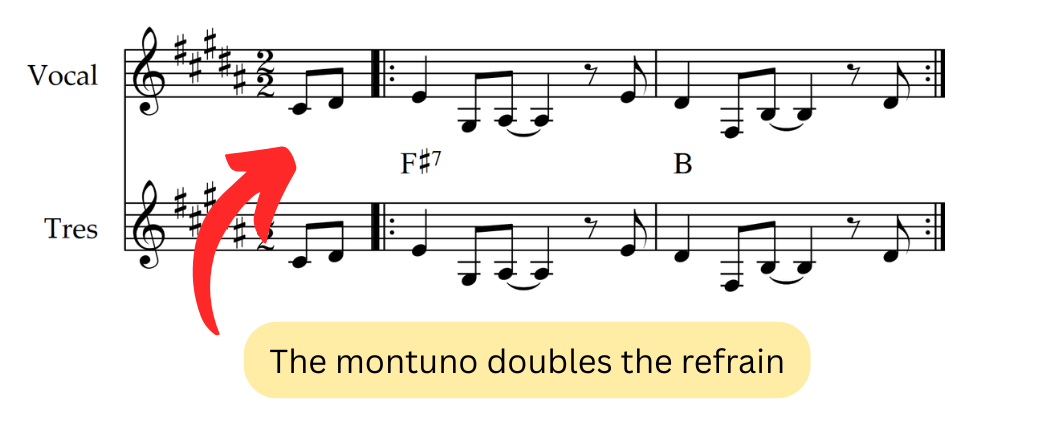
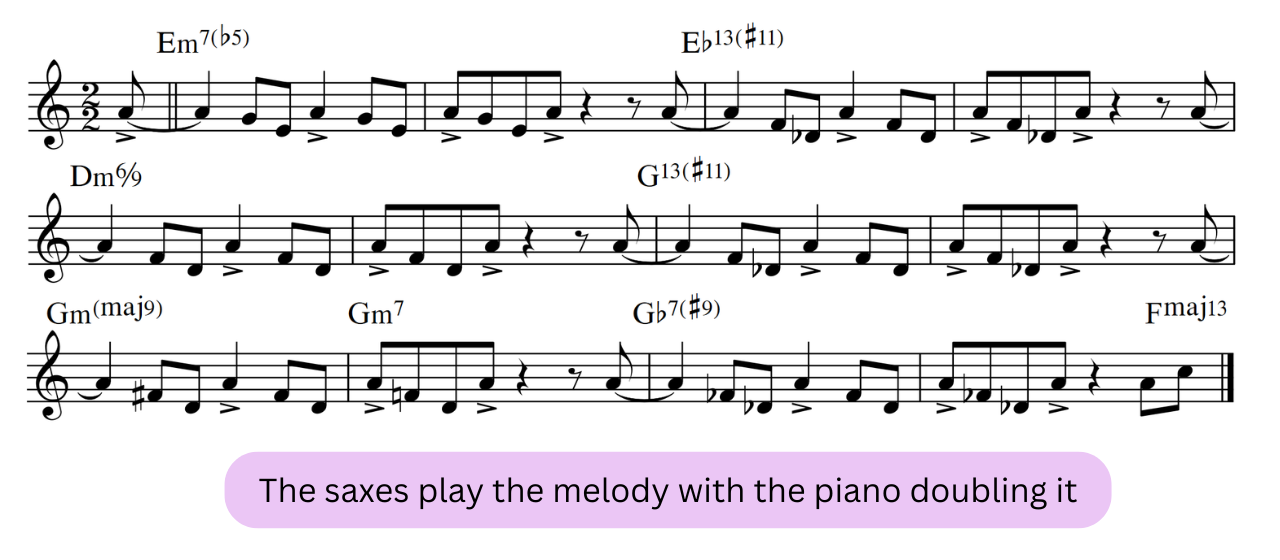
While it may sound somewhat simple compared to some of the patterns that exist in modern Latin music, you’d be surprised how effective it is to copy the main hook of a chorus or pick a certain motif and double it in a montuno part. Sometimes the line may need to be edited slightly to either add more syncopation or additional notes to better represent the chord progression but for the most part taking a portion of the melody is a quick and practical way to write a montuno, and even better, it’s authentic! I’ve consistently been surprised just how effective this approach is and have used it multiple times in my own writing, such as in my arrangement of A Night In Tunisia where I use the melody in the C section as a montuno.
A Night In Tunisia
Arr. Toshi Clinch
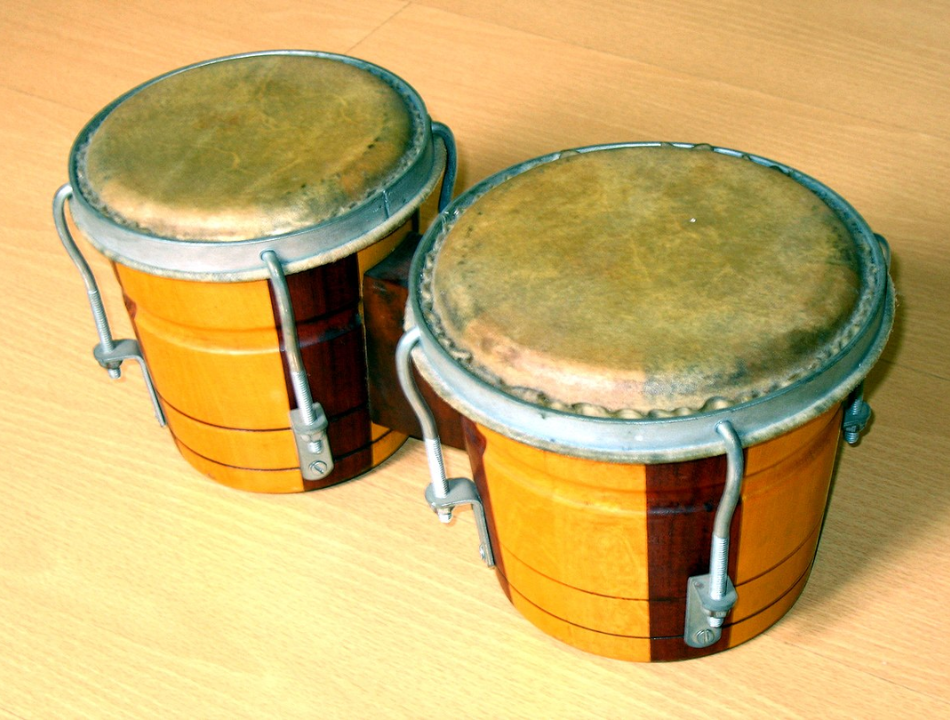
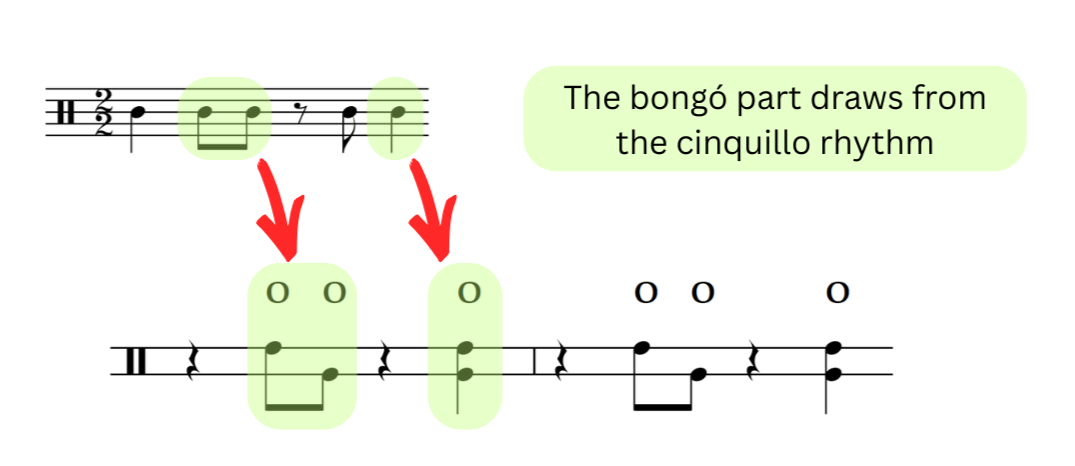
Before moving to the next style, it’s worthwhile to unpack what the other instruments play in nengón as we will see many of those same characteristics come back later when we explore son. Up first is the bongó, the first inherently Cuban drum to emerge from the country and an instrument that was created at a similar time and in a similar location to the tres. However, due to their use in pop culture today, these drums are far more recognizable in the Western world. Unlike the conga, the bongó did not come out of any one African influence, instead, it was a new instrument which was highly versatile and could mimic the Afro-Cuban drums, transplanting that vocabulary to other musical contexts. Originally, the instrument was made from two bocú drums (as found in conga oriental) and was played sitting down with the drums held between the bongosero’s knees. The drums had one larger and one smaller head to reflect the genders of the instrument, a trait found consistently in Africa and in Afro-Cuban music, and were much smaller than the modern conga. However, the size did not diminish the volume that the bongó produced, emulating a similar crack to what can be heard by a quinto in the rumba tradition. The double headed nature of the drum made it quite flexible, allowing the player to access many different Afro-Cuban rhythms whether they be from the early folkloric ceremonies or from later styles. Although the drums were from Oriente, they eventually became popular throughout Cuba and across the world with the development of son. This process transplanted many folkloric rhythms into popular dance styles, a process which the conga couldn’t do due to their prohibition prior to the 1940s. It should also be noted that the bongó played in nengón, as well as the other precursor styles to son, is slightly different from the instrument you may be familiar with. Its full name is bongó de monte, and it is tuned considerably lower than modern day bongós, sometimes being even lower than conga drums. Interestingly, the drums are played in reverse to son, with the larger drum, the hembra, on the drummer’s left-hand side with the macho on the right. Alongside the guajeo in the tres, in nengón the bongó follows a consistent pattern that is likely derived from the cinquillo rhythm and can interject rhythmic fills from time to time to add interest.
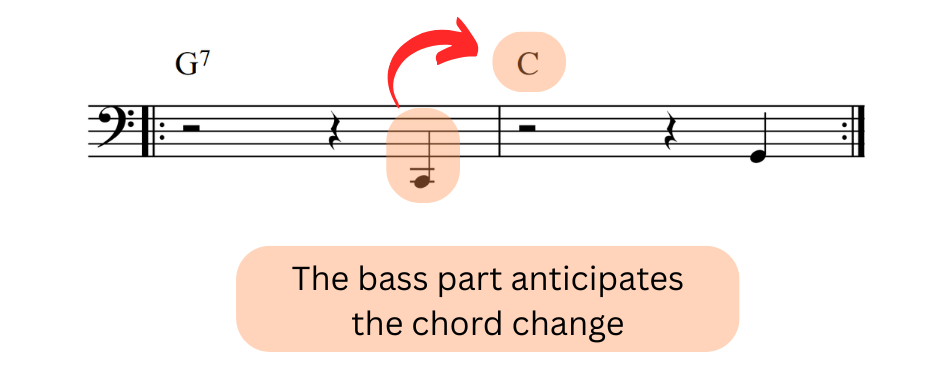
Moving on to the role of the bass instrument, the tingo talango (and later the marimbula) generally plays one note per bar which has an indistinct pitch and lands on beat four. As a result of this rhythmic placement, nengón has a feeling of anticipation where the chord progression is constantly being pushed each bar.
The last instrument to accompany the ensemble is the guayo, a metal scraper which outlines the major downbeats. In some circumstances, the instrument can be replaced with a standard guiro, and in many cases is played alongside a pair of maracas which outline the same rhythm. Unlike any of the other Cuban styles of this period, nengón also has a different rhythmic lilt where eighth notes/quavers are played in a quasi-triplet feel quite like the swing feel found in jazz. Additionally, there is no primary bell pattern to guide the instruments or dancers.
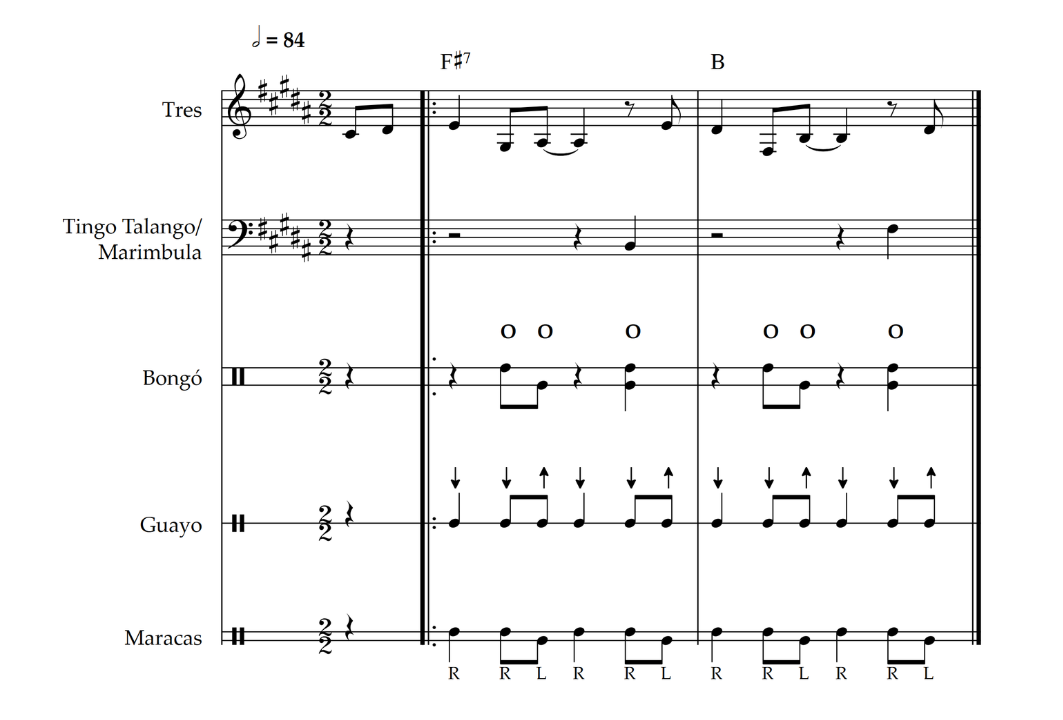
Like much of Cuban music, the vocals, lyrics, and dancing play a major role in nengón. Alongside the instrumentalists are three vocal parts divided into one lead singer, and two supporting singers who only enter for the choral refrains. Sometimes the lead vocalist may improvise the lyrics, but in general they follow a set verse with lyrical embellishments while the choral refrain features common phrases such as “Cogelo pa’ ti nengón.” For the most part, the melody of both the verse and the choral refrain are based on the guajeo played by the tres with the only differences coming from the number of syllables assigned to each rhythm.
As you can imagine, there are also unique qualities found in the dance, where most of the figures are built around the movements of farmers and plantation workers in the Guantánamo region. The couple’s dance is made up of multiple actions with the most characteristic being a foot-dragging motion drawn from how slaves used to grind coffee and cacao beans with their feet. Other figures reflect the general nature of everyday work on a farm such as cattle tasks and horseback riding.
Finally, the last characteristic worth mentioning is form. Initially, the piece begins with a section called the Llamada de Montuno, where the tres starts playing a guajeo. From there, the bongó and bass part join on an anacrusis with the remaining instruments being introduced on the downbeat in a section called the Ejecución Colectiva. These two parts make up the introduction which is then followed by the main body where the lead singer sings multiple verses and cues the choral refrains. It is during this section, called Canto de Nengón, that the dancers join the party, eventually finishing with a dynamic climax followed by a slow decrescendo.
Moving on to another regional style of Baracoa, kiribá is very similar to what we have just unpacked with nengón, however it is faster and features a few points of difference. The style likely emerged sometime during the mid-to-late 19th century but unfortunately like nengón there is very little documentation about its history other than the stories passed down by locals. Looking at the various instrumental parts, the tres plays a guajeo, with many of the recordings I’ve listened to being slightly more syncopated in comparison to nengón but still being derived from the melody. The guajeo also more commonly outlines a I-V-V-I progression which extends the overall feel from two bars to eight. In the bass part, a second note is sometimes added on the and-of-2 which creates a quasi tresillo feel but still emphasizes the beat four push. The remaining instruments all play similar parts to what we saw in nengón, but with the increased tempo are said to reflect the galloping feel of a horse.
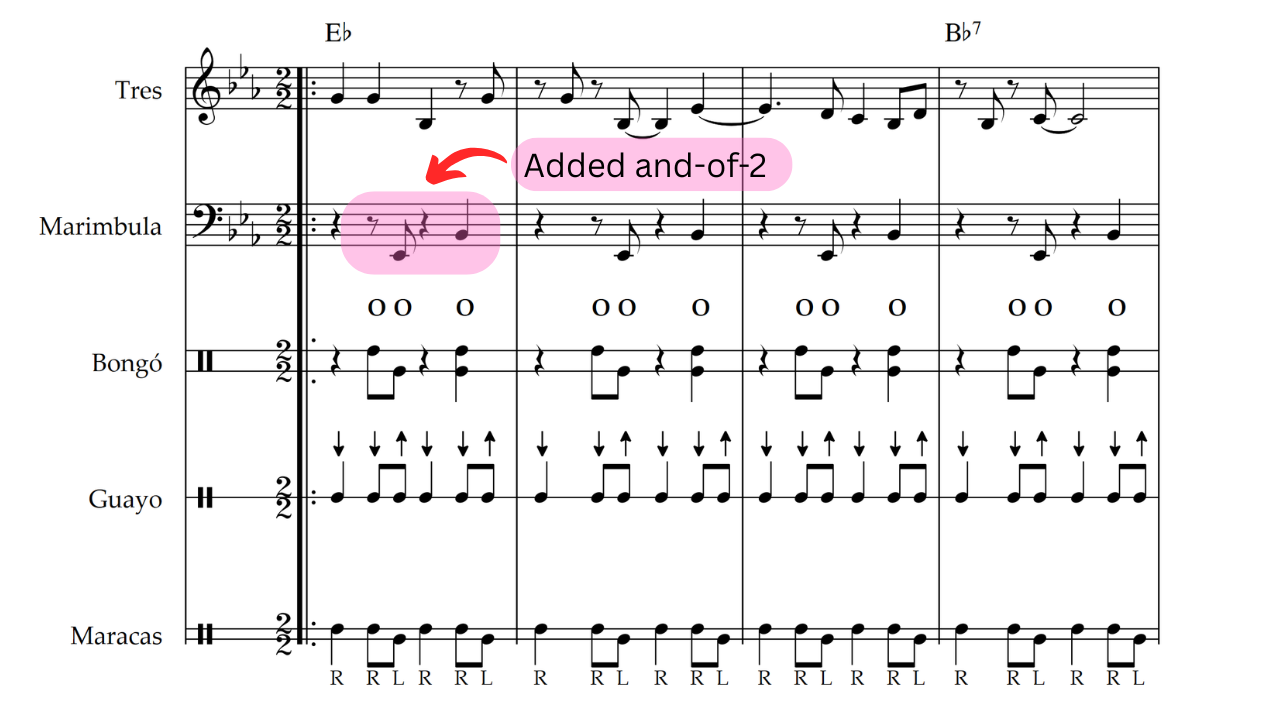
One of the larger differences occurs in the vocal parts, where instead of set verses the lead singer primarily improvises alongside a choral refrain for the duration of the piece. Sometimes the vocalists take it in turns soloing, and for the most part the phrases are built from a vocabulary of their favorite sayings. The form is the same as nengón with the Canto de Kiribá only featuring the call-and-response vocals. Again, the dance is like nengón but is freer and can incorporate other dance steps if desired.
As kiribá evolved it became part of a larger family of styles called regina, a word which refers to the section where the singer improvises interchangeably with choral refrains. Also commonly referred to as bachata, many other styles such as changüí and son fall under this category too. However, this should not be confused with the bachata that came out of the Dominican Republic in 1962.
While I’ve separated this section into focusing on kiribá and nengón separately, both styles are commonly played together at social events and help make up the early styles of the Guantánamo region. Over time both were developed and started to include more syncopation, eventually creating a new style called changüí. Importantly for this resource, both styles demonstrate what the earliest montunos sounded like and provide a model that we can copy in our own writing. Not to mention, demonstrate a few other key characteristics such as the bongó and bass parts which will become quite important as we delve into both son and son montuno. But before we get there it is time to look at how changüí changed the role of the guajeo.
Changüí
Built from kiribá and nengón, changüí was developed in the Yateras area of Guantánamo sometime in the second half of the 19th century. Today not many know of the style, including those in Cuba, but changüí plays a major role in the overall picture of Cuban music and established the fundamental vocabulary of many of the popular styles of the 20th century. A fantastic comparison I came across is that changüí is to Cuban music what the blues is to the music of the United States. That doesn’t mean it sounds anything like the blues, but how it operates in Cuban history follows a similar path where changüí is comparable to the early rural versions of the blues from the Mississippi Delta while son could be seen as the more refined urban blues. The word changüí comes from the Bantu word “quissangui” and has multiple meanings including party, dance, and music, all of which perfectly describe the location and setting that the style is performed in. Like what we have seen with the other regional styles of the Guantánamo province, there is very little documentation about the early history of changüí, with most of the current knowledge being passed down through the lyrics of various traditional songs. However, there is enough information to understand the major characteristics of the style, as well as to unpack the similarities and differences to both kiribá and nengón.
Lucky for those of us who did not grow up in the eastern part of Cuba, changüí is performed in similar settings with the same instrumentation and the same triplet time feel as the previous styles we’ve unpacked. There are, however, a few developments that occur in each instrumental part which give the style a far more syncopated feeling compared to kiribá and nengón. One of which directly impacts the development of the montuno. Unlike earlier, the guajeos in changüí are considerably more syncopated and are constructed using only offbeats. When combined with the other instruments it creates a feeling where the offbeats are played so strongly that they can be misinterpreted as downbeats, so much so that the feeling has its own name: contratiempo. As the melody line of the vocals is built around the tres part, they too play contratiempo, with the only instrument outlining a major downbeat being the guayo and maracas. This feeling is amplified due to the absence of a bell pattern to hold the entire ensemble together and new listeners may find it hard to locate the primary pulse of a song. I know I certainly did and my first transcriptions of changüí were all completely wrong as I heard the tres playing on the downbeats.
Así es el Changüí
Grupo Changüí de Guantánamo
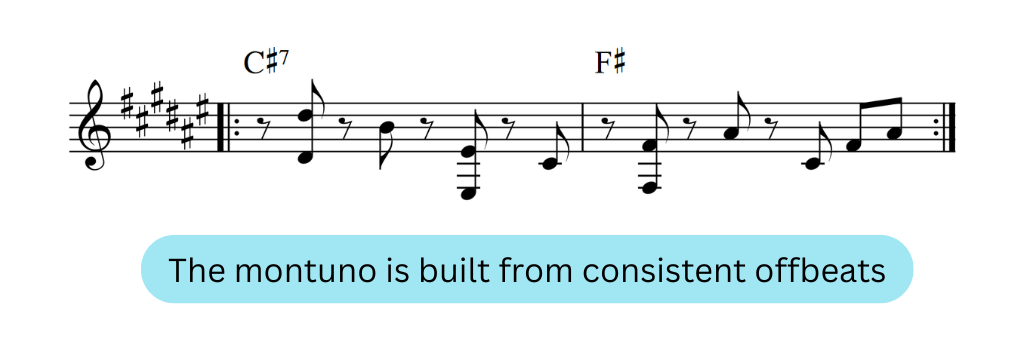
Building off the initial characteristics of the guajeos we looked at with nengón and kiribá, we now have a second trait to add to our montuno tool belt. Instead of constructing a line purely off of the melody or a specific theme, we can use consistent offbeats that highlight some kind of arpeggio that aligns with the accompanying chord progression. Unlike the earlier guajeos, this particular approach is more in line with the montunos of later Latin styles and is only a small step from what we will see shortly when we explore son.
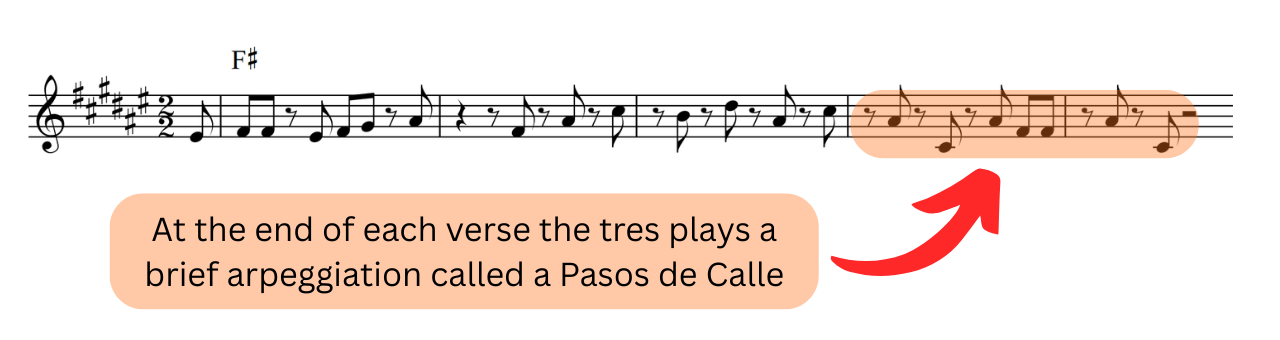
Outside of the new guajeos that are used, another characteristic of changüí are the two or four bar arpeggiations that the tres plays after each line of the verse. These interjections are called Pasos de Calle and usually outline the triad that the previous vocal line finished on, helping prepare the vocalist for their next entry.
Así es el Changüí
Grupo Changüí de Guantánamo
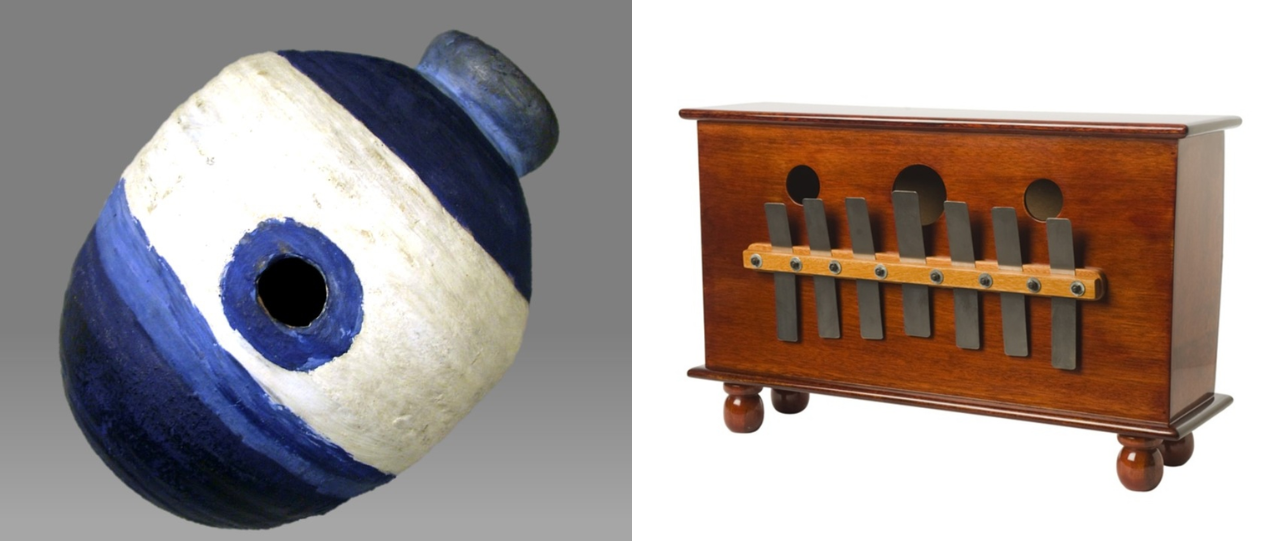
Moving to the other instruments, the bass part plays the same quasi-tresillo pattern that we saw in kiribá and anticipates the chord progression by accenting beat four. While the early forms of changüí would have used the tingo talango, between the formation of the style and the 1920s, two other bass instruments became commonplace. Similar to the jug bass in the United States, one of the instruments was the botija, a clay jug with two holes where a musician would blow into one and manipulate the amount of air escaping from the other to control the pitch. It is likely that the botija was used in the other regional styles too, but again, due to limited records it is hard to know for sure. Eventually, whether the botija or tingo talango was being used, by the 1920s the marimbula, a large instrument that works off the same concept as the mbira but is the size of a small cabinet, became the go-to bass instrument and is still used today. Once the transition had been made to the marimbula, the bass part began to change, and the player could alter their part depending on the section they were in. However, we’ll touch on this in more detail in a moment when we cover form. Lastly, in contrast to the previous styles, the bongó departs from outlining a continuous ostinato, instead improvising throughout a piece in a similar manner to the quinto in rumba or the premier in Tumba Francesa.
Así es el Changüí
Grupo Changüí de Guantánamo
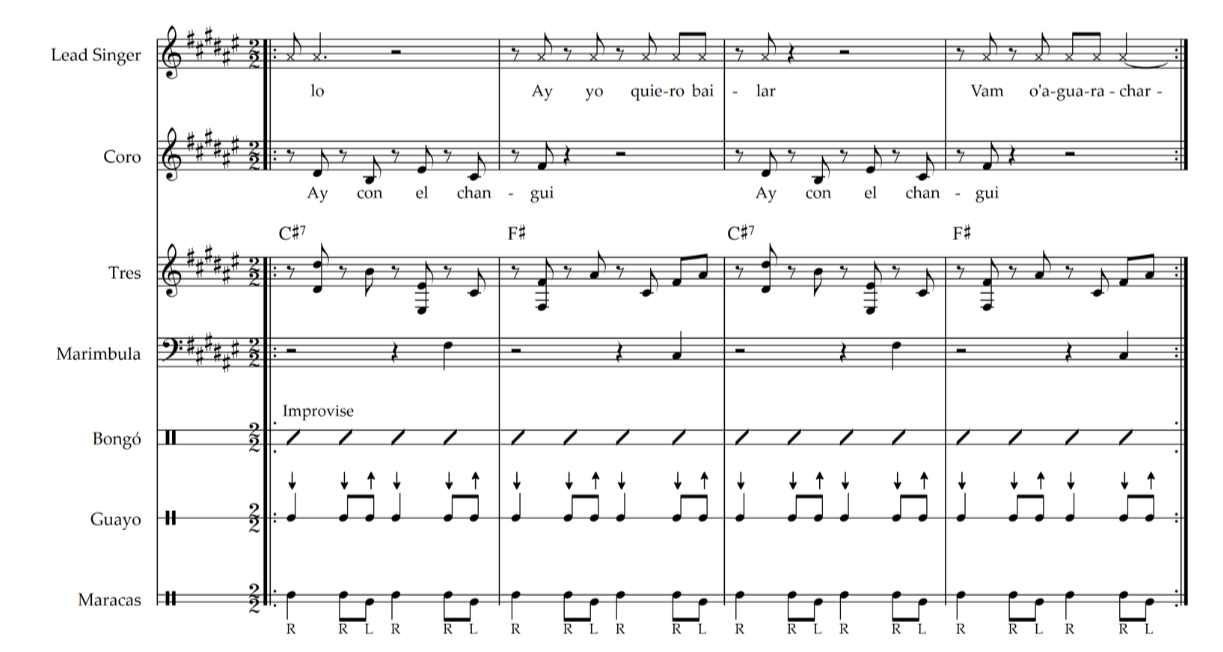
As nengón and kiribá developed into changüí one of the major changes was in the form. Multiple new sections were added and with them came more complexity to the style. Changüí begins with the Llamada de Montuno where the tres plays a guajeo for two or three cycles before the rest of the ensemble joins in with the Ejecución Colectiva. At this moment the bass plays a flourish which covers all of the keys on the instrument, usually six or more, and the bongó plays a five-stroke roll on the hembra (large drum). To mark the transition into the third section called the Canto Changüísero, the guayo player or maraquero sometimes shouts to psych up the ensemble. The canto section is similar to nengón and features a verse by the lead singer with lyrics that can cover a range of topics including parties, various characteristics of changüí itself, the local history of the region, love songs, and politics. The verse is followed by the fourth section which is quite like kiribá but with a few developments. Like kiribá, the section features improvisation being exchanged with choral refrains, however, it can include much longer bouts of vocal improvisation where the lead singers break into controversias similar to those found in punto guajiro. These may follow the decima form but can also be extended to more than ten lines if needed. Once the longform improvisation is completed the vocals return to the standard regina call-and-response format, a section which is often called the montuno section not to be confused with the same word used to describe the rhythms played on the tres or piano. From here, changüí breaks into a new unique section where the tres and bongó improvise and the bass simplifies their part to only one note on beat four. After the improvisation the ensemble returns to the montuno section which then transitions to the final climax and decrescendo, also known as the Climax de Despedida. During this final section the marimbula may also add embellishments to contribute to the overall energy of the ensemble.
As we can see, changüí combines elements of nengón and kiribá while also adding new sections and characteristics which help differentiate the style. Some of the other similar characteristics which we haven’t covered yet include: the tempo which is in a similar ballpark to kiribá, the topics discussed in the lyrics, the vocal refrains which follow the guajeo played by the tres, and the harmony which generally rotates around the I and V chord. The dance is also similar to both styles, being a couple’s dance with the main difference being that the figures are danced contratiempo landing on the offbeats. Hopefully it is clear how each style evolved from one another, but before moving on to son and how the montuno developed further, there is one area which requires further attention. Changüí introduces instrumental improvisation into the regional styles of the Guantánamo province in a unique manner different to what can be heard in other styles like punto guajiro and rumba.Within the style there are two primary forms of improvisation, one which takes place on the tres and the other on the bongó. As the former is a little easier to comprehend from a western music background, we’ll start there.
Tres soloing focuses on sequences of arpeggios unlike the stepwise melodic motion found in punto guajiro. It is very uncommon for chords or flashy lines to be used with tresero’s preferring single-note lines played in contratiempo, placed in a similar way to what we have seen with the guajeos. The tres is usually played with downstrokes, but some tresero’s make use of a technique called doblando where the musician plays a quick upstroke to create an echo effect, quite similar to tremolo on the guitar. As tresero’s are restricted rhythmically, they create interest by utilizing doblando alongside other picking techniques as well as playing lines in different places on the fingerboard and using a variety of voicings. Although chromaticism isn’t used prominently, sometimes during a solo the player will make use of chromatic leading notes to major chord tones.
Vengan a Bailar Bailadores
Grupo Changüí de Guantánamo
Unlike the Tres, bongó improvisation is considerably more complicated, drawing from elements of Afro-Haitian drumming and quinto improvisation in rumba. Before diving into the various rhythms and where they come from, it would be wise to be aware of the different tones available on the instrument. Most patterns feature four techniques, the open tone, rim tone, bass tone, and the muffled tone, all four of which come from vodú drumming techniques used in Petwo ceremonies. A fifth technique may also be used where the bongósero wets a finger and slides it over the head of one of the drums, creating a moaning sound reminiscent of a drum found in both Dahomey and Abakuá ceremonies. This technique, for the most part, is only used during the Climax de Despedida, but is distinct enough that it warrants a mention alongside the other three tones. Similar to what we covered when looking at rumba, the bongó plays ride patterns and uses them to set up improvisations as well as general supporting devices for the ensemble. One of the most common ride patterns is believed to have come from a rhythm played by the gwonn or segon drums in Petwo. While the rhythm is quite different to that played on the bongó, it makes use of an alternating bass, muffle, bass, rim, open pattern which is the same basic concept as changüí.
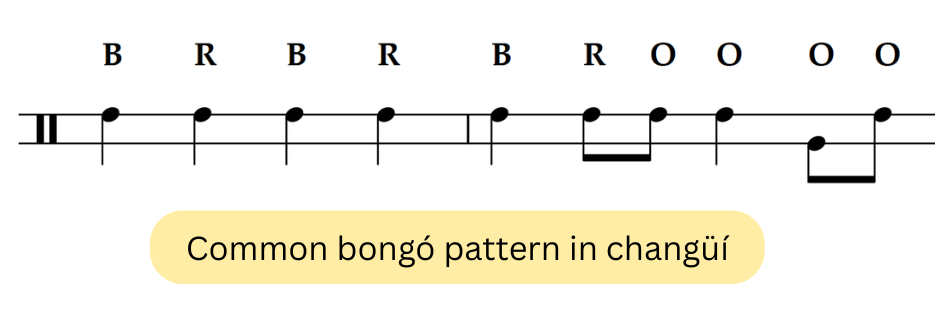
Initially, techniques from various Afro-Haitian styles provided the foundational vocabulary for the instrument such as flams and rolls as well as prominent accents being placed on the and-of-1 and and-of-4. Of course, the bongó is free to revert to the pattern we’ve seen earlier in both nengón and kiribá as well as the ride pattern from vodú. Sometimes in the Climax de Despedida the bongó will opt for another rhythm from the masón section of Tumba Francesa, accenting the and-of-2 and beat 4 like the bombo part. Outside of these specific rhythmic patterns, the bongósero can look for inspiration from various places in the ensemble such as the tres or vocal part. In some instances, it will also interact with the dancers like how the premier converses with the solo male dancer in the frenté section of Tumba Francesa. As changüí developed into son and moved west, it picked up vocabulary from the rumba tradition and mimicked the quinto techniques we looked at in an earlier resource. However, this type of language is more commonly associated with son, and it wasn’t implemented into changüí until much later in the 20th century.
Now that might all seem a little bit complicated, and you’d be right in thinking that because I can’t say I’m a master at either forms of improvisation. However, regardless of one’s ability to understand or actually perform such improvisation, it is interesting information that helps give us a better understanding of changüí. And with all of that covered, we have to keep moving forward to see how the montuno developed further with the final style of this resource: son.
Son Oriental & Son Cubano
There have been many theories about how son was created and whether it was started in eastern Cuba or other locations such as Havana. Most historians agree that it came together from a mixture of influences in Oriente, but to help give you a larger perspective on the style we will briefly go over two of the strongest arguments about the style’s inception. For a portion of the 20th century, one historian posed the idea that son had been around since the 16th century due to a reference in a folkloric lyric. Supposedly they had transcriptions of said style, but once challenged, the theory was dismissed as there was no way to know how the early style had sounded and that the transcripts were likely influenced by the 20th century approach to performing Cuban music. Others have suggested that son existed in the same timeframe as contradanza and danza and had actually merged with the styles to create danzón, drawing connections to the name being danza + son. Although there are similarities between the two styles such as the habanera rhythm in the bass line, there have been no significant records to back up this claim other than the musical similarities. While both of these hypotheses are fascinating, the most likely origin of the style comes from the group of styles we have just covered.
As we have seen, changüí was the result of nengón and kiribá developing over time, a transitional process that likely kept evolving and eventually resulted in the creation of son as it received further influences from other styles. Not much is known about the sound of early son other than it shared a lot of characteristics with changüí, but we do know the three major influences which led to the creation of the style and can help inform us on what it sounded like. Alongside changüí, son can be seen as a combination of elements from rumbita and trova (two vocal styles which we discussed in an earlier resource). Changüí provided the foundational layer for the other two styles to build off, establishing the instrumentation, montuno section, and the improvisational style. From rumbita travelling east, son picked up the two-part quatrain-estribillo form, and finally from the eastern city of Santiago de Cuba it got the vocal sensibilities of the trova tradition. Alongside these components there were a few other changes that weren’t directly linked to any one influence. The most evident was the tempo, which would have been considerably slower than changüí, as well as a shift away from the contratiempo feeling of consistent offbeats. However, this difference may have come later when the style moved from east to west and became known as son cubano.
Problematically for this resource, there are no recordings of the development of early son and the earliest tracks available all share influences from later variations. Instead of hypothesizing about how the style sounded, I think it is probably best to move into territory where we have recordings to analyze, knowing that early son most likely sounded somewhere in between what we analyzed with changüí and what we will see with son cubano.
After the Cuban War of Independence, son moved west and with the shift came a number of musical transformations. As a result, son can be thought of in two distinct categories: son oriental, which is the earlier variation from the east, and son cubano, the slightly later version once the style had become popular across the country. How son got to Havana is a highly contested topic among historians, but one pathway does offer an insight as to how it became popular in the city and could potentially be one of the earliest known transmissions from the east. With the new Cuban government came a new army that travelled all over the country to both small and large towns. As you can imagine, the army acted as a conduit for musical styles to move around Cuba and in 1909 they brought son oriental into Havana while also taking guaguancó east. Now this may not have been the first time the style had been played in the city, but thanks to the association with the military, son quickly was seen as more acceptable compared to other Afro-Cuban styles. Other factors played a major role in its quick rise in popularity such as the portable nature of the ensemble, simple vocal refrains which anyone could sing along to, informal dance moves, and its presence on Cuban radio. Before long, son replaced danzón and bolero as the most popular style on the island and with that popularity came major musical changes.
Being a primarily Afro-Cuban style, when son arrived in Havana it began to be played in the same places that rumba had been developing, namely the solares. This had a notable effect, with the style picking up one of the common bell patterns from rumba as well as the incorporation of the claves. Nowadays we call this bell pattern “son clave” as it is predominantly associated with son and the related styles, however it did come from the influence of rumba and operates in the same manner as every other bell pattern. While it is quite likely that prior to son cubano, son oriental and the other styles had been clave orientated, the addition of a guiding bell pattern made it abundantly clear what orientation the music was in. In my opinion, this is the main distinction between son oriental and son cubano, with the former focusing on primarily clave neutral rhythms with no bell pattern accompaniment. One quick side note, if you are unfamiliar with rumba or the concept of clave, I would suggest looking at my previous resource on the topic before continuing.
The 1920s ushered in the golden age of son cubano where the son sextet format reigned supreme. There were a number of popular groups including Sexteto Habanero and Sexteto Nacional, both of which helped establish the common instrumentation of the style. Specifically, vocals, tres, guitar, bongó, and a bass instrument, with claves, maracas, and guayo being used as auxiliary instruments by the vocalists. Thanks to the adoption of a two-bar bell pattern, the established parts for some of these instruments changed. Notably for this resource, that included the guajeos the tres played which now had multiple options to choose from.
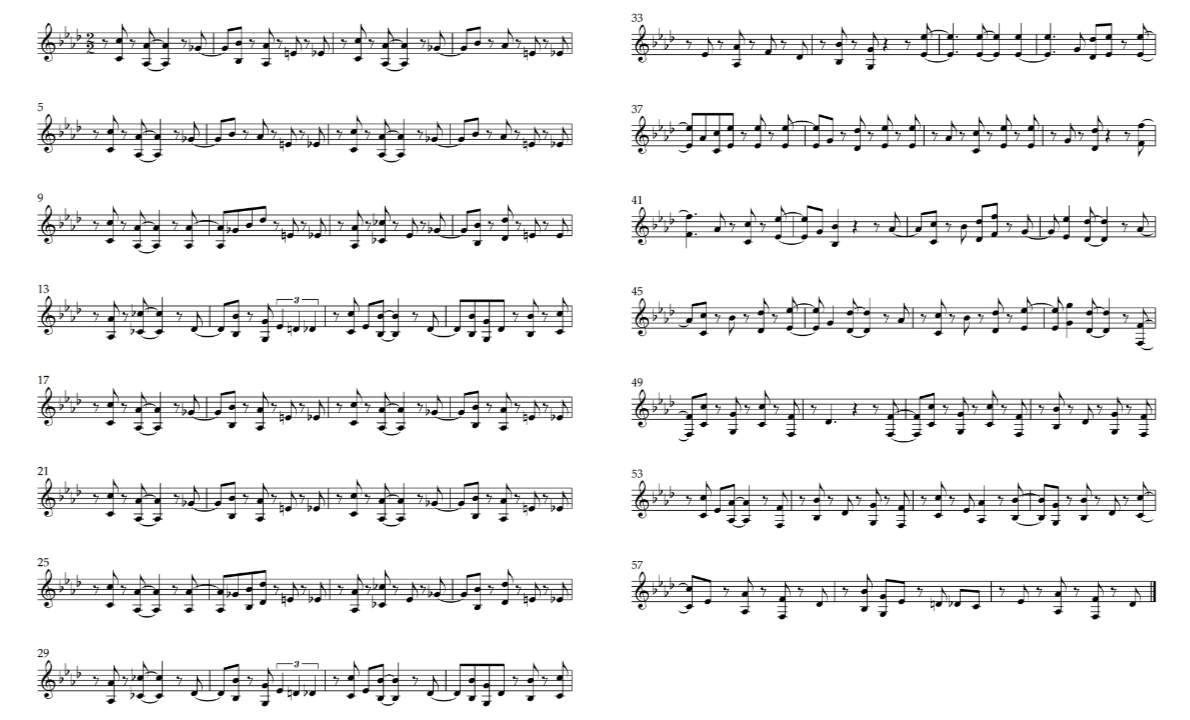
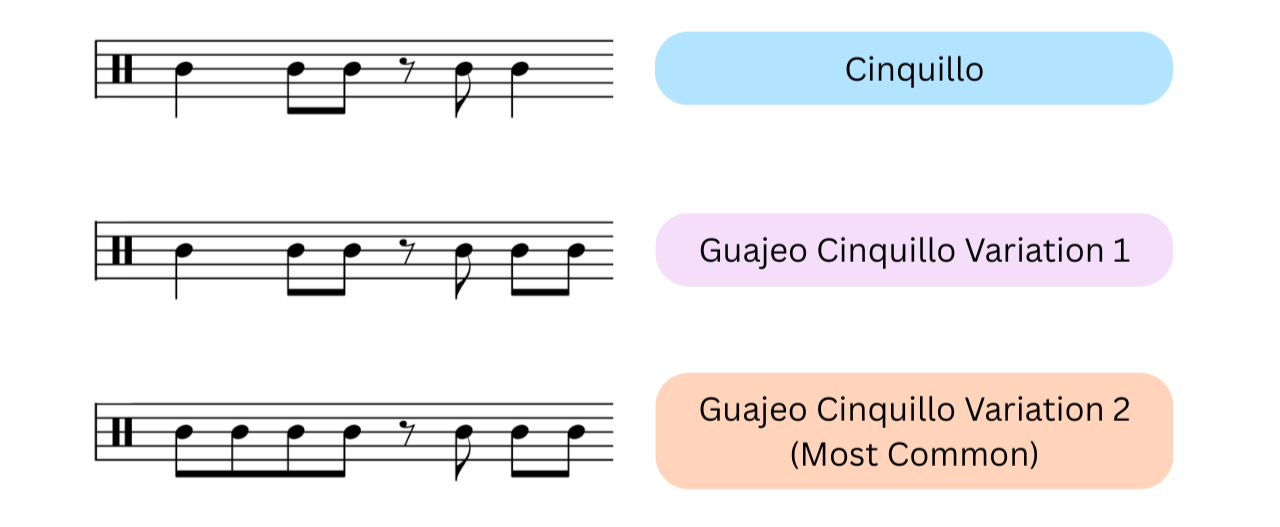
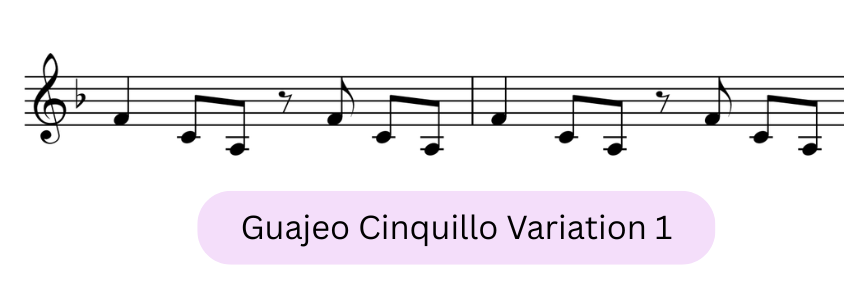
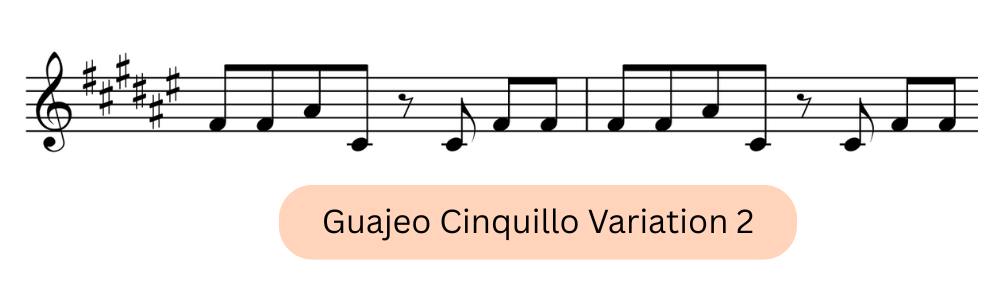
Instead of strictly sticking to the offbeats, guajeos started to emphasize downbeats to a greater degree as well as drawing on other rhythms. One of the most common was the cinquillo, likely due to the Afro-Haitian influence of eastern Cuba, which became a prominent feature of most recorded guajeos of the time. The rhythm was seldom played in its original format, with the norm being to embellish it slightly by adding extra eighth notes/quavers. One particular variation which was quite popular was to play almost consistent eighth notes/quavers with a rest on beat 3. My hunch is that this option emerged from the embellished cinquillo pattern as it is only one eighth note/quaver different, but there is a case to be made about it coming from other places too. Another variation I have read about has the guajeo mimic the same two-bar cinquillo pattern found in danzón. Unfortunately, I have yet to come across a recording of a guajeo which actually uses said rhythm but I mention it here as there is some plausibility to its existence. Regardless, what is most important is that we understand these options as they can help us make informed decisions when writing our own montunos. Almost always, the notes allocated to these rhythms came from arpeggiating the chord progression of a given piece.
Bururú Barará
Sexteto Nacional
La Campana
Sexteto Habanera
Alongside the cinquillo options, perhaps the most favored choice was to double the vocal line similar to what we saw with nengón and kiribá. As son developed, the accompanying melodies did too, and by the time the 1920s came around there were many different rhythmic options being used. Subsequently, the guajeos sounded more diverse compared to those we looked at earlier.
Going one step further, where the precursor styles only had one guajeo for an entire piece, son cubano now had two. Thanks to the incorporation of the two-part quatrain-estribillo form from rumbita, it was common for there to be a guajeo for both sections. Due to the second section often being at a much greater tempo, the guajeo would often revert back to a more syncopated line similar to changüí but sometimes with one subtle difference. Instead of playing consistent offbeats, sometimes a downbeat would be placed on the two side to help reinforce clave direction. Unfortunately, the quality of the recordings from this time often make it hard to discern exactly what is taking place in the tres part, so exactly how much this was used is up for debate.
Rosa, Qué Linda Eres
Sexteto Habanero Godinez
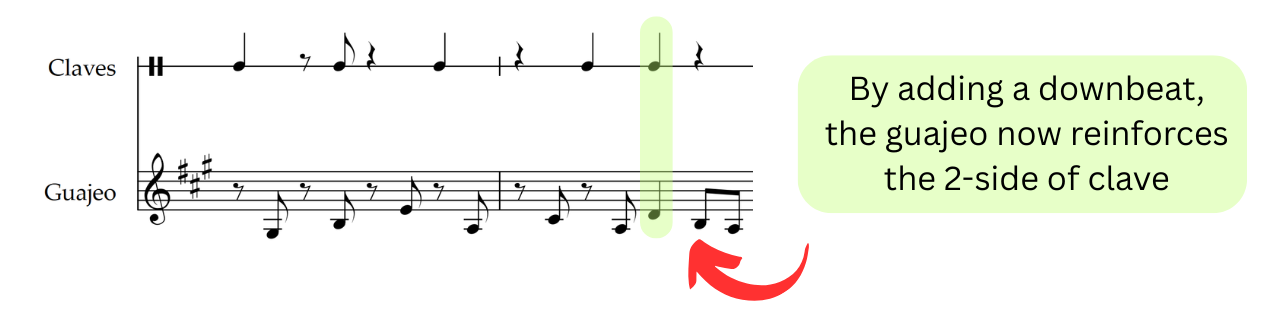
For the most part, all of the other instruments followed in line with the precursor styles we’ve unpacked. There definitely were some developments that took place but I’ll save those particular details for the next resource when we explore the common rhythm section parts and how they changed from son cubano through to son montuno. For now, the main points to be aware of are that the marimbula transitioned to the upright bass in the mid 1920s which brought a wider access of rhythms and notes to draw from, and the guitar part generally strummed consistent eighth notes/quavers or copied the guayo/maraca pattern.
By 1927, the son sextets turned into septets with the addition of the trumpet, a horn which provided an upper register voice that complemented the other instruments and broadened the overall sound of the ensemble. Although the trumpet was most likely added through the influence of other Cuban styles, there is a possibility that it did come from the early jazz tradition found in New Orleans due to the connection that existed between Cuba and the United States at the time. This is further reinforced by the fact that the trumpet’s main role in son cubano is to improvise using a variety of mutes. However, the trumpet solos in a different way to early jazz, one which is built on the grounds of the improvisatory techniques developed in Cuba such as what we’ve explored with the tres in changüí.
One final area worth expanding upon is the change in form between changüí and son. As mentioned earlier, thanks to rumbita, son cubano was built around two sections. Up first was a strophic melody that was usually repeated four times and called the verse, followed by an open refrain called the montuno. Within the first section, vocalists could opt for a variety of different lyric structures such as the redondilla, which is the ABBA section of the decima system, or the four-line quatrain found in guaracha. In the latter montuno section, the vocals were split into a lead singer and a choir and follow the exact same call-and-response style that we saw in kiribá and changüí. The lead singer could improvise or embellish the estribillo/hook sung by the choir and it was common for soneros to access other influences in the montuno, sometimes singing a pentatonic based melody in their falsetto register to call out to the Chinese population of Cuba or quoting Yoruba texts in triple meter. Similar to the precursor styles, the montuno section also often included some form of improvisation from the tres or trumpet.
And with that we’ve come to the end of this particular resource but not the end of the conversation about building montuno parts. From nengón to son cubano, the montuno has played a significant role in Cuban music since the latter half of the 1800s. Hopefully by exploring these different contexts you now have a few more approaches when it comes to writing your next montuno. Whether it be the doubled vocal parts from nengón and kiribá, the syncopated contratiempo guajeos from changüí, or the multiple options in the early variations of son, each present fantastic possibilities that are still applicable today. Of course these are not the only possibilities available to us, but that will have to wait for next time.
The Takeaway
As we’ve seen, there are many different ways to write a montuno thanks to the development of styles such as nengón, kiribá, changüí, and son, all of which provide options for our own writing. However, this resource is only the beginning and there is much more music we can analyze in order to understand how to write a successful montuno. Up next we continue with son and how it developed into son montuno in the 1940s, specifically focusing on how it established the rhythm section formula still used in most Latin styles today. And of course, that means we will be looking at montunos in greater detail!