

How To Understand & Capture
The Sound Of Songo & Timba
When it comes to Cuban music, often as arrangers we think of the styles of the 1940s and 50s as they overlapped with some of the most popular jazz styles of the 20th century and became a major part of the Western musical world. However, Cuban music kept developing over the second half of the 20th century and churned out even more amazing music albeit outside of the grasp of Western audiences. Specifically, there are two styles which helped redefine the sound of Cuba and are still popular to this day: songo and timba, with both adding incredible new layers to the tapestry of Latin music.
Unlike other Cuban styles such as son, bolero, or mambo, the words songo and timba were completely foreign to me until relatively recently. Having gone through a music degree with some exposure to Latin music, there were definitely run-ins with various other styles but it actually wasn’t until the end of 2019 when someone mentioned timba to me for the first time. Offering no real explanation as to what the style represented, I was left with a new name and absolutely no idea how to identify what was timba and what wasn’t. After about a year of research, eventually I came to realize that timba was where Cuban music had progressed to in the 1990s and the name was often used as an umbrella term for much of the music that came from the country since. Through the research process I also stumbled across songo, an earlier style that established a new sound for Cuban music in the late 1960s and was the link between the mambo era of the 50s and the emergence of timba in the 90s. As a complete beginner, listening to both styles was an amazing experience and thanks to some useful resources, I was able to start understanding exactly what was going on in the music.
While songo and timba haven’t quite found their way into the larger world of jazz arranging to the same degree as earlier Cuban styles, they both provide a number of unique elements worth being aware of. Instead of drawing heavily from the jazz tradition, they take influence from the popular styles after the swing era, leading to a very creative and different sounding music that perhaps blends more appropriately with more modern styles such as rock and funk rather than those related to swing. Like all music, neither songo or timba were created in a vacuum and both were built off of many elements present in earlier Cuban styles. As a result, in this particular resource, I’ll be using a lot of terminology unpacked in other articles I’ve written on Cuban music and if you are not familiar with terms such as clave or some of the prominent styles such as mambo and son montuno, I’d highly recommend you taking a look at those particular resources before carrying on. With that said, let’s jump in!
The Journey From Mambo To Songo
The musical landscape of Cuba went through some significant changes from the mambo boom of the 1950s to the creation of songo at the end of the 60s. Most notably was the descaraga movement which reshaped how music was seen in Cuba. While the piano was becoming a prominent part of most Cuban styles in the 1930s and 40s, a new wave of guitar playing trovadores emerged to help refresh the traditional Cuban love song. The movement began in a house located in the Cayo Hueso neighbourhood of Havana, where trovador Tirso Díaz hosted informal musical gatherings of friends called descargas that could go into the early hours of the morning. Like the earlier generations of trovadors, the majority of the people that came together had received no prior musical training and were primarily self-taught. At the time the popular singers of the day were Nat King Cole, Ella Fitzgerald, and other crooners, and the young trovadores tried to mimic their style. The result was a new style called filin, being the creolized translation of the word feeling, which drew heavily from popular songs which were improvised over by the trovadores.
Like the earlier trovadore style of bolero, filin also featured romantic themes. However, instead of the stereotypical sentimental style found in bolero, filin was more direct with simpler expressions of love. With the introduction of French impressionist harmony in other Cuban styles, filin began to capture similar extensions on the guitar, creating a sense of floating tonalities like those found in the music of Debussy which complemented the crooner-like vocals. Perhaps more importantly for the state of Cuban music, filin was not designed for dancing, marking a new direction for Cuban music. Originally the style was performed by just vocals and guitar accompaniment, but as the informal meetings at Díaz’s house grew more popular, a wider variety of singers, lyricists, and arrangers met, and as a result the style became used in multiple settings. Arranger Andrés “El Niño Rivera” Echevarría, brought filin to the popular conjunto format and with it, a more sophisticated sense of harmony that had not been present in son beforehand.
While the United States was absorbing son and mambo, the descarga movement was increasing in popularity in Cuba. Although it began with musicians such as José Méndez and César Portillo de la Luz, others including Bebo Valdés frequented the descargas and developed the idea of merging jazz with other forms of Cuban music. With the help of Valdés, the term descarga shifted to describe jam sessions based around son montuno that focused on the instrumental and improvisational aspect of Cuban music. Quickly, the new format started attracting many of the prominent musicians, such as Israel “Cachao” López who departed from playing danzón in the 1950s to experiment with his own descargas. As a result, many fantastic albums were recorded such as “Cuban Jam Session” and “Descargas en Miniatura” which further cemented the descarga movement among Cuban audiences. Thanks to these musicians, the descarga movement transformed Cuban music as a whole and allowed for a more “classical” listening approach away from dancing.
After the Cuban revolution in 1959, the musical landscape changed once again on the island. Thanks to the country adopting communism, there was more emphasis placed on preserving the Afro-Cuban roots of Cuban music, with black culture being thrust into the limelight. One of the first styles to come out of this new emphasis on Afro-Cuban culture was mozambique, created by Pello el Afrokán in 1963. Due to its background in Cuban street carnivals, many of the same instruments from conga de comparsa were used, with adaptations made on core bell patterns that referenced various Afro-Cuban folkloric styles.
Mozambique
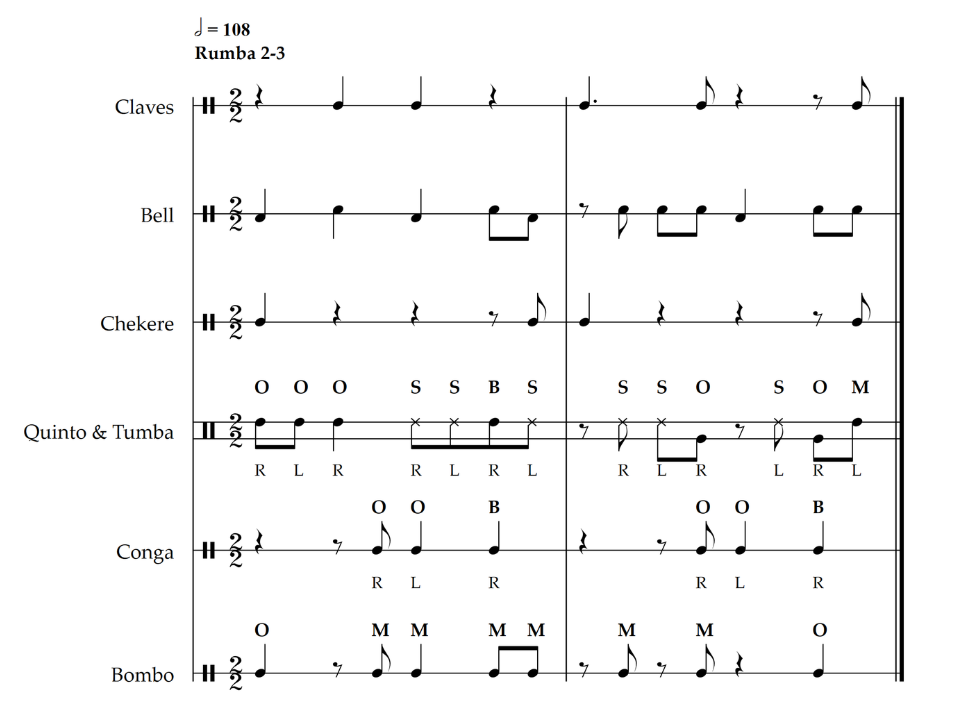
Thanks to the new leadership, conservatories were built and musicians were paid a monthly salary to perform from the government. Unfortunately, due to the embargo placed on Cuba by the United States, almost all tourism dried up and strict regulations were placed on live music venues, resulting in a highly skilled musician workforce that had nowhere to perform dance music. Unlike earlier generations, the post-revolution musicians had received formal training on their instruments, bringing a new wave of virtuosic skill to Cuban music that had not been present to the same level before 1959. Instead of following the same path as Latin musicians based in New York City who reverted to playing more traditional Cuban styles rebranded under the salsa title, the Cuban musicians decided to take influences from rock, soul, jazz, blues, and other popular styles in the 1950s and 60s and blend them with their own music. As a result, Cuban music once again moved in a new direction and songo was created.
Songo
Taking inspiration from rock and roll, in 1968 Juan Formell infused elements of American pop music with the charanga format and the rural Afro-Cuban style changüí, calling the new sound changüí 68. However, the name didn’t stick around for long and by the following year it had been renamed songo, primarily being associated with Formell’s new band Los Van Van. Building off an Afro-Cuban foundation, Formell drew inspiration from Cuban dance music as well as the harmonies and grooves being played in the United States at the time, resulting in a fresh approach that was unlike any previous Cuban style. Around the same time, other musicians started experimenting with similar approaches, with bands like Irakere and Ritmo Oriental emerging as further examples of the changing musical landscape on the island. While all three sounded quite different to one another, they each drew from similar influences and created a diverse range of sounds that all could be described as songo. As such, these days the word itself can be used in a number of different capacities with the most common definitions being:
- A specific rhythmic pattern
- The music of Los Van Van
- The majority of Cuban dance music from the 1970s and 80s, primarily revolving around bands such as Los Van Van, Ritmo Oriental, and Irakere
- The rhythmic and harmonic experiments by Juan Formell
- A section of a timba arrangement, where a member of the rhythm section plays a pattern drawn from songo
Songo revolutionized Cuban dance music, with almost every instrument being drastically impacted, and core rhythmic techniques being applied to the whole ensemble. Although there are a wide range of contrasting examples from the period, some of the core similarities within these recordings include: a tempo between 105-130bpm, the use of rumba clave, and the addition of the backbeat from Western popular music. Additionally, the typical two bar ostinato cycle, which had already been stretched to four bars with Arsenio Rodríguez’s son montuno, was usually extended further to the point where one tumbao could last for up to four cycles of clave. Perhaps one of the most important features of the style was the incorporation of the drum set, an instrument that had not been featured to a large extent prior in Cuban music. Whether played as a standalone instrument, or as a hybrid timbale setup, the impact of it being included in Cuban dance music drastically changed the feeling of the percussion section.
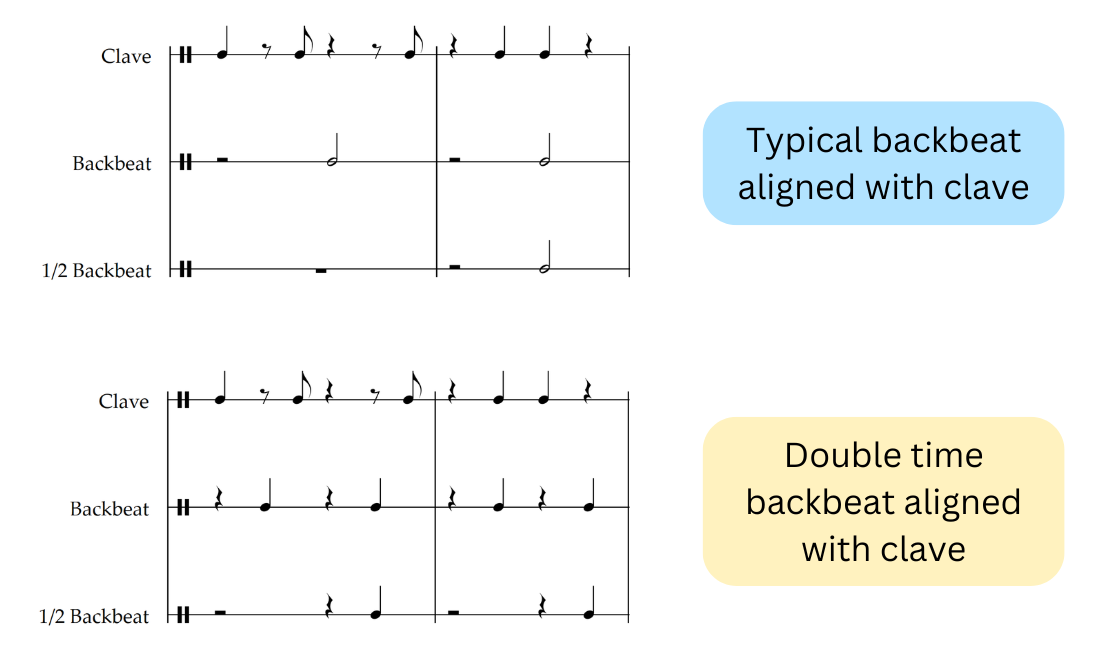
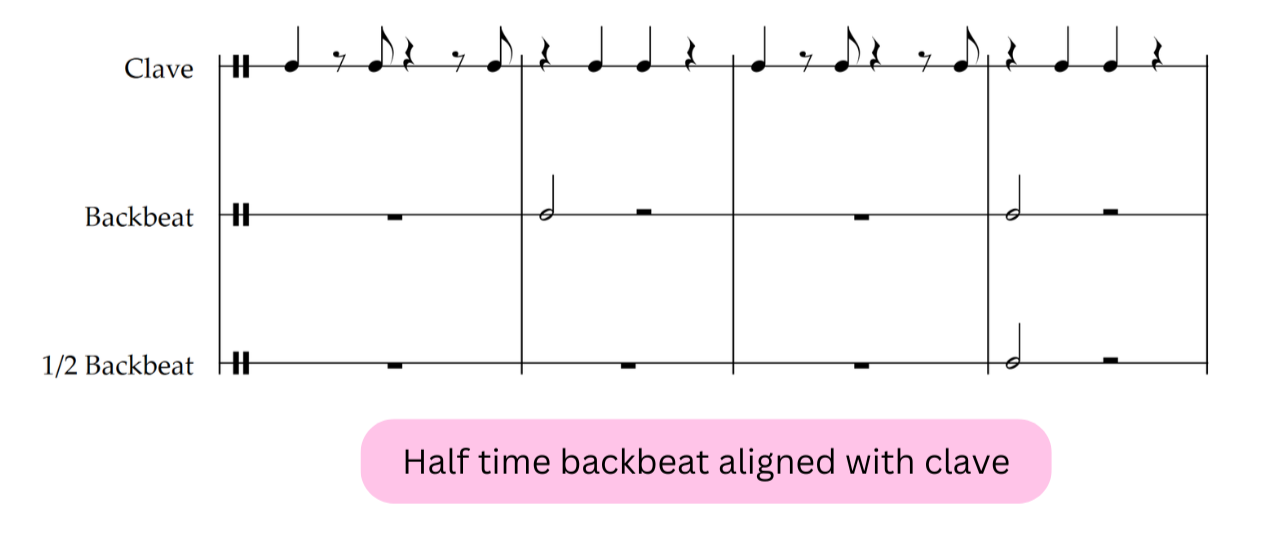
When looking at the addition of the drum set there is one name that most people look to first: José Luis Quintana, or perhaps better known as “Changuito.” Not only did he popularize the hybrid timbale setup by using components of the drum set like the bass drum and cymbals, he also was one of the first people to successfully utilize the backbeat from Western music in a Cuban setting. By building off of the overlapping concept often used in rumba, Changuito would apply the backbeat at either double time or half time over the other to create a variety of accents that locked in with the two-bar clave cycle.
Tu Decisión Cuál Es?
Los Van Van
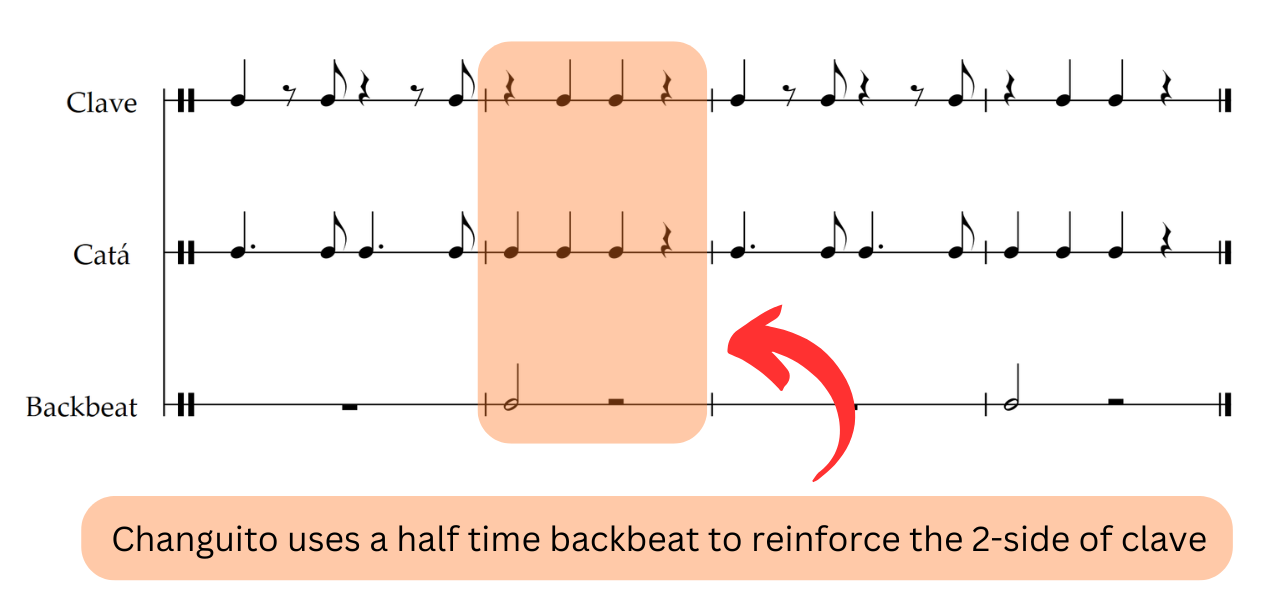
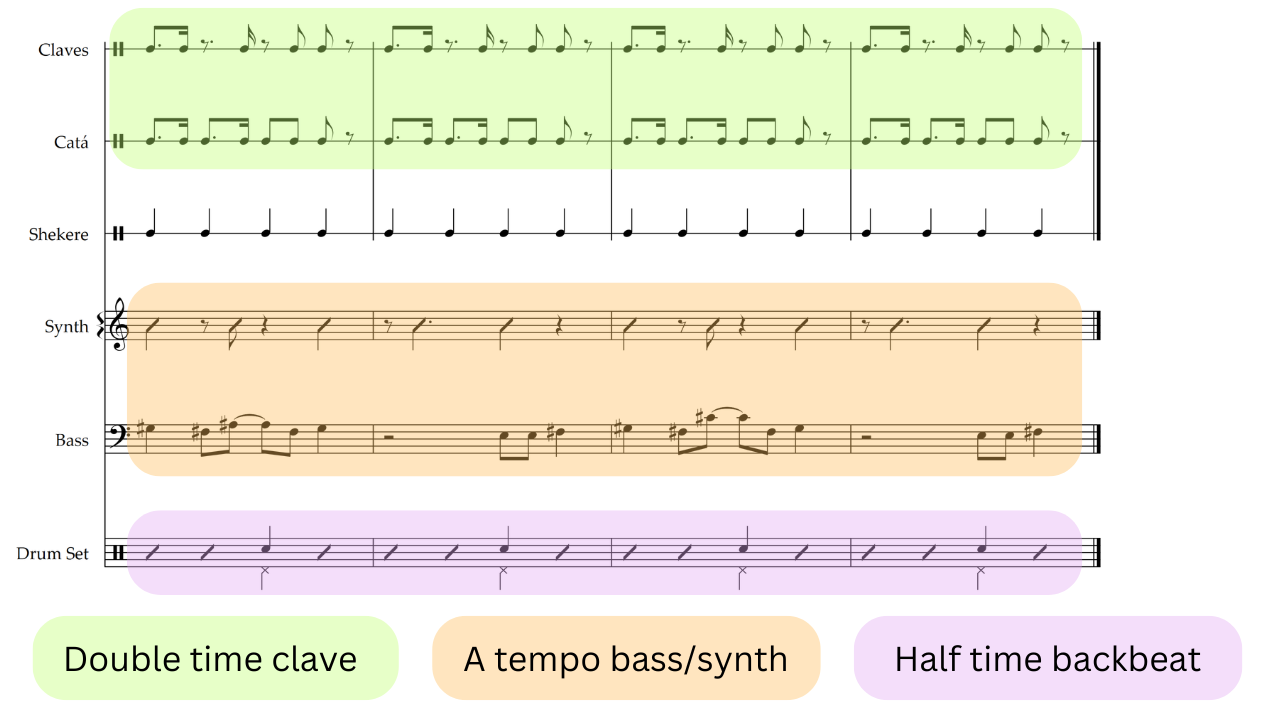
To take this concept to another level, not only did Changuito alter the backbeat in relation to clave, but he also implied various levels of claves on top of each other. In a similar manner to how the mambo musicians of the 1940s and 50s used rhythms to imply clave, sometimes Los Van Van would do the same through secondary bell patterns and bass parts. As a result, you could have a half-time backbeat over one clave, a bass or piano part at the normal tempo implying another clave, as well as some sort of double time rhythm above played on a secondary percussion instrument like the guagua/catá implying a third clave layer. To top it off, all of them would somehow compliment each other and not feel cross clave. As you can imagine, there are dozens of possible combinations within this framework. Fortunately, Tu Decisión Cuál es? by Los Van Van offers a great example as how one might go about organizing all of the layers together.
Tu Decisión Cuál Es?
Los Van Van
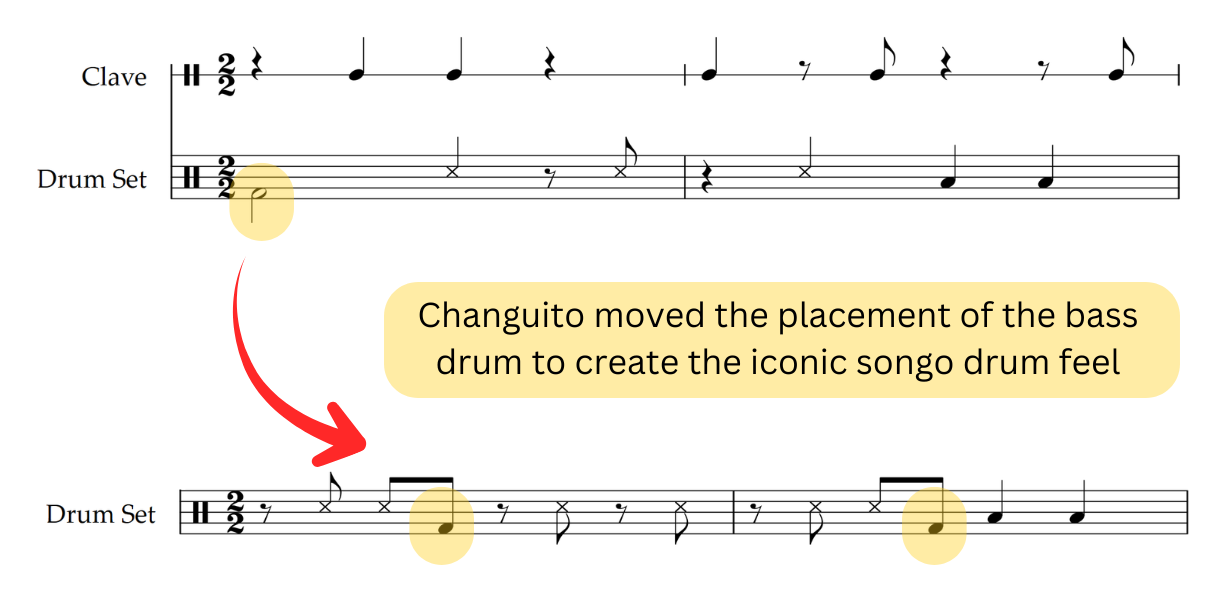
Although Changuito is often seen as the primary mastermind behind songo drumming, he actually wasn’t the first and built off the concepts developed by Blas Egües, the original drummer of Los Van Van. Egües was the one to create the first songo feel with Los Van Van’s first album, opting to place the bass drum on beat 1 of the two-bar cycle with various placements of the snare and toms. Following the departure of Egües, Changuito joined the group in 1970 and altered the bass drum, shifting it to the and-of-2 and putting it in both bars. By doing so, he established the common songo drum pattern.
Moving over to the conga, the most common pattern played by the conguero was the marcha (another name for tumbao) on two drums, with each of the three major songo bands having a different approach. In Los Van Van, the conguero stressed open tones found in guaguancó that linked with the timbale/drum set parts, whereas in Ritmo Oriental they began by using the common tumbao pattern and over time transitioned to using a similar guaguancó approach too. In contrast, Irakere based their approach around the Yoruban batá tradition with the conguero merging rumba with batá rhythms to create their conga patterns.
Like the conga and timbale/drum set, the bass also evolved, now having more freedom and being highly influenced by 1960s rock, soul and other American styles. It was common for parts to feature vocabulary from jazz such as walking bass lines, as well as similar vocabulary to legendary Motown bassist James Jamerson. Depending on the track, sometimes the bass part could sound more in line with the funkier American sound more so than the established Cuban tumbaos of the 1940s and 50s. Bassists would also use pedal points to add new textures to songs, as well as substituting the I chord for the vi to add intensity.
Aside from the revolutionary instrumental patterns, songo built off of the cierre/bloque concept from son montuno. All of the major bands incorporated these hit sections within their compositions, but Ritmo Oriental went one step further by engaging in a technique they called “Con Efecto.” As an ensemble they would rapidly slow down to an unrelated tempo during the cierres/bloques, which created far more tension compared to other songo bands.
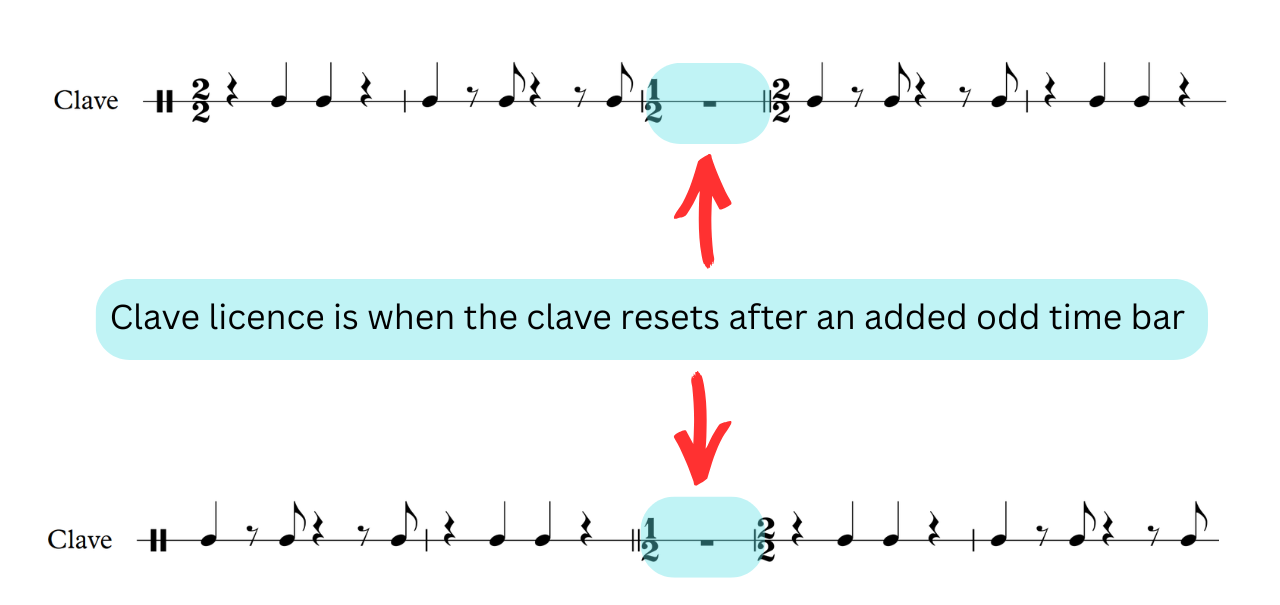
Created by Juan Formell with Los Van Van, another concept that got introduced with songo was clave license where Formell broke away from the traditional clave approach. Instead of pieces adhering to a strict 2-3 or 3-2 cycle for an entire song, at the end of some phrases an odd time bar was added and then followed by a new clave cycle. The odd bar could be of any length, with two beats typically being the favored choice by Los Van Van. Interestingly, in American based Latin styles such as salsa, this approach went against the standard conventions where one clave cycle must be adhered to for a full song. However, both clave licence and the New York approach featured full musical phrases following the typical two bar clave cycles, with the only difference being how they flipped sides for new phrases.
Songo very much moved away from the sound of mambo and cha-cha-chá, and created a whole new palette for Cuban musicians to use in the 1960s. By combining each of the elements we’ve just covered as well as a few from other styles like son montuno and mambo, you can get a basic songo blueprint to apply to your own arrangements. Unfortunately, due to the large variability in the sound of Cuban songo bands in the 1970s, there is no one right way to capture the style. What I will say is that at the bare minimum a songo arrangement should feature some form of backbeat as well as the iconic Changuito drum part. Everything else is completely up to your taste and if you want it to feel quite funky with layers of synths and keyboards, go right ahead. Due to some of the early American rock influences on the style, there are some examples that feel slightly dated today, but if you can look past the timbre, a world of complexity awaits you. Songo very much changed the game with Cuban music and added more layers on top of an already dense vocabulary of music. It is crazy to think that songo was being developed at the same time as salsa and from the same core material. Over time the style faded away and transitioned into the current popular style in Cuba: Timba.
Timba
To understand how Timba emerged as the prominent Cuban style in the 1990s, we must go back to how Castro’s government impacted the trajectory of Cuban music after the 1959 revolution. As we covered earlier, post revolution Cuba placed importance on Afro-Cuban culture and set up multiple conservatories for musicians to receive higher education in the arts. Unfortunately, although the dictatorship brought some positive points, there were many negative aspects that impacted Cuban culture. The creation of the conservatories was one part of a much larger agenda which also included musicians being paid a monthly salary from the government. Both of these outcomes came from the Cuban government placing value on classical music over more popular dance styles. As a result, almost all of the live music venues shut down in Cuba, and even though the musicians were being paid regularly and receiving a high level of music tuition, there was nowhere to perform and nowhere for people to dance to music. Additionally, the Cuban government restricted live music to only be played by those that were formally trained, cutting out a majority of the working population of musicians on the island.
By the end of the 1970s, salsa had started to seep into Cuba, but at first it wasn’t accepted with the locals who preferred other more interesting styles than regurgitations of traditional Cuban music. The mindset eventually flipped in the early 1980s and as a result most Cuban bands altered their instrumentation in order to stay relevant. In 1985, the Cuban government reversed its status on popular dance music, which led to the opening of multiple dance venues and a major boom in Cuban music. Finally, in the 1990s the Soviet Union fell which caused Castro to move his focus away from sugar cane production and into tourism. Cuba once again received new influences into the island and was able to export what had been happening musically in the country for over three decades.
Thanks to the influence of salsa, a new variation of the genre created in Cuba, called salsa cubana, became the dominant sound of the island in the 1990s. It had directly come from the songo era and was ushered in with a new band called NG La Banda. Based on the Irakere model of the 1980s, NG La Banda played a mixture of dance music and jazz and had a four-piece horn section made up of two trumpets and two saxes. In 1988, the band was put together as a supergroup by José Cortés that used multiple members of Irakere and began to play music that depicted the urban black identity in Cuba, similar to the hip-hop movement in the United States. The band was a sponge for different styles, being influenced by funk, rap, salsa, cumbia, and many others, and quickly shaped the Cuban music scene with bands such as La Charanga Habanera, Paulito FG y La Élite, and Klimax following suit. Each band brought a new edge to the music, and before long salsa cubana was renamed timba. After the fall of the Soviet Union, timba became the popular style in Cuba due to its lyrical content and dance style.
Typically, timba songs featured lyrics that talked about the barrio lifestyle, as well as articulated issues such as race, class, and gender that were relatable to the working class. Although the style was considered dance music, it was the first true example of Cuban music made by first rate trained musicians, meaning that it was far more technical and required arrangements that had to be rehearsed. Over time, timba highlighted solo singers more so than the ensembles they came from, which created a popstar model similar to what existed in the United States. At the same time, bands such as La Charanga Habanera focused more on sex appeal compared to the image of the black barrio, which together created a sense of escapism for the common people of Cuba. Unlike salsa which was a Pan-Latin style produced in the United States and the Caribbean, timba was purely Cuban.
Timba shared many similarities with New York salsa, but drew different conclusions from the influences. For instance, they were both built around son but in timba, musicians were expected to play with less reliance on fixed patterns, the opposite of salsa which had grown out of the set rhythms of traditional Cuban music. Both were influenced by jazz, but salsa drew from the more traditional swing era sound whereas timba used more modern models such as funk and jazz fusion. A good way of thinking about it is that salsa was a natural continuation of the big band era, with timba being modelled after bands like Weather Report, Earth, Wind and Fire, and Blood Sweat and Tears. With the importance of Afro-Cuban culture being stressed in Cuba post revolution, the styles that came out of the island such as mozambique, songo, and timba were all based around rumba clave, a stark contrast to salsa which was based around son clave. Generally, timba preferred interaction with the audience and dancing over improvisation, and although there was freedom within individual parts to interpret tumbaos and chord progressions, all instruments were locked within a framework. Salsa on the other hand was based around the descarga model where improvised soloing was at the core of the style.
NG La Banda provided the model for timba’s musical form, basing it off the classic son montuno structure that began with a quieter narrative verse called the tema followed by a second more energetic section called the montuno. As with most son based music, more emphasis was placed on the second section which was generally open and featured call and response between the coro and solo singer. Additionally, the two sections were usually connected with a short instrumental bridge (called the puente), similar to the cierres/bloques used in son montuno. However, there was an extra level of complexity added within the puente, where the percussion stopped playing and the band reduced down to a single piano ostinato accompanied by offbeat bass drum hits and percussive glissandos on the bass guitar. This specific section of the puente was called the apoyo or presión and either played directly before the first coro or accompanied it. Once the coro entered, the bass drum stopped, the percussion re-entered, and the bass resumed playing a tumbao. This effect could be used multiple times throughout a piece to create variety, and could even be used right at the beginning of a song.
Within the montuno section, the horn parts followed a similar sound to salsa and were interwoven alongside percussive ostinatos and syncopated piano and bass figures. The section was typically filled with coros, hits, instrumental phrases and breaks, and often transitioned into a solo improvisation section called the mambo. These mambo sections alternated with each coro and acted as an instrumental interlude, with the first mambo typically being the longest and eventually reducing in size to add more excitement and chaos as it overlapped with the coro. Cierres/bloques could be played at the end of sections, or during the puente, and were played by the whole ensemble or various rhythm section members depending on the level of intensity required. Some bands such as Manolito and Klimax allowed for some improvisation in their cierres/bloques, whereas La Charanga Habanera followed a fixed structure that was the same every time. The order of parts within the montuno section could be altered in live settings based on the energy of the audience, which meant that the arrangement of a song could go between any of the coros or mambos, and the apoyo could be signalled at any time. Finally, songs typically ended with either a fade out on the last coro or with an instrumental coda derived from the intro.
As timba progressed, more songs focused on the coro sections due to the popularity amongst dancers. The preference to spend a small amount of time on the verse compared to the montuno harkened back to the early son and changüí styles, which emphasized the montuno section throughout a performance.
Taking a page out of son montuno, timba used interwoven rhythmic and melodic ostinatos in all instruments. Harmonically, the interaction between the bass, chords on the synth, and fast piano tumbaos created a diverse palette that was not heard in earlier styles. Unlike other styles, timba featured faster and more irregular piano tumbaos that added dissonances and chromaticism in the passing notes, made popular by César "Pupy" Pedroso and Rodolfo "Peruchín" Argudín Justiz. However, not all pianists played the same tumbao in both hands, with artists such as Tirso Duarte and Ivan “Melon” Gonzalez using two different tumbaos at the same time to create a polyrhythmic feel. Alongside the piano was a second keyboard/synth which added an extra harmonic layer by playing held chords. Often the keyboard would use effects such as strings, synth bass, and percussion to add further density and textures. Additionally, the keyboard would accent notes with the horn section and could play a contratumbao that complemented the primary piano part.
Building off the motown inspired basslines of songo, the bass parts reflected the developments of the instrument in American popular music by incorporating slap bass and glissando techniques. Although they were based around a similar ostinato to salsa, the bass lines had far more freedom and often doubled technical lines in unison or octaves with the horns.
Like many other Afro-Cuban styles, the percussion section created a rhythmic web of interwoven rhythms, a lot of which transitioned directly from songo to timba. The conga played a marcha pattern with up to four drums, while the drum kit drew from typical funk and rumba patterns. Sometimes the bongós were used, and other times they were replaced with a woodblock which outlined similar rhythms. Other instruments such as claves, maracas, and guiros were also common.
Finally, the horn sections in timba were virtuosic, similar to the Los Angeles studio sound of the 1970s and 80s. The lines were fast and syncopated, and inspired by jazz and funk. In most cases the lines were played in octaves or unison, with harmony being reserved for the final note of a phrase.
Combining all of these elements gives the rough foundation for every timba song. Similarly to songo, there are many differences between artists and no one singular sound is the trademark of the style. By applying the various textures we’ve unpacked and merging them with timba’s highly flexible form, you’ll be able to achieve a great starting point for writing an arrangement in the style. Of course, all of these components build off much of the established sound of Cuban music in the first half of the 20th century, so these components alone won’t make a timba arrangement feel authentic and must be combined with the many techniques associated with son montuno, rumba, and mambo.
Like the many revolutionary styles before it, timba established a new sound for Cuban music that has continued to be popular into the start of the 21st century. Similarly to salsa, it reworked the sound of son montuno but instead of reverting to tradition, timba innovated and drew more heavily from American styles which ultimately gave the style a unique sound and flavor. It’s hard to say exactly where Cuban music will go next but I imagine it will be equally as complex as what has come before as well as be incredibly captivating.
The Takeaway
Songo and timba represented a bold new direction for Cuban music in the second half of the 20th century. Unlike the more traditional direction of Latin music found in the United States, both styles followed the innovative new sounds of rock and funk, creating a new palette of textures that hadn’t been heard before. In a similar fashion to the Afro-Cuban music they were based on, both songo and timba feature equal amounts of complexity which can take some time to feel natural for those who didn’t grow up listening to the music. Fortunately, getting accustomed to the overall sound is a wonderful journey no matter how long it takes, and one I would highly recommend if you want to try and understand the music on a deeper level. Lastly, both styles provide a wonderful template for how we can integrate our own influences into our arrangements, demonstrating that it is okay to take risks and push past established norms.